
Ergonomics Awareness Training for Supervisors Practice Test
$69.00
- Buy to unlock unlimited access to all Quiz questions and Answers in this Quiz.
- After purchase you can print a PDF of the whole quiz at any point. The PDF will contain the questions and the correct answers.
About this Exam
The Ergonomics Awareness Training for Supervisors Practice Test is an indispensable study tool designed specifically for front-line leaders, managers, and team leads across all industrial and office sectors. This practice exam empowers supervisors to master the principles of ergonomics, enabling them to proactively identify workplace hazards that lead to musculoskeletal disorders (MSDs) and other strain-related injuries. By simulating the atmosphere of the final completion exam, this resource provides supervisors with the confidence and knowledge required to foster a safer, more productive work environment for their teams. This training is crucial for anyone responsible for employee well-being, operational efficiency, and regulatory compliance in the modern workplace.
Ready to test your knowledge?
Buy Now to Access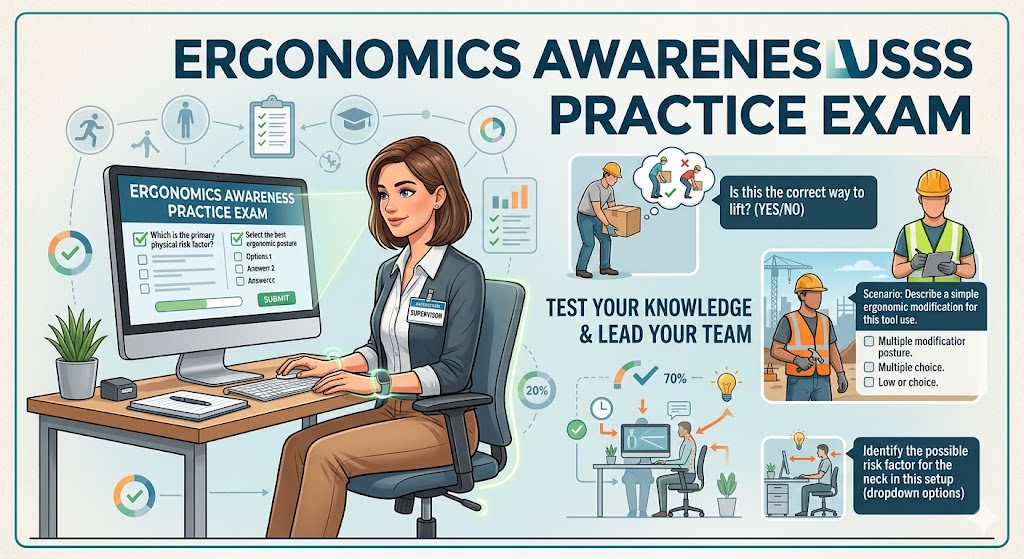
Additional Information
What the Course Entails and Exam Details
The corresponding core curriculum for this training provides a comprehensive foundation in the science of human engineering. The course, and this corresponding practice test, cover vital topics required for organizational leadership. These include: a thorough definition of ergonomics and its impact on performance; the recognition and prevention of Musculoskeletal Disorders (MSDs); detailed analysis of ergonomic risk factors such as forceful exertion, high repetition, vibration, and awkward postures; effective methods for hazard identification and risk assessment; and the implementation of practical control measures, split into engineering, administrative, and personal protective equipment (PPE) strategies. Supervisors also study office ergonomics—including computer workstation setup—and industrial ergonomics, focusing on manual material handling and tool design. The training concludes by defining a supervisor’s specific roles and responsibilities in managing an ergonomics program.
What to Expect in the Final Exam
While specific course providers may have slight variations, the final assessment for the Ergonomics Awareness Training for Supervisors is typically a robust online examination. You can expect a format predominantly composed of multiple-choice questions, which may include theoretical principles, factual recall, and scenario-based problem-solving. Some exams may also incorporate short-answer questions to test the application of ergonomic controls in diverse real-world settings. A passing score is usually high, often requiring 80% or greater accuracy, to ensure that supervisors have achieved a thorough mastery of safety leadership. While often delivered as an un-timed, self-paced final step of an online learning module, some formal proctored sessions may have a time limit, typically ranging from 60 to 90 minutes.
How to Study and Exam Centers
The most effective way to prepare for the final exam is through active review, centered on the use of this practice test. Use the practice exam multiple times to diagnose your weak points and to familiarize yourself with the question phrasing. Focus your study sessions on understanding the core risk factors (Force, Posture, Repetition) and how to apply the hierarchy of controls to mitigate them. Create flashcards for key definitions and MSD examples. Simulate real exam conditions by taking the practice test in a quiet environment without notes. Regarding exam centers, the standard Ergonomics Awareness Training for Supervisors is almost exclusively completed via an organization’s Learning Management System (LMS) or an authorized online training portal. Physical testing centers are rarely used for this level of internal certification, unless it is bundled within a broader, multi-day safety management course taken at a corporate academy or an external safety school.
Job Opportunities from the Course
Gaining an Ergonomics Awareness Training for Supervisors completion card is a powerful resume enhancer that does not just unlock new job titles but significantly boosts a professional's value within management and safety structures. This knowledge is crucial for roles focused on increasing efficiency while decreasing injury-related costs. By mastering these principles, professionals accelerate their career path in management and health and safety specialization. Specific job titles and career paths enhanced by this completion include: Health and Safety Supervisor, Operations Manager, Manufacturing Team Lead, Logistics Manager, facilities Manager, Risk Management Specialist, Occupational Health Coordinator, Human Resources Manager (with safety focus), and Quality Control Supervisor. In highly regulated or high-risk industries, this knowledge is often seen as a prerequisite for senior leadership roles.
Frequently Asked Questions
Reviews
5.0
Based on 0 reviews
Leave a Review
No reviews yet. Be the first to review!