
ESCO Electrical Theory and Application Practice Test
$69.00
- Buy to unlock unlimited access to all Quiz questions and Answers in this Quiz.
- After purchase you can print a PDF of the whole quiz at any point. The PDF will contain the questions and the correct answers.
About this Exam
The ESCO Electrical Theory and Application certification is a foundational credential designed specifically for professionals in the HVACR (Heating, Ventilation, Air Conditioning, and Refrigeration) industry.
It validates a technician's understanding of how electricity powers, controls, and interacts with complex mechanical systems.
This exam is expertly tailored for HVACR students, apprentices, and early-career technicians who want to prove their electrical competence to potential employers.
Earning this certification demonstrates that you can safely and effectively navigate the electrical components of modern climate control systems, setting you apart as a knowledgeable and reliable technician.
Ready to test your knowledge?
Buy Now to Access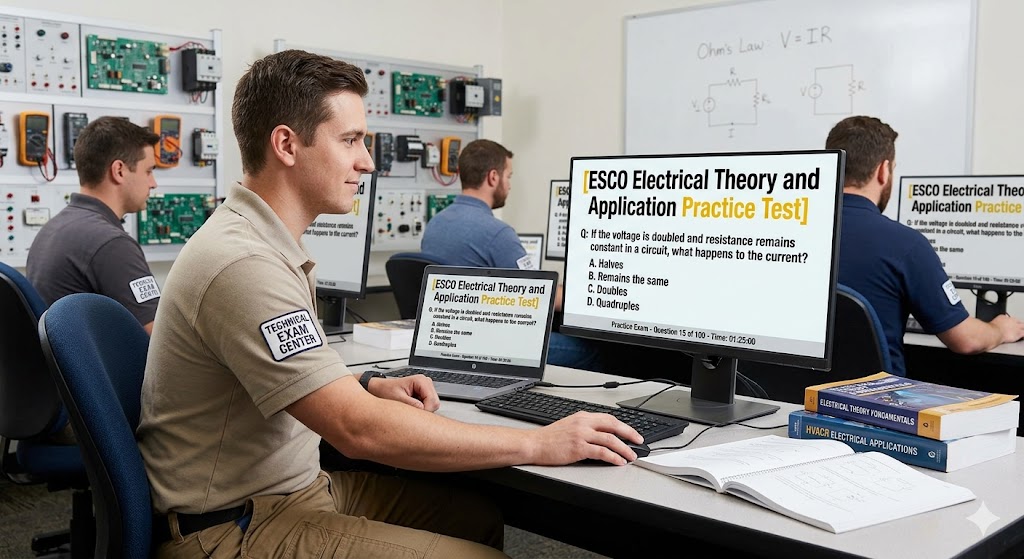
Additional Information
What the Course Entails and Exam Details
Preparing for this exam requires a solid grasp of both fundamental electrical science and practical, real-world application.
You will dive deep into basic electrical theory, mastering core concepts like Ohm’s Law, Watt’s Law, and the relationships between voltage, current, and resistance.
The syllabus extensively covers the differences and functions of series, parallel, and series-parallel circuits.
Furthermore, you will learn to identify and understand the purpose of essential HVACR components, including capacitors, relays, contactors, motors, and transformers.
A significant portion of the material also focuses on reading complex wiring diagrams and safely using electrical testing meters to diagnose system failures.
What to Expect in the Final Exam
The final certification exam is a rigorous assessment designed to test your theoretical knowledge and diagnostic reasoning.
You can expect a closed-book, multiple-choice format, typically consisting of 50 comprehensive questions.
Candidates are generally given a strict time limit of 60 to 90 minutes to complete the test, ensuring you can recall and apply information efficiently.
To achieve certification, you must reach a passing score requirement of at least 70%.
While personal notes and reference books are strictly prohibited, you are generally permitted to use a standard, non-programmable calculator to solve Ohm's Law and Watt's Law equations.
How to Study and Exam Centers
Success on this test requires a blend of textbook review and practical visualization.
Your most actionable study strategy is to take multiple practice exams to familiarize yourself with the question formatting and identify your weak areas.
Spend dedicated time studying standard HVACR schematics; trace the paths of power and control circuits until you can read them like a map.
Reviewing the official ESCO Institute training manuals is highly recommended, as the exam questions are directly aligned with their curriculum.
When you are ready to test, you can take the exam at authorized physical testing centers, which include registered trade schools, community colleges, and specific HVACR training facilities.
Additionally, many institutions now offer secure online portals with remote proctoring, allowing you to take the exam from home under strict monitoring guidelines.
Job Opportunities from the Course
Earning the ESCO Electrical Theory and Application certification unlocks a variety of rewarding and high-demand career paths.
Because electricity is the backbone of modern mechanical systems, employers actively seek out candidates with proven electrical troubleshooting skills.
Here are the specific job titles this certification helps you secure:
HVACR Service Technician
Commercial Refrigeration Mechanic
Facilities Maintenance Engineer
Electrical Appliance Repair Specialist
Building Automation Technician
Industrial Maintenance Mechanic
Frequently Asked Questions
Reviews
5.0
Based on 0 reviews
Leave a Review
No reviews yet. Be the first to review!