
Essentials of Fire Fighting Practice Exam
$69.00
- Buy to unlock unlimited access to all Quiz questions and Answers in this Quiz.
- After purchase you can print a PDF of the whole quiz at any point. The PDF will contain the questions and the correct answers.
About this Exam
The Essentials of Fire Fighting certification is the gold standard for introductory fire service training across North America and beyond.
It is primarily based on the comprehensive curriculum developed by the International Fire Service Training Association (IFSTA).
This pivotal exam is designed for aspiring firefighters, dedicated volunteers, and new recruits who are ready to prove their fundamental knowledge and operational readiness.
Passing this exam demonstrates that a candidate has mastered the critical life-saving concepts necessary to safely and effectively protect their communities.
It serves as the gateway to earning your Firefighter I and Firefighter II state or national certifications.
Ready to test your knowledge?
Buy Now to Access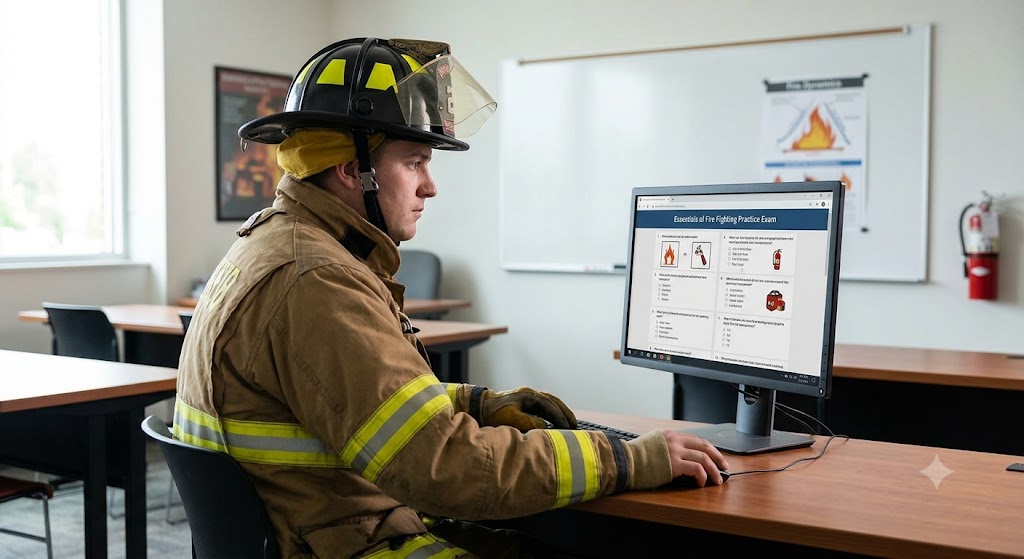
Additional Information
What the Course Entails and Exam Details
The course syllabus is incredibly diverse, preparing candidates for both the physical and mental demands of the fire service.
It covers fundamental fire dynamics, teaching recruits exactly how fire behaves, spreads, and reacts in different structural environments.
Students learn the critical aspects of building construction to understand structural integrity during an emergency.
The curriculum also dives deep into the proper use of Personal Protective Equipment (PPE) and self-contained breathing apparatus (SCBA) functionality.
Additionally, you will master the principles of tactical ventilation, water supply operations, fire hose deployment, and the effective use of portable fire extinguishers.
Search and rescue operations, ropes and knots, and hazardous materials (HazMat) awareness are also core components of this essential training.
What to Expect in the Final Exam
The final assessment typically consists of two distinct parts: a written cognitive exam and a hands-on practical skills evaluation.
The written exam is heavily multiple-choice, often featuring between 100 to 150 questions that test your theoretical knowledge and situational judgment.
Candidates are generally given a strict time limit, ranging from two to three hours, to complete the written portion.
You must typically achieve a passing score of at least 70% or 75%, depending on the specific regulations of your state or certifying agency.
Beyond the written test, you must pass a rigorous physical skills test where evaluators grade your ability to execute tasks like donning PPE, throwing ladders, and tying rescue knots under pressure.
Strict rules apply during the examination, including a zero-tolerance policy for electronic devices and a requirement to strictly follow the proctor's safety guidelines during the practical phase.
How to Study and Exam Centers
Effective preparation requires a blend of textbook study, active recall, and physical conditioning.
Begin by reading the IFSTA manual thoroughly and highlighting key definitions, safety procedures, and step-by-step tactics.
Utilize flashcards and online practice exams to familiarize yourself with the phrasing of multiple-choice questions.
Joining a study group with fellow recruits is highly recommended, as it allows you to quiz each other and physically practice knots and equipment handling.
When it is time to take the test, exams are typically administered by your state's fire training commission or a designated local fire academy.
Many jurisdictions also utilize authorized third-party testing centers, such as Pearson VUE, for the computer-based written portion.
Always verify your testing location and registration requirements through the Pro Board or the International Fire Service Accreditation Congress (IFSAC) portal relevant to your state.
Job Opportunities from the Course
Earning your certification by passing the Essentials of Fire Fighting exam opens the door to a highly rewarding career in public safety.
First and foremost, it qualifies you for the role of a Municipal Career Firefighter, where you will respond to urban emergencies, structural fires, and medical calls.
It is also the foundational requirement for becoming a Dedicated Volunteer Firefighter, allowing you to serve rural or suburban communities with professional-level skill.
With additional specialized training, this credential paves the way to becoming a Wildland Firefighter, combating forest and brush fires on state and federal lands.
Many graduates also transition into roles as Industrial Firefighters, protecting large-scale manufacturing plants, refineries, and private corporate facilities.
Furthermore, this certification provides a strong stepping stone for those looking to become Fire Inspectors, Fire Investigators, or Emergency Medical Responders.
Frequently Asked Questions
Reviews
5.0
Based on 0 reviews
Leave a Review
No reviews yet. Be the first to review!