
ETA Local Electrical Joint Apprenticeship and Training Committee (LEJATC) Year 1 Practice Test
$69.00
- Buy to unlock unlimited access to all Quiz questions and Answers in this Quiz.
- After purchase you can print a PDF of the whole quiz at any point. The PDF will contain the questions and the correct answers.
About this Exam
Embarking on a career as an electrical apprentice through the ETA Local Electrical Joint Apprenticeship and Training Committee (LEJATC) is a foundational step toward becoming a skilled, licensed journeyman electrician.
This program represents the gold standard in electrical training, structured through a partnership between the International Brotherhood of Electrical Workers (IBEW) and the National Electrical Contractors Association (NECA).
The Year 1 training is designed for entry-level individuals looking to build a career in the skilled trades, providing the essential blend of classroom theory and paid, on-the-job training.
Successfully completing the first year requires passing a rigorous final examination, and using a dedicated practice exam is the best way to validate knowledge and build confidence before the official test.
Ready to test your knowledge?
Buy Now to Access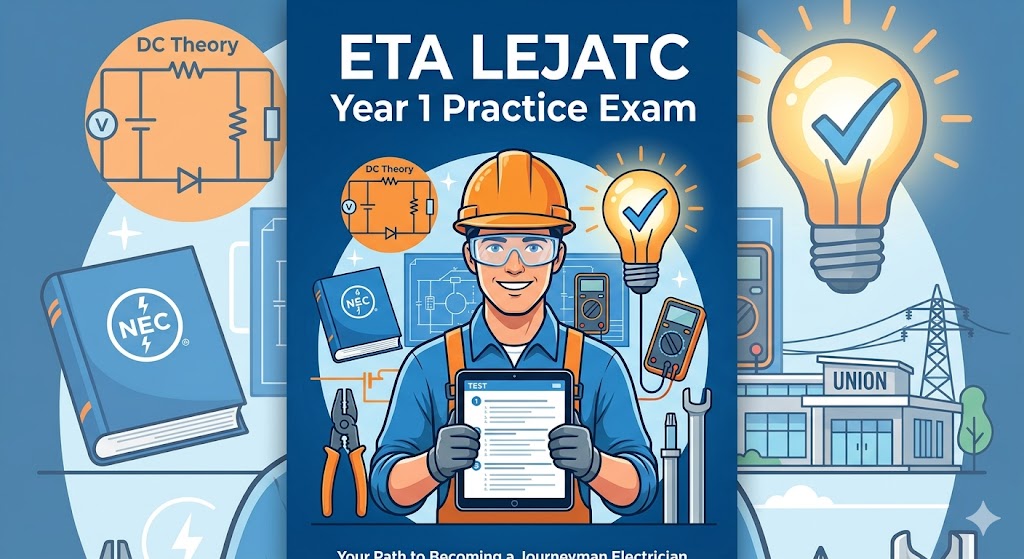
Additional Information
What the Course Entails and Exam Details
The first year of the electrical apprenticeship is focused on introducing core concepts and fundamental safety protocols that govern the industry.
Students undergo intense training to build a strong theoretical foundation before progressing to more complex electrical systems in later years.
The core topics typically covered in the Year 1 curriculum, and consequently on the exam, include:
Advanced DC Theory: Understanding circuits, voltage, current, resistance, and the application of Ohm's Law in series and parallel circuits.
Applied Mathematics: Mastering the trade math necessary for calculating electrical loads, conduit bending, and theory applications.
The National Electrical Code (NEC): A crucial introduction to Navigating the Code book and understanding general wiring requirements for safety.
Blueprint Reading: Learning the symbols, layouts, and interpretations of electrical construction drawings.
Jobsite Safety: Comprehensive training on OSHA regulations, proper use of tools, and electrical hazard awareness.
Conduit Bending: The theory behind bending EMT and rigid conduit, including offsets, 90-degree bends, and saddles.
What to Expect in the Final Exam
The ETA LEJATC Year 1 final exam is a comprehensive assessment designed to ensure apprentices possess the necessary knowledge to safely advance to Year 2.
The format is generally a computer-based, closed-book exam.
However, students are typically permitted to use an approved copy of the National Electrical Code (NEC) book, as being able to navigate the code is a required skill.
While specifics can vary slightly by local JATC jurisdiction, the exam consists primarily of multiple-choice questions testing both theoretical knowledge and practical application scenarios.
There may be a strict time limit, often spanning several hours, requiring test-takers to work efficiently.
A passing score is generally 70% or higher, though individual locals may have higher requirements.
Students must be prepared for questions that require calculations, circuit analysis, and referencing specific articles within the NEC.
How to Study and Exam Centers
Preparing for this exam requires a strategic blend of reviewing coursework, practicing calculations, and utilizing practice tests to identify knowledge gaps.
The most effective study strategy is the consistent use of an ETA LEJATC Year 1 practice test, which simulates the formatting, difficulty, and time constraints of the actual exam.
Candidates should review all assignments from their First-Year lessons, focusing heavily on DC theory and the proper application of Ohm's and Kirchhoff's Laws.
Furthermore, spending time navigating the NEC index to quickly locate specific articles is vital for success in the open-book portion of the test.
The actual final exam is administered in a controlled, proctored environment.
Typically, this takes place directly at the local LEJATC training facility or authorized school where the apprentice completed their classroom training.
Schedules and specific testing windows are provided directly to the apprentices by their local JATC training director toward the end of the school year.
Job Opportunities from the Course
Completing Year 1 and passing the comprehensive exam is the requisite gateway to advancing within the apprenticeship program.
While it does not immediately grant a license, successful completion allows the apprentice to move to Year 2, unlocking higher pay scales and more complex on-the-job responsibilities.
Finishing the complete LEJATC program (typically 5 years) leads directly to high-demand careers, including:
Inside Wireman
Residential Wireman
Telecommunications Installer/Technician
Instrumentation Technician
Industrial Maintenance Electrician
Electrical Project Manager or Estimator
Frequently Asked Questions
Reviews
5.0
Based on 0 reviews
Leave a Review
No reviews yet. Be the first to review!