
Ethical Hacking Essentials Practice Test
$69.00
- Buy to unlock unlimited access to all Quiz questions and Answers in this Quiz.
- After purchase you can print a PDF of the whole quiz at any point. The PDF will contain the questions and the correct answers.
About this Exam
The Ethical Hacking Essentials (EHE) certification is a highly respected, entry-level credential created by the EC-Council.
It is expertly designed to introduce learners to the thrilling and rapidly growing world of cybersecurity.
This certification is ideal for high school students, university students, and IT professionals looking to transition into a security-focused career path.
By mastering these fundamentals, you will build a rock-solid foundation in identifying vulnerabilities and understanding the hacker mindset from a purely ethical and legal standpoint.
Taking an Ethical Hacking Essentials practice exam is the perfect way to gauge your readiness and build confidence before facing the real challenge.
Ready to test your knowledge?
Buy Now to Access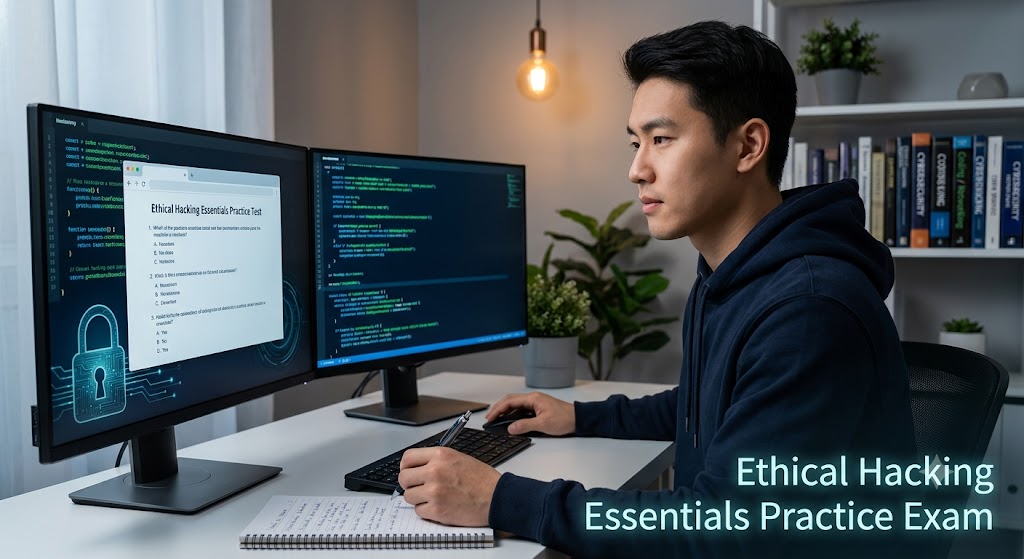
Additional Information
What the Course Entails and Exam Details
The Ethical Hacking Essentials course covers a comprehensive range of foundational cybersecurity topics.
You will dive deep into the fundamental concepts of information security, learning how to safeguard digital assets against modern threats.
The syllabus explores various threat vectors, including password cracking, malware, and social engineering tactics.
Students will also learn about the specific vulnerabilities found in web applications, cloud computing environments, and IoT (Internet of Things) devices.
Furthermore, the course touches on network-level attacks and the essential defensive countermeasures required to mitigate them.
Ultimately, this curriculum transforms absolute beginners into capable candidates who understand how cyber attacks are orchestrated and prevented.
What to Expect in the Final Exam
When you sit for the final Ethical Hacking Essentials exam, you should be prepared for a rigorous yet fair assessment of your knowledge.
The exam typically consists of 75 multiple-choice questions designed to test both your theoretical understanding and your practical problem-solving skills.
Candidates are given a strict time limit of exactly 2 hours to complete the test.
To achieve certification, you must reach a passing score, which generally ranges from 60% to 85?pending on the specific exam form provided by the EC-Council.
There are no tricky practical lab simulations in this specific foundational exam; it relies entirely on your ability to analyze scenarios and select the best multiple-choice answer.
Calculators and outside electronic devices are strictly prohibited, ensuring a secure and controlled testing environment.
How to Study and Exam Centers
Success in this exam requires a strategic, well-rounded approach to studying.
Begin by taking a high-quality practice exam to identify your weak areas and familiarize yourself with the question format.
Make sure to carefully review the official EC-Council syllabus and create flashcards for key terms, port numbers, and specific attack methodologies.
Hands-on practice is also invaluable; try setting up a basic virtual lab using VirtualBox to safely experiment with network scanning and fundamental ethical hacking tools.
When you are ready to test, the exam can be taken through the ECC Exam Center online.
You have the flexible option of taking the exam via a remote, online proctored environment from the comfort of your home.
Alternatively, you can schedule an in-person session at an authorized Pearson VUE testing center or an approved academic institution near you.
Job Opportunities from the Course
Earning your Ethical Hacking Essentials certification opens the door to numerous exciting entry-level roles in the tech industry.
Junior Cybersecurity Analyst: Monitor network traffic, analyze security alerts, and assist in incident response protocols.
IT Security Intern / Trainee: Support senior security teams with vulnerability assessments and basic penetration testing tasks.
Network Defender / Network Administrator: Apply security best practices to enterprise networks to prevent unauthorized access.
Help Desk Technician (Security Focused): Resolve IT issues while identifying and escalating potential security threats like phishing or malware infections.
Junior Penetration Tester: Help ethical hacking teams run automated vulnerability scanners and compile basic security reports.
Frequently Asked Questions
Reviews
5.0
Based on 0 reviews
Leave a Review
No reviews yet. Be the first to review!