
Ethical, Legal, and Professional Issues in Counseling Practice Exam
$69.00
- Buy to unlock unlimited access to all Quiz questions and Answers in this Quiz.
- After purchase you can print a PDF of the whole quiz at any point. The PDF will contain the questions and the correct answers.
About this Exam
The [Ethical, Legal, and Professional Issues in Counseling Practice Exam] is a foundational assessment designed for graduate-level counseling students and aspiring professionals. This comprehensive exam evaluates a candidate's understanding of the crucial ethical codes, legal requirements, and professional standards that govern the counseling profession. It is not usually a standalone certification but a critical component of major comprehensive exams, such as the Counselor Preparation Comprehensive Examination (CPCE) and national licensure exams like the National Counselor Examination (NCE). Passing this domain demonstrates that you possess the knowledge and judgment necessary to navigate complex situations and protect both your clients and your professional standing.
Ready to test your knowledge?
Buy Now to Access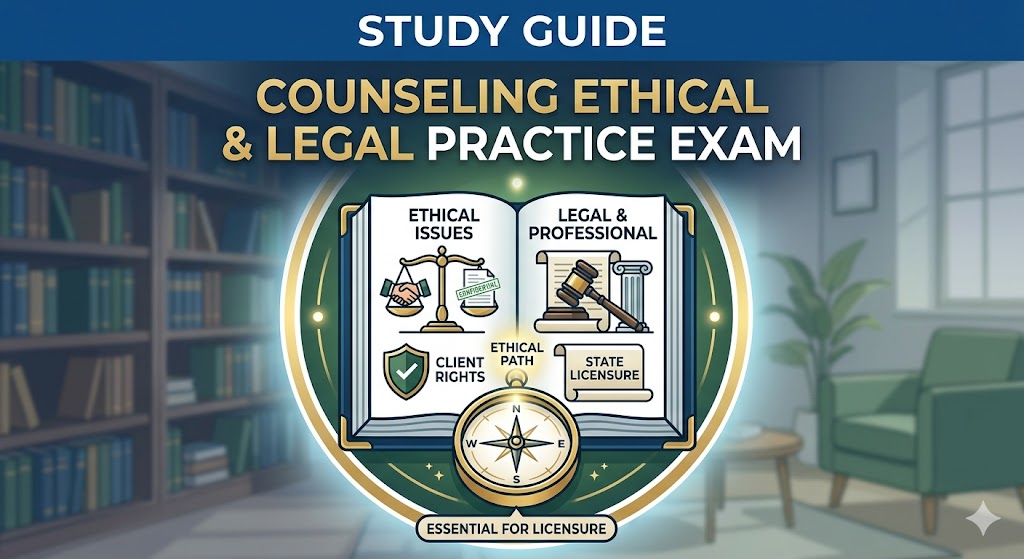
Additional Information
What the Course Entails and Exam Details
This exam covers the core knowledge required to practice counseling safely, effectively, and professionally. It ensures that candidates can apply ethical principles and legal regulations to real-world scenarios. The key areas of focus include:
Professional Counseling Orientation: Understanding the history, philosophy, and scope of practice for counselors, including the roles and responsibilities of professional organizations.
Ethical Codes and Standards: Mastery of the ACA Code of Ethics (American Counseling Association) and other relevant codes, including principles like autonomy, beneficence, non-maleficence, justice, and fidelity.
Confidentiality and Privacy: In-depth knowledge of client confidentiality, its legal and ethical limits (e.g., duty to warn, mandatory reporting of abuse), and HIPAA regulations.
Informed Consent: The process of providing clients with essential information about therapy to ensure they can make an autonomous decision to participate.
Professional Boundaries and Dual Relationships: Recognizing and managing boundary issues, including the prohibition of sexual relationships with clients and the complexities of other dual or multiple relationships.
Legal Issues in Counseling: Understanding malpractice, negligence, liability insurance, and the counselor's role in legal proceedings, such as responding to subpoenas.
Client Rights and Responsibilities: Promoting client welfare, autonomy, and their right to terminate treatment or access records.
Credentialing and Licensure: The process of obtaining and maintaining state licensure and national certification (e.g., NCC).
What to Expect in the Final Exam
When integrated into a larger examination like the CPCE or NCE, the Ethical, Legal, and Professional Issues section will consist of multiple-choice questions.
Format: The entire CPCE has 160 questions, while the NCE has 200 questions. The Ethical domain typically makes up a significant portion, often around 12% to 15% of the total scored questions.
Time Limit: Candidates are generally given between 3 hours and 45 minutes to 4 hours and 15 minutes to complete the entire comprehensive exam. There is no separate time limit for the ethics section.
Passing Score: There is no universal passing score for this specific domain or the overall exam. For the CPCE, the minimum passing score is set individually by each university program. For the NCE, the passing score is determined by state licensing boards and can vary.
Questions: The questions are often vignette-based, presenting a ethical or legal dilemma and asking you to identify the most appropriate, ethical, or legal course of action.
How to Study and Exam Centers
Preparation for this exam requires a deep understanding of ethical principles and the ability to apply them. Here are actionable strategies for success:
Master the Code of Ethics: Obtain and memorize the key sections of the ACA Code of Ethics. Don't just read it; understand the intent behind each standard.
Use Practice Exams: Take as many practice quizzes and full-length practice exams as possible. Focus on the explanation for both correct and incorrect answers to understand the rationales.
Analyze Case Studies: Review ethical case studies to practice identifying dilemmas, applying the Code of Ethics, and making sound decisions.
Study Key Legal Concepts: Understand the difference between ethics and law and know the major legal issues impacting counseling, including confidentiality exceptions in your state.
Join Study Groups: Discussing scenarios with peers can help you see different perspectives and solidify your understanding.
Exam Centers
Because this exam is part of larger comprehensive and licensure tests, you do not take it on its own.
For the CPCE: This exam is typically administered on-campus at your university or college testing center. Check with your academic advisor for scheduling details.
For the NCE/NCMHCE: These national exams are administered through Pearson VUE, which has a vast network of professional testing centers globally. You must register through the National Board for Certified Counselors (NBCC) and schedule your appointment at a physical Pearson VUE center.
Job Opportunities from the Course
Passing this comprehensive exam domain is a critical step towards counselor licensure. Once licensed, you can pursue numerous rewarding career paths, including:
Licensed Professional Counselor (LPC)
Licensed Mental Health Counselor (LMHC)
Licensed Clinical Professional Counselor (LCPC)
School Counselor (K-12)
Substance Abuse and Behavioral Disorder Counselor
Marriage and Family Therapist (LMFT, requiring additional specialized training)
Clinical Supervisor
Private Practice Counselor
College Career Counselor
Crisis Intervention Specialist
Frequently Asked Questions
Reviews
5.0
Based on 0 reviews
Leave a Review
No reviews yet. Be the first to review!