
Ethical Professional Practice Test
$69.00
- Buy to unlock unlimited access to all Quiz questions and Answers in this Quiz.
- After purchase you can print a PDF of the whole quiz at any point. The PDF will contain the questions and the correct answers.
About this Exam
A passing score on an Ethical Professional Practice Test is a critical milestone for individuals entering regulated professions, including engineering, geosciences, healthcare, and finance, as well as those seeking specific corporate certifications. This examination is not designed to test technical knowledge but to assess a candidate's understanding of the legal and ethical frameworks that govern their field. It ensures they can apply core principles such as integrity, honesty, confidentiality, and accountability to real-world scenarios. It is, essentially, a validation of one's commitment to protecting the public interest and upholding the reputation of their chosen vocation.
Ready to test your knowledge?
Buy Now to Access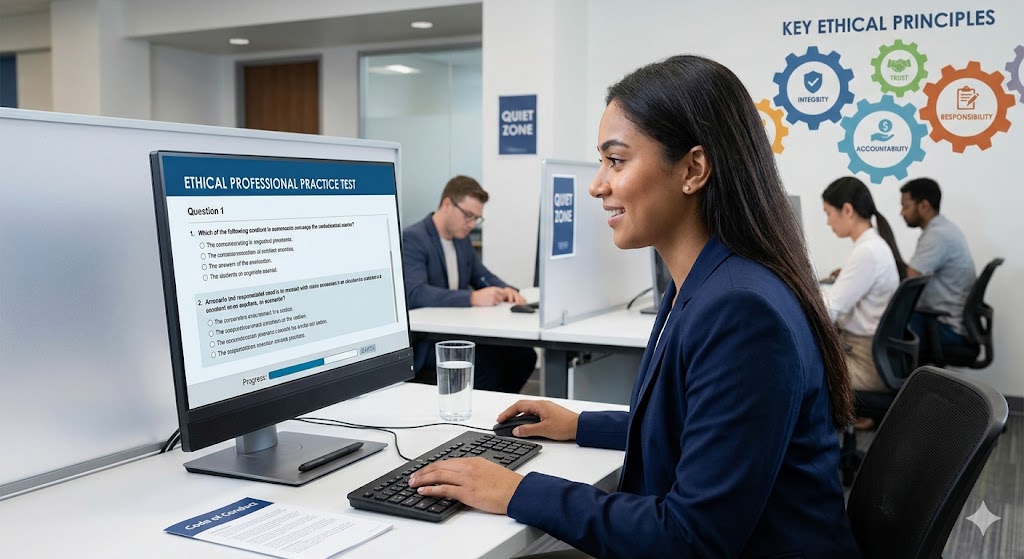
Additional Information
What the Course Entails and Exam Details
While the exact syllabus can vary slightly depending on the jurisdiction or the specific certifying body, the core content of an Ethical Professional Practice course covers several key areas. Candidates are expected to master fundamental concepts such as the difference between ethics and law, the history of professional regulation, and the specific codes of ethics governing their field. Beyond general theory, the material typically focuses on:
Conflict of Interest: Recognizing, managing, and declaring situations where personal interests conflict with professional duties.
Confidentiality: Understanding the boundaries of safeguarding sensitive information.
Public Interest and Safety: Placing the well-being of society above all other considerations.
Professional Conduct and Integrity: Guidelines for interactions with clients, employers, colleagues, and the public.
Reporting and Whistleblowing: The ethical and legal responsibilities when encountering misconduct.
The exam itself is typically a proctored, standardized assessment, designed to be comprehensive and to challenge a candidate's decision-making process.
What to Expect in the Final Exam
When you arrive at your testing center or log in to a secure online portal for your Ethical Professional Practice Test, you should expect a format dominated by multiple-choice questions. These questions are often scenario-based, presenting you with a complex situation and asking for the most appropriate ethical course of action. You might also encounter true/false questions or fill-in-the-blank statements designed to test your direct knowledge of the relevant codes or laws.
Most variations of this exam are timed, with limits ranging from 90 minutes to three hours, depending on the scope. A common passing score is between 70% and 80%, reflecting a requirement for high proficiency. Specific rules are strict; it is almost universally a 'closed book' exam, meaning you cannot refer to notes, books, or online resources. You must rely solely on your preparation and understanding.
How to Study and Exam Centers
Effective study for this test requires both memorization and application. First, download the official candidate handbook and the specific Code of Ethics for your profession. Do not just read them; dissect them. Use flashcards for key terms, definitions, and clauses.
Your most powerful tool, however, will be practice exams. Seek out sample questions and full-length practice papers. After each session, do not just check your answers; read the detailed rationales for why a particular answer is correct. The exam evaluates how you think, so understanding the underlying reasoning is paramount.
You will typically take this exam at an authorized Exam Center, such as those operated by Pearson VUE, which are location-based. Alternatively, some organizations offer online proctoring, allowing you to take the exam from a private, secure location while being monitored via a webcam and microphone. In some cases, the exam is administered directly through an authorized university or professional school after a specific preparatory course. Check the instructions provided by your specific regulatory or certifying body for the most accurate list of options.
Job Opportunities from the Course
Passing the Ethical Professional Practice Test is a universal asset, and for many, a mandatory requirement, unlocking various career paths and positions. It signals to employers and regulatory bodies that you possess the required moral judgment to operate with autonomy and responsibility. Passing this test can be a direct requirement or a major advantage for roles such as:
Certified Professional Engineer
Professional Geoscientist
Compliance Officer
Corporate Ethics Manager
Licensed Healthcare Practitioner (e.g., Nurse, Pharmacist, Doctor)
Chartered Financial Analyst (CFA) or equivalent in finance
Project Manager (where ethical sourcing and safety are key)
Human Resources Manager (handling workplace misconduct and integrity)
Legal Professional (specific bar ethics requirements)
Risk Manager
Frequently Asked Questions
Reviews
5.0
Based on 0 reviews
Leave a Review
No reviews yet. Be the first to review!