
Ethics and Moral Issues Practice Test
$69.00
- Buy to unlock unlimited access to all Quiz questions and Answers in this Quiz.
- After purchase you can print a PDF of the whole quiz at any point. The PDF will contain the questions and the correct answers.
About this Exam
The Ethics and Moral Issues Practice Test is designed as a comprehensive self-assessment tool for students, professionals, and lifelong learners aiming to test their knowledge of foundational and applied moral philosophy. This practice exam is an excellent resource for anyone enrolled in intro to ethics courses, preparing for professional certification exams with ethics components (like business, medical, or legal boards), or individuals simply wishing to improve their ethical reasoning and decision-making skills. It offers a low-stakes environment to identify knowledge gaps, practice time management, and build confidence before a final evaluation.
Ready to test your knowledge?
Buy Now to Access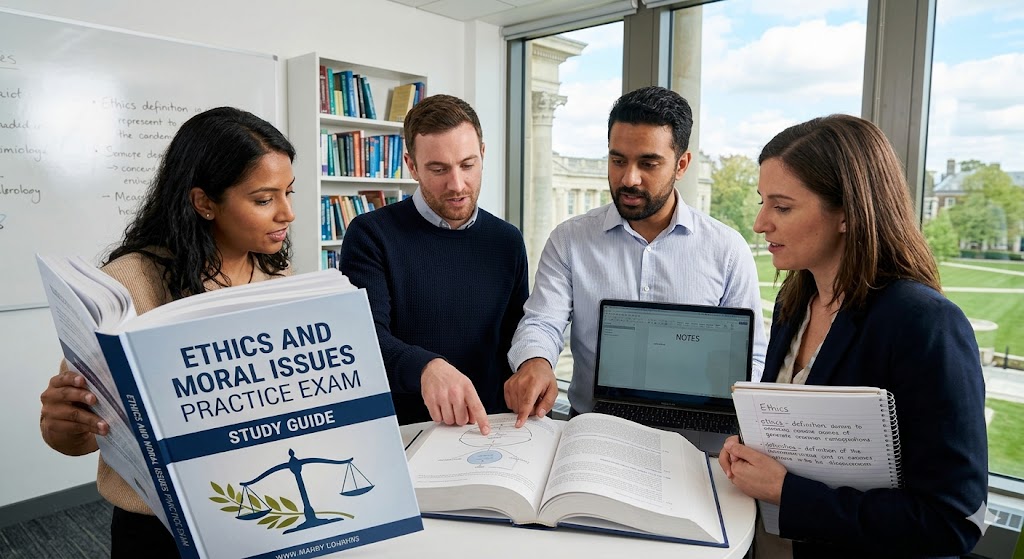
Additional Information
What the Course Entails and Exam Details
While the specific topics of a practice test are determined by the provider, a comprehensive "Ethics and Moral Issues" test will typically draw from a standard syllabus. This practice exam simulates the content and challenge level of a general higher education or foundational professional exam, covering key areas including:
Foundational Ethical Theories: Understanding the core frameworks that define moral right and wrong, including Deontology (duty-based, like Kant), Consequentialism/Utilitarianism (outcome-based, like Mill and Bentham), Virtue Ethics (character-based, like Aristotle), and Care Ethics.
Key Ethical Principles: Defining and applying principles such as autonomy, beneficence, non-maleficence, justice, and fidelity in diverse contexts.
The History of Moral Philosophy: Recognizing major figures and movements that have shaped ethical thought.
Moral Reasoning and Decision-Making: Learning and applying structured models for ethical problem-solving and critical analysis.
Applied Ethics (Contemporary Issues): Testing your ability to apply theoretical frameworks to modern, complex moral dilemmas, such as:
Bioethics and Medical Ethics: Euthanasia, abortion, genetic engineering, patient rights, and resource allocation.
Business and Professional Ethics: Corporate social responsibility (CSR), whistleblowing, conflicts of interest, data privacy, and fair labor practices.
Environmental Ethics: Climate change responsibility, animal rights, and sustainability.
Digital and AI Ethics: Algorithmic bias, surveillance, and the moral status of artificial intelligence.
Practice Exam Details: This specific practice test usually consists of multiple-choice questions designed to be completed within a set timeframe to mimic actual exam pressure. It may feature scenario-based questions that require you to apply multiple concepts simultaneously. The goal is complete, rapid-fire assessment and review.
What to Expect in the Final Exam
This Ethics and Moral Issues Practice Test is intended to simulate what you will encounter in a final course exam or a professional ethics certification section. However, it is crucial to understand the distinction.
A practice test is a study tool. A final, official exam will have significant structural and formal differences:
Format: A final exam will be more comprehensive. While often based on multiple-choice, it may also include essay questions, short-answer responses, and detailed case studies that require in-depth synthesis of several theories.
Length and Time: Expect a longer duration and significantly more questions in a final exam, requiring sustained concentration, sometimes lasting 2–4 hours.
Scoring and Passing: Unlike the immediate feedback of this practice test, an official exam has a strict, pre-determined passing score (often 70% or higher). Failing can require a significant waiting period and additional fees for re-taking.
Supervision and Rules: Final certification exams are proctored, meaning a live supervisor or recording software ensures no external help, notes, or academic misconduct occurs. Practice tests are typically self-administered.
How to Study and Exam Centers
Preparation for an ethics exam is unique because it requires both rote memorization of definitions and the flexible application of abstract concepts to real-world scenarios. Here is a strategy for success:
Study Strategies:
Start with the Syllabus: Understand the exact "scope" of your official exam. Every program weighs theories and applied topics differently.
Master the Big Three Theories: You must be able to define, compare, contrast, and apply Deontology, Utilitarianism, and Virtue Ethics. Create comprehensive flashcards for these concepts.
Use Active Recall: When taking this practice test, don't just find the right answer. Explain why the wrong answers are incorrect, using proper ethical terminology (e.g., "This answer is wrong because it applies a utilitarian view, but the question asks for a deontological analysis.").
Practice on Case Studies: Go beyond multiple-choice. Find detailed ethics case studies and practice writing short-essay responses, detailing which ethical framework you would use and justifying your recommended decision.
Re-take the Practice Exam: Treat each attempt as a real test. Focus on improving your speed and accuracy in reasoning.
Where to Take the Exam:
Practice Test: This specific "Ethics and Moral Issues Practice Test" is typically hosted by an online platform, educational institution (like a University's Learning Management System), or a private test preparation company. It is intended to be taken remotely from your own computer.
Final Certification Exam: Official, high-stakes ethics exams are rarely self-administered. You will likely take the final certification through one of two methods:
Online Proctored: The exam is delivered via a specialized secure browser (like Pearson VUE's OnVUE or Prometric's ProProctor), where you are monitored via webcam and microphone.
Physical Testing Center: You must schedule an appointment and travel to an authorized brick-and-mortar testing center, such as those run by Pearson VUE, Prometric, or specific professional associations (e.g., the local medical board’s testing facility).
Job Opportunities from the Course
A strong understanding of ethics is not just academic; it is a critical differentiator in the professional world. Employers across every sector value individuals with proven ethical reasoning skills. Successfully mastering this content through study and practice can lead directly to, or be a mandatory requirement for, roles such as:
Ethics and Compliance Officer
Corporate Social Responsibility (CSR) Manager
Sustainability Specialist
Human Resources (HR) Manager (with ethics focus)
Clinical Ethicist
Bioethics Researcher
Data Ethics Analyst
Legal Consultant
Environmental Policy Analyst
AI Ethics and Safety Researcher
Grant Compliance Manager
Conflict Resolution Specialist
Internal Auditor
Frequently Asked Questions
Reviews
5.0
Based on 0 reviews
Leave a Review
No reviews yet. Be the first to review!