
Ethics in Counseling Practice Test
$69.00
- Buy to unlock unlimited access to all Quiz questions and Answers in this Quiz.
- After purchase you can print a PDF of the whole quiz at any point. The PDF will contain the questions and the correct answers.
About this Exam
The Ethics in Counseling Practice Test is a vital resource for aspiring and current mental health professionals.
This exam is designed for individuals pursuing careers as Licensed Professional Counselors (LPCs), Marriage and Family Therapists (LMFTs), Clinical Social Workers (LCSWs), school counselors, and other counseling specialists.
It ensures that candidates are thoroughly prepared to navigate the complex moral dilemmas and professional standards inherent in the counseling field.
By focusing on ethical principles and legal requirements, this practice test serves as an indispensable tool for successful licensure.
Ready to test your knowledge?
Buy Now to Access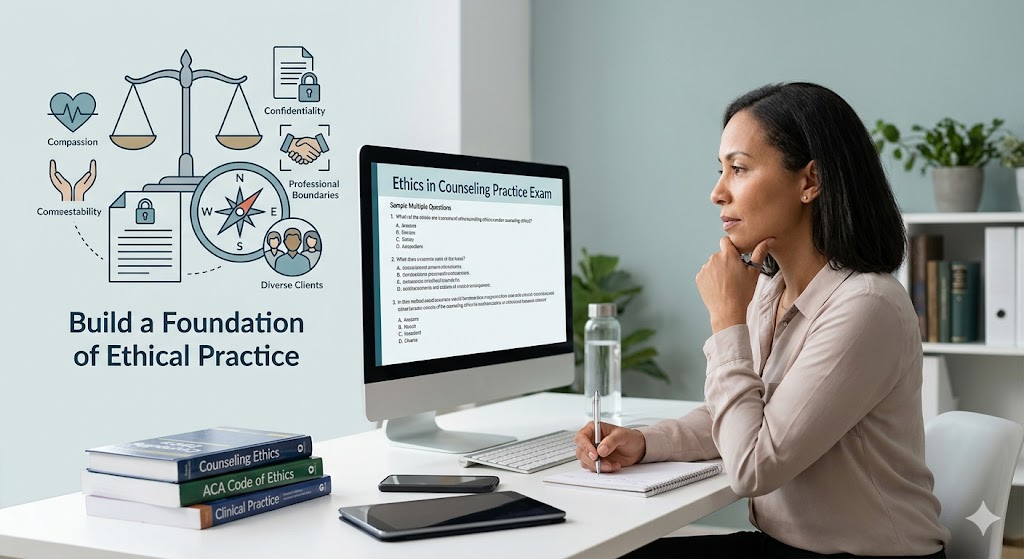
Additional Information
What the Course Entails and Exam Details
The Ethics in Counseling Practice Test comprehensive content assesses critical knowledge areas.
The core domains covered include client rights, confidentiality, professional competence, and appropriate professional boundaries.
Candidates are tested on their understanding of informed consent, record-keeping, and addressing multicultural concerns within counseling.
Specific focus is placed on handling dual relationships, managing ethical dilemmas involving minors, and complying with state and federal legal standards.
Mastering these topics is essential for demonstrating the ability to practice ethically and responsibly.
What to Expect in the Final Exam
The actual final licensure exam, which this practice test simulates, typically follows a structured format.
It is generally a computerized, multiple-choice examination consisting of 100 to 200 questions.
The duration of the exam is usually around 3 to 4 hours, and specific passing scores vary by state and licensing board.
Questions include scenario-based applications of ethical codes, testing both recall and critical thinking abilities.
The final official exam ensures candidates can practically apply the ethical principles of autonomy, beneficence, and non-maleficence.
How to Study and Exam Centers
Effective preparation for this practice test involves using a combination of methods.
Regularly review the official ethical codes, such as the ACA Code of Ethics, and complete sample questions to build confidence.
Engaging with study guides and ethical case studies will deepen your understanding of how to apply principles in real-world situations.
Join study groups or utilize online forums to discuss ethical scenarios and seek different perspectives on complex issues.
Official licensure exams are typically administered through authorized organizations like Pearson VUE at physical testing centers or sometimes via secure online proctoring, depending on the state.
Job Opportunities from the Course
A strong foundation in ethics, validated by passing the licensure exam, opens numerous career paths.
Potential job opportunities include working as a Licensed Professional Counselor, a Marriage and Family Therapist, a Clinical Social Worker, or a School Counselor.
Other roles might involve being a Substance Abuse Counselor, a Rehabilitation Counselor, or a Child and Adolescent Counselor in various clinical settings.
Successful completion and subsequent licensure demonstrate to employers and clients a commitment to the highest standards of care.
Here is your comprehensive study guide and SEO-optimized title for the [Ethics in Counseling Practice Test], along with a custom image.
Frequently Asked Questions
Reviews
5.0
Based on 0 reviews
Leave a Review
No reviews yet. Be the first to review!