
ETS Major Field Test Criminal Justice Practice Test
$69.00
- Buy to unlock unlimited access to all Quiz questions and Answers in this Quiz.
- After purchase you can print a PDF of the whole quiz at any point. The PDF will contain the questions and the correct answers.
About this Exam
The ETS Major Field Test (MFT) in Criminal Justice is a comprehensive, outcomes-based assessment designed to measure the critical thinking and foundational knowledge acquired by students nearing completion of their undergraduate criminal justice degree. This exam goes beyond mere factual recall, evaluating a student's ability to analyze complex scenarios, solve problems, interpret data, and understand relationships within the diverse field of criminal justice. For students, this practice exam is an invaluable tool to gauge their readiness for the actual test, identify areas for improvement, and gain confidence. For academic programs, the MFT provides critical data to evaluate curriculum effectiveness and demonstrate student achievement to accreditation bodies. It is designed for senior students about to graduate with a Bachelor’s degree in Criminal Justice or a closely related discipline.
Ready to test your knowledge?
Buy Now to Access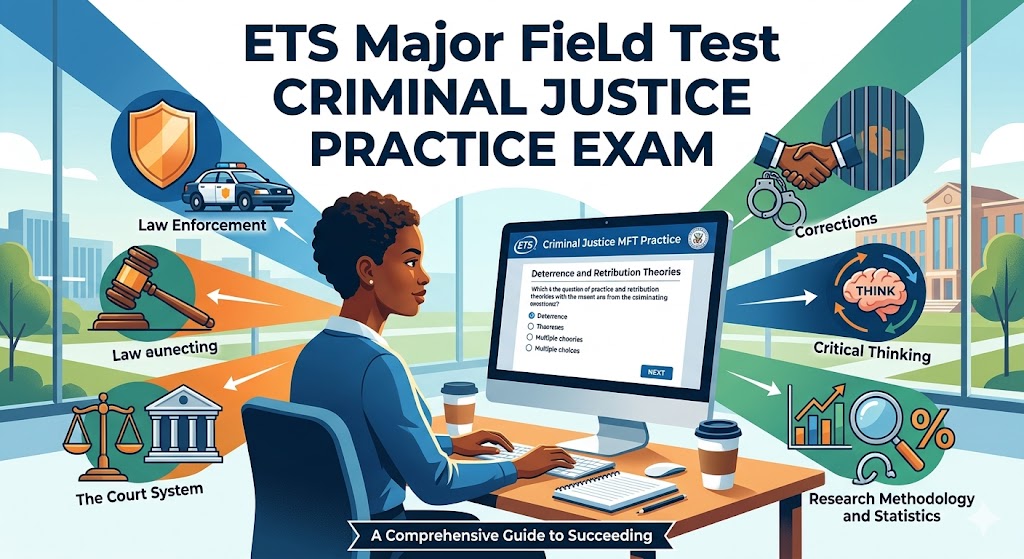
Additional Information
What the Course Entails and Exam Details
The ETS Major Field Test for Criminal Justice is not a course itself, but a comprehensive examination of the skills and subject matter covered in most undergraduate criminal justice programs. The practice test reflects the core content areas of the final exam, ensuring students are well-prepared for the variety of questions they will encounter. The final exam content is distributed across five primary assessment indicators:
The Law (~20%): Covers civil vs. criminal law, the elements of a crime, criminal liability, legal defenses, constitutional law, and the sociology and philosophy of law.
Law Enforcement (~20%): Explores the social function of the police, the history of policing in the United States, community-police relationships, critical issues like corruption, investigative techniques, and organizational management.
Corrections (~20%): Focuses on the history and philosophy of corrections, juvenile versus adult systems, probation and parole, theories of punishment, prison organization, and community corrections.
The Court System in the United States (~20%): Details the history and organization of the US court system, pre-trial processes, plea bargaining, sentencing, and judicial decision-making.
Theories of Criminal Behavior (~20%): Examines key criminological theories, including classical, positivist, conflict, and integrated perspectives.
Additionally, two overlapping themes are integrated throughout the entire test:
Critical Thinking: Questions requiring students to draw inferences, recognize assumptions, deduce conclusions, interpret evidence, and evaluate arguments.
Research Methodology and Statistics: Questions evaluating the understanding of quantitative and qualitative research designs, basic statistics, sampling methods, and hypothesis testing.
What to Expect in the Final Exam
The ETS Major Field Test in Criminal Justice is a standardized, two-hour exam. It consists of 150 multiple-choice questions, some of which are grouped in sets and based on materials such as diagrams, graphs, and statistical data. The test is typically administered through your college or university, either in a paper-and-pencil format or online, depending on the institution's choice. It is a proctored exam, meaning it must be taken under official supervision, whether on-campus or through an approved online proctoring service. There is no predetermined "passing score" set by ETS. Instead, individual institutions establish their own performance standards based on national comparative data. Students receive a total score, and the institution receives summary group data for each assessment indicator to help evaluate program performance.
How to Study and Exam Centers
Preparation for the MFT is distinct from preparing for a standard course exam, as it covers your entire undergraduate career. Actionable study strategies include:
Review Core Textbooks: Revisit key concepts from your introduction to criminal justice, policing, courts, corrections, law, and theory courses.
Utilize Practice Materials: The ETS website provides sample questions and a test description booklet. Using a comprehensive practice exam, like this guide supports, is highly effective for learning the question style and pacing.
Review Research and Statistics: Ensure you understand the basic research designs, data collection methods, and fundamental statistics relevant to social science research.
Focus on Weak Areas: Use practice results to pinpoint content areas where your knowledge is weakest and dedicate extra time to those topics.
Take the exam in standard centers. As an institutional assessment, the MFT is administered directly by your university or college. They are responsible for determining the specific testing location (typically an on-campus testing center) and notifying you of the scheduled date and time. There are also options for off-campus online proctoring, which your institution may offer. Contact your academic advisor or department chair for exact details on administration at your school.
Job Opportunities from the Course
A strong performance on the Major Field Test demonstrates significant mastery of the criminal justice discipline, which is a powerful credential as you enter the job market. A Bachelor’s degree in Criminal Justice, validated by a rigorous MFT, unlocks a wide spectrum of career paths in the public and private sectors:
Police Officer or Patrol Officer
Sheriff’s Deputy
State Trooper or Highway Patrol Officer
Criminal Investigator or Detective
Correctional Officer or Jailer
Probation or Parole Officer
Victim Advocate or Coordinator
Loss Prevention or Asset Protection Specialist
Crime Scene Investigator or Technician
Fraud Investigator
Bailiff
Court Clerk or Case Administrator
Fire Investigator or Inspector
Private Security Manager
Homeland Security Specialist
Customs and Border Protection Officer
Frequently Asked Questions
Reviews
5.0
Based on 0 reviews
Leave a Review
No reviews yet. Be the first to review!