
Evidence‑Based Practice (EBP) Practice Test
$69.00
- Buy to unlock unlimited access to all Quiz questions and Answers in this Quiz.
- After purchase you can print a PDF of the whole quiz at any point. The PDF will contain the questions and the correct answers.
About this Exam
Welcome to your essential study guide for the Evidence-Based Practice (EBP) Practice Test. Evidence-Based Practice is the cornerstone of modern healthcare, blending the latest high-quality research evidence with clinical expertise and patient values to make the best possible care decisions.
This exam is designed for healthcare professionals, including registered nurses, physicians, allied health practitioners, and medical students. Achieving proficiency or certification in EBP demonstrates a commitment to providing safe, effective, and up-to-date patient care. This practice test will help you identify knowledge gaps and feel confident when approaching your final assessment.
Ready to test your knowledge?
Buy Now to Access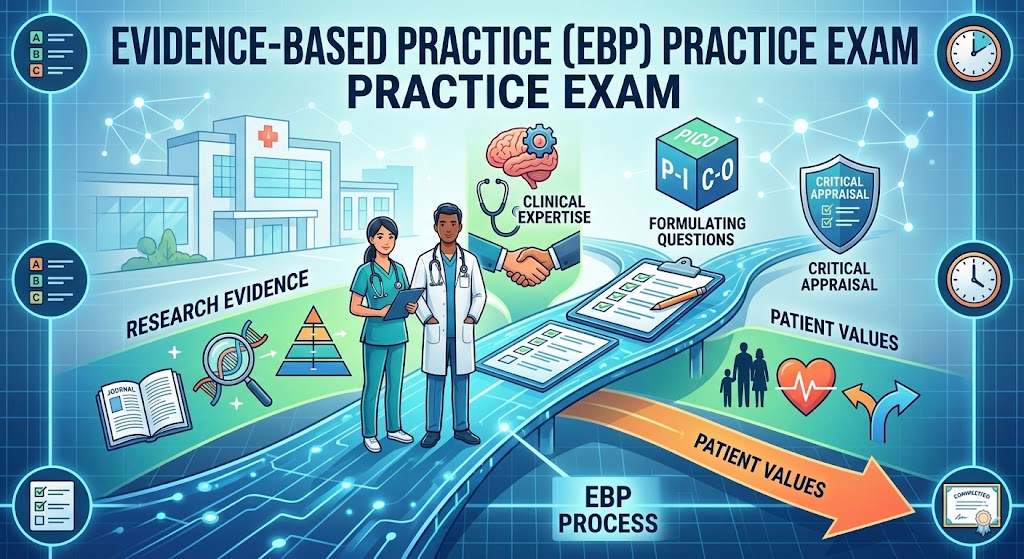
Additional Information
What the Course Entails and Exam Details
The core syllabus of an Evidence-Based Practice course focuses on a specific five-step process that you must master. Your exam will thoroughly test your knowledge of these steps and your ability to apply them in a clinical context.
The primary topics you must study are:
Cultivating a Spirit of Inquiry: Understanding the motivation to question current practices.
Asking Clinical Questions: Mastering the PICO format (Patient/Population, Intervention, Comparison, Outcome) to create answerable research queries.
Acquiring the Best Evidence: Navigating literature databases like PubMed and CINAHL using MeSH terms, keywords, and Boolean operators.
Critically Appraising the Evidence: Evaluating the quality of studies. This includes recognizing study designs (e.g., randomized controlled trials, systematic reviews, cohort studies, and qualitative research), interpreting statistical data, and using appraisal scales for bias and validity.
Integrating and Evaluating: Applying findings alongside patient preferences and expertise, and measuring the outcome.
The final exam often measures your ability to recognize the hierarchy of evidence and apply the appropriate levels to clinical decision-making.
What to Expect in the Final Exam
While exact structures can vary between institutions and certification boards, you can generally expect a computer-based final exam.
The predominant format is multiple-choice questions, which may be mixed with scenario-based questions that ask you to apply the five steps of EBP to a practical patient case.
Passing scores are commonly in the range of 75% to 80%. Time limits are strictly enforced, so efficiency is key. For example, a 60-question exam might allow 90 minutes. Familiarize yourself with the rules of your specific testing body before the day.
How to Study and Exam Centers
Preparation should focus on active recall and application. Simply reading the course material is not enough. Here are effective strategies:
Practice PICO: Create several PICO questions based on your current clinical experiences.
Search a Database: Conduct a real PubMed search using one of your PICO questions and try to locate a systematic review and a randomized controlled trial on the topic.
Review Appraisals: Go through the tools and checklists used to critically appraise studies. Pay attention to how to identify risk of bias.
Take Practice Tests: Use resources like this EBP Practice Test repeatedly to become comfortable with the question types and time constraints. Analyze your incorrect answers.
Regarding exam centers, for informal courses, tests may be conducted within your institution's own online portal. However, for a formal, nationally recognized EBP certification, you will likely register with a professional organization and take the proctored exam at an authorized center. This may include major networks like Pearson VUE or specific physical testing sites at affiliated universities and health schools.
Job Opportunities from the Course
A strong foundation in Evidence-Based Practice unlocks numerous leadership and specialized roles. Certification makes you a highly attractive candidate for positions focused on improving quality and outcomes.
The career paths and specific job titles opened by this qualification include:
Evidence-Based Practice (EBP) Specialist
Clinical Nurse Leader (CNL)
Nurse Scientist
Quality Improvement (QI) Coordinator
Director of Clinical Excellence
Clinical Research Coordinator
Case Manager
Professional Development Specialist
Risk Management Analyst
Unit-Based Clinical Educator
Frequently Asked Questions
Reviews
5.0
Based on 0 reviews
Leave a Review
No reviews yet. Be the first to review!