
Evidence Technician Exam
$69.00
- Buy to unlock unlimited access to all Quiz questions and Answers in this Quiz.
- After purchase you can print a PDF of the whole quiz at any point. The PDF will contain the questions and the correct answers.
About this Exam
The Evidence Technician Exam is a critical stepping stone for individuals looking to build a career in forensic science and law enforcement.
This certification is designed to validate a candidate's proficiency in identifying, collecting, preserving, and documenting physical evidence at a crime scene.
It is the perfect credential for aspiring crime scene investigators, current police officers seeking specialized roles, and forensic science students wanting to prove their practical knowledge.
By passing this exam, you demonstrate to agencies that you possess the meticulous attention to detail required to handle sensitive materials without compromising an investigation.
Ready to test your knowledge?
Buy Now to Access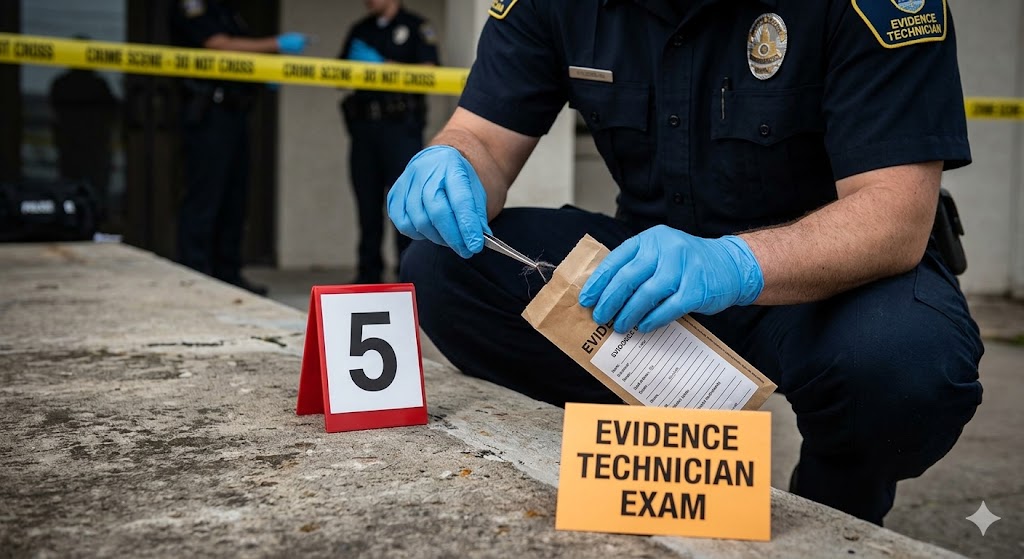
Additional Information
What the Course Entails and Exam Details
Preparing for the Evidence Technician certification requires a deep dive into both the scientific and legal aspects of forensic investigation.
The core syllabus typically begins with the fundamentals of securing and protecting a crime scene to prevent contamination.
Candidates will learn specialized evidence collection techniques, including how to properly lift latent fingerprints, swab for DNA, cast footwear impressions, and gather trace evidence like hair and fibers.
Another major component of the course is mastering forensic photography and sketching, ensuring that the scene is visually documented before anything is moved.
Finally, the curriculum places heavy emphasis on the legal procedures surrounding the chain of custody, search warrants, and courtroom testimony, ensuring that all collected evidence is legally admissible in court.
What to Expect in the Final Exam
The final exam is designed to rigorously test both your theoretical knowledge and your practical decision-making skills.
Typically, the test consists of a multiple-choice written section containing anywhere from 100 to 150 questions.
Many testing agencies also include a practical skills assessment where you must demonstrate proper collection and packaging techniques on mock evidence.
Candidates are generally given a time limit of two to three hours to complete the written portion.
A standard passing score usually falls between 70% and 80%, depending on the specific issuing agency or state law enforcement board.
The exam environment is strictly proctored, meaning it is a closed-book test with stringent identification requirements, and no unauthorized electronic devices are allowed in the testing room.
How to Study and Exam Centers
Success on the Evidence Technician Exam comes down to combining consistent study habits with hands-on practice.
We highly recommend utilizing practice exams to familiarize yourself with the phrasing of multiple-choice questions and to identify your weak areas.
Creating flashcards for legal definitions, evidence packaging protocols, and basic forensic terminology will greatly enhance your recall speed.
If possible, set up mock crime scenes at home to physically practice bagging, tagging, and logging items, as muscle memory is invaluable for the practical portion of the test.
Depending on your jurisdiction, the exam is usually administered at authorized local police academies, state law enforcement training commissions, or through specialized forensic associations like the International Association for Identification (IAI).
Many of the written components are now offered at dedicated Pearson VUE or Prometric physical testing centers, while practical assessments are held at certified training facilities.
Job Opportunities from the Course
Earning your certification as an Evidence Technician opens the door to a variety of exciting and rewarding roles within the criminal justice system.
Here are some of the primary career paths this credential can unlock:
Evidence Technician: The most direct career path, working for local or state police departments to process crime scenes and manage collected evidence.
Crime Scene Investigator (CSI): A more advanced role focused on reconstructing crime scenes and analyzing complex physical evidence.
Property and Evidence Custodian: A vital administrative and organizational role managing the secure storage and legal logging of evidence within a police department vault.
Forensic Science Technician: An entry-level laboratory role focusing on the initial intake, processing, and preliminary testing of field evidence.
Latent Print Examiner Trainee: A specialized pathway for those who want to focus specifically on analyzing and comparing fingerprints lifted from crime scenes.
Medicolegal Death Investigator: Assisting medical examiners or coroners in investigating the circumstances surrounding unexplained or violent deaths.
Frequently Asked Questions
Reviews
5.0
Based on 0 reviews
Leave a Review
No reviews yet. Be the first to review!