
EVOC Mandate 24 Practice Test
$69.00
- Buy to unlock unlimited access to all Quiz questions and Answers in this Quiz.
- After purchase you can print a PDF of the whole quiz at any point. The PDF will contain the questions and the correct answers.
About this Exam
The Emergency Vehicle Operator Course (EVOC) is a comprehensive program designed for all personnel who operate emergency vehicles, including ambulances, fire apparatus, and law enforcement units.
Its primary purpose is to equip operators with the specialized knowledge, defensive driving skills, and legal understanding required to navigate high-stress situations safely and efficiently, minimizing risks to themselves and the public.
"EVOC Mandate 24" specifically refers to a specialized curriculum that meets or exceeds a mandatory 24-hour training threshold, often required for initial certification or mandatory in-service training updates, depending on the jurisdiction and agency.
This study guide and practice exam are tailored to help students prepare for the final evaluation that concludes this critical safety course.
Ready to test your knowledge?
Buy Now to Access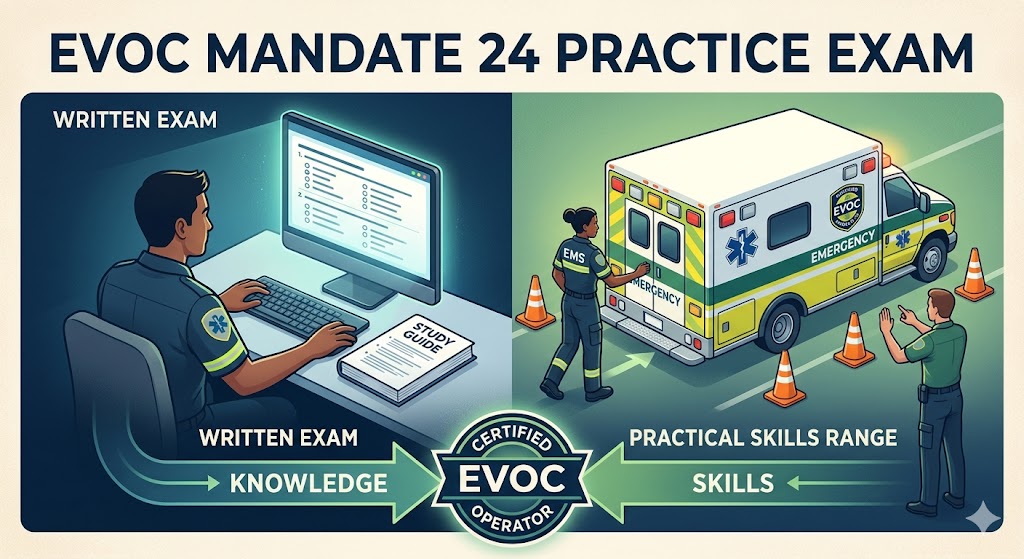
Additional Information
What the Course Entails and Exam Details
A typical EVOC Mandate 24 course covers a comprehensive range of critical topics for emergency vehicle operation.
It begins with the legal aspects, detailing state laws, organizational policies, and the concept of "due regard" for public safety while operating under emergency conditions.
The core curriculum includes:
Vehicle Inspection and Maintenance: Procedures for daily checks to ensure operational readiness.
Physics of Driving: Understanding weight transfer, centrifugal force, braking distances, and vehicle dynamics.
Defensive Driving and Collision Avoidance: Techniques for anticipating hazards and preventing accidents.
Intersections and Right-of-Way: Specialized strategies for managing the most dangerous part of emergency response.
Backing and Spotting: Proper procedures for moving a vehicle in reverse, including the use of hand signals and spotters.
Emergency and Non-Emergency Mode: Differentiating rules of operation and appropriate use of lights and sirens.
Special Situations: Driving in inclement weather, navigation, and radio communication protocols.
What to Expect in the Final Exam
The final EVOC Mandate 24 exam is almost universally split into two distinct components: a written examination and a practical skills evaluation.
Students must successfully pass both sections to receive their certification.
Written Examination: This part usually consists of 50 to 100 multiple-choice or true/false questions derived directly from the classroom modules and training manual.
It covers all conceptual aspects, including legal definitions, defensive driving principles, and vehicle knowledge.
The time limit for the written portion is generally between 60 and 90 minutes.
A passing score typically requires achieving 70% or 80%.
Practical Skills Evaluation: The second component is a hands-on driving test on a controlled range.
Under the supervision of an accredited instructor, students must demonstrate proficiency in executing specific maneuvers, including backing into a spot, parallel parking, maneuvering through a serpentine course, controlling intersections, and potentially controlled braking.
This section is often scored on a pass/fail basis for each maneuver, with the instructor evaluating control, safety, and adherence to established techniques.
How to Study and Exam Centers
Preparation for the EVOC Mandate 24 requires a mix of conceptual study and physical skill practice.
Effective Study Strategies:
Review the Manual: The foundational training manual provided by your agency or course is your single best source.
Take Practice Tests: Utilizing practice exams, like this one, is crucial for simulating the exam experience, identifying knowledge gaps, and familiarizing yourself with the types of questions asked.
Form Study Groups: Collaborating with colleagues to review key concepts can be highly effective.
Focus on High-Risk Topics: Pay extra attention to the sections on intersections, backing, and the legal aspects of "due regard."
Visualize the Course: Rehearse the practical skills in your mind, visualizing the steps for each maneuver and the required hand signals.
Where to Take the Exam: The EVOC Mandate 24 exam is rarely an independent test. It is the culmination of a mandatory course.
The written and practical exams are usually administered directly by the training entity that provided the course.
These can include physical testing centers at:
Authorized State and Regional Emergency Services Training Academies
Accredited Community Colleges and Technical Schools
Fire Department, EMS agency, or Law Enforcement Training facilities.
Some specialized online portals may host the written portion, but a physical driving range is always required for the practical skills evaluation.
Job Opportunities from the Course
Successful completion of an EVOC Mandate 24 course is a key qualification, and often an absolute requirement, for various critical roles in public safety and emergency services.
This certification unlocks career paths in multiple fields.
Job Roles and Career Paths:
Emergency Medical Technician (EMT)
Paramedic
Ambulance Driver/Attendant
Firefighter (all ranks requiring vehicle operation)
Fire apparatus Operator / Engineer
Law Enforcement Officer (Police, Sheriff, State Trooper)
Private Ambulance Transport Driver
Critical Care Transport Driver
Special Operations Vehicle Operator (e.g., Hazmat, Search & Rescue)
EVOC Instructor (with additional experience and certification)
Frequently Asked Questions
Reviews
5.0
Based on 0 reviews
Leave a Review
No reviews yet. Be the first to review!