
Expert Field Medical Badge (EFMB) Practice Test
$69.00
- Buy to unlock unlimited access to all Quiz questions and Answers in this Quiz.
- After purchase you can print a PDF of the whole quiz at any point. The PDF will contain the questions and the correct answers.
About this Exam
The Expert Field Medical Badge (EFMB) is widely recognized as one of the most prestigious and challenging special skill badges in the United States Army.
It is meticulously designed for military medical personnel who wish to demonstrate exceptional professional competence and physical endurance.
Earning this badge signifies that a soldier has mastered both tactical operations and elite medical proficiency under incredibly grueling field conditions.
This certification is the ultimate mark of excellence aimed at combat medics, medical officers, and other dedicated healthcare professionals serving in the armed forces.
Ready to test your knowledge?
Buy Now to Access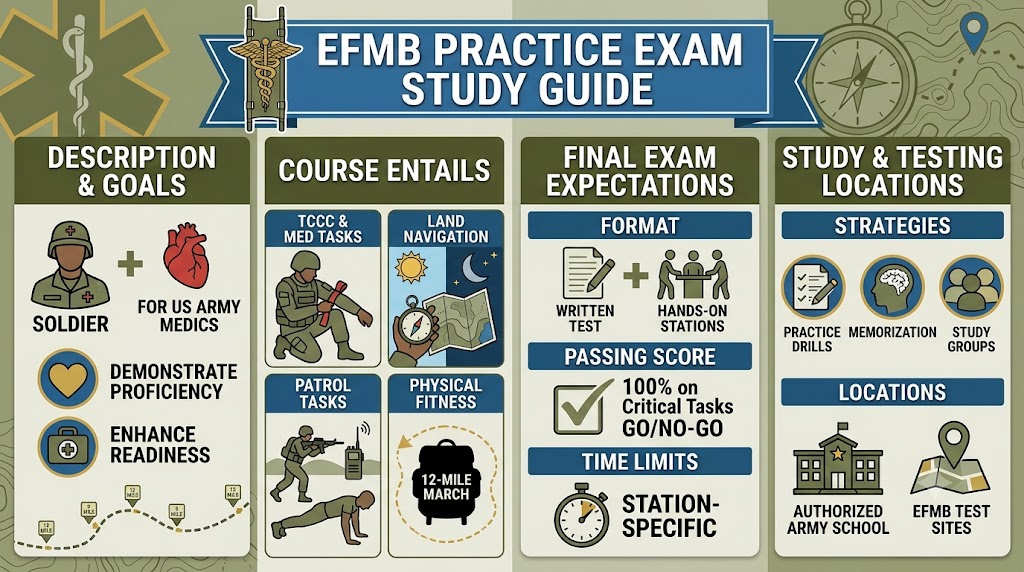
Additional Information
What the Course Entails and Exam Details
The EFMB testing process is a rigorous, multi-day event that systematically pushes candidates to their physical and mental limits.
The core curriculum focuses heavily on Tactical Combat Casualty Care (TCCC), requiring candidates to perform life-saving interventions flawlessly under simulated combat stress.
You will be extensively tested on a wide array of critical skills, including tactical evacuation procedures, military communication, and chemical, biological, radiological, and nuclear (CBRN) defense operations.
Furthermore, the course demands high-level proficiency in both day and night land navigation across challenging terrain.
Warriors must also condition themselves to complete a highly demanding 12-mile forced ruck march while carrying standard fighting gear and a weapon.
What to Expect in the Final Exam
The EFMB is not a standard written exam, but rather an intense physical and practical evaluation spanning several consecutive days.
Candidates typically begin with a comprehensive written test consisting of multiple-choice questions covering medical protocols, tactical doctrine, and basic soldier skills.
You must achieve a passing score of at least 75 percent on this written portion to advance to the field events.
Following the written test, soldiers must navigate physical fitness assessments and complete complex combat testing lanes (CTLs).
In these specialized lanes, evaluators grade your ability to execute tasks perfectly according to strict Army standards, and any critical failure results in immediate elimination.
The final hurdle of the examination is the legendary 12-mile ruck march, which must be completed within a strict three-hour time limit.
How to Study and Exam Centers
Success in the EFMB requires months of dedicated physical conditioning combined with intense academic study.
You should start by thoroughly reviewing the current Army regulations, specifically AMEDD Pamphlet 350-10, and actively practicing TCCC algorithms until they become absolute muscle memory.
It is highly recommended to form study groups with fellow candidates to conduct mock combat testing lanes and peer-review your hands-on techniques.
As for the testing location, the EFMB is hosted by various Army installations globally, rather than commercial testing centers like Pearson VUE.
Military units typically host these specialized testing events once or twice a year on active bases.
You must coordinate directly with your unit's chain of command to secure a testing slot and receive official deployment orders to the specific testing site.
Job Opportunities from the Course
While the EFMB is officially a military badge rather than a civilian certification, it significantly accelerates career progression and opens elite doors within the armed forces.
Holding this badge proves your exceptional leadership, technical expertise, and resilience, making you highly competitive for promotions and advanced assignments.
Earning this badge unlocks or enhances the following career paths:
Senior Combat Medic Instructor
Platoon Sergeant or First Sergeant in specialized medical units
Special Operations Medical Support personnel
Advanced Tactical Healthcare Administrator
Military Medical Treatment Facility Leader
Elite Field Operations Coordinator
Frequently Asked Questions
Reviews
5.0
Based on 0 reviews
Leave a Review
No reviews yet. Be the first to review!