
Explorer Ride Practice Test
$69.00
- Buy to unlock unlimited access to all Quiz questions and Answers in this Quiz.
- After purchase you can print a PDF of the whole quiz at any point. The PDF will contain the questions and the correct answers.
About this Exam
The Explorer Ride certification is a preparatory program designed for aspiring motorcycle riders, providing a critical foundation of knowledge and skills before they attempt their state-level licensing exams. This program is ideal for individuals who are new to riding or those looking to formalize their understanding of safe motorcycle operation and traffic laws. It is designed to bridge the gap between initial interest and confident, licensed riding. The associated practice test allows candidates to evaluate their readiness in a low-stakes environment, mimicking the conditions of the final comprehensive evaluation.
Ready to test your knowledge?
Buy Now to Access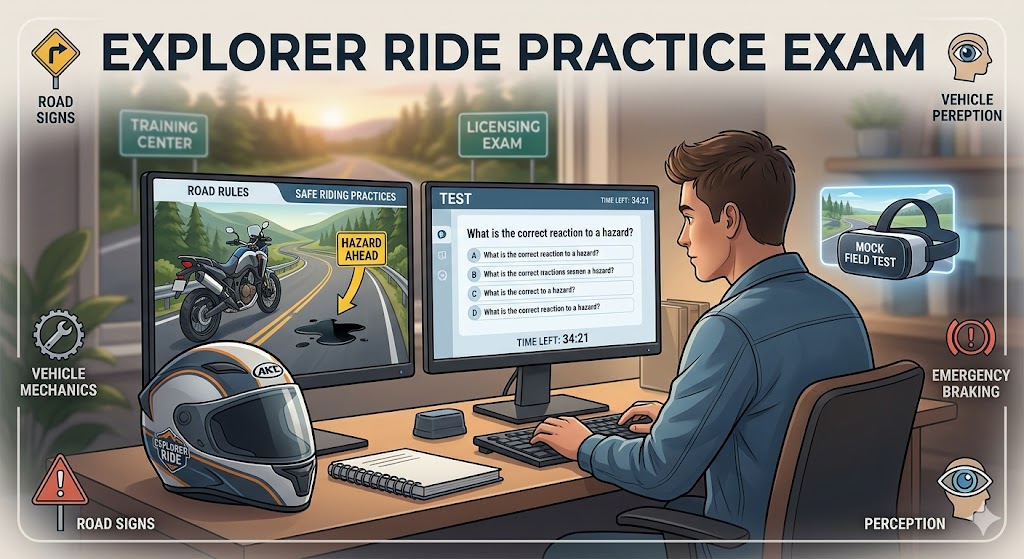
Additional Information
What the Course Entails and Exam Details
The Explorer Ride course covers a wide array of topics crucial for a safe and responsible riding career. It is structured into comprehensive modules that include, but are not limited to:
Motorcycle Controls and Operations: Understanding the layout, function, and proper use of all essential controls (throttle, clutch, front/rear brakes, gear selector, etc.).
Basic Riding Skills: Techniques for starting, stopping, turning, and slow-speed maneuvers.
Safe Riding Practices: Developing essential defensive riding strategies, including lane positioning, following distance, and the "SEE" strategy (Search, Evaluate, Execute).
Rules of the Road and Traffic Laws: Detailed knowledge of traffic signs, signals, right-of-way rules, and motorcycle-specific laws in your jurisdiction.
Hazard Perception and Avoidance: Identifying and responding effectively to common road hazards such as oil slicks, sand, potholes, and other vehicles.
Vehicle Mechanics and Maintenance: A foundational understanding of basic pre-ride inspections (T-CLOCS) and routine maintenance.
Rider Protective Gear: Identifying and understanding the importance of proper safety equipment, including helmets, jackets, gloves, pants, and boots.
What to Expect in the Final Exam
The comprehensive final exam for the Explorer Ride program is typically a two-part process:
Written Knowledge Test: This section is typically a multiple-choice format, often administered on a computer. It evaluates a candidate's understanding of all theoretical concepts, including rules of the road, safe riding principles, and vehicle operation. The exam usually consists of 50 to 100 questions. To pass, a candidate must typically achieve a score of 80% or higher. There is often a time limit, ranging from 60 to 90 minutes.
Practical Skills Evaluation (Field Test): Successful completion of the written test is a prerequisite for the practical exam. This evaluation is conducted on a closed course under the supervision of a certified instructor. It tests a candidate’s ability to perform essential physical skills, including a figured-eight turn, controlled braking, counter-steering, and hazard avoidance. Each skill is scored on a points system, with deductions for errors. Candidates must achieve a cumulative passing score, often 80% or better, and must not commit any critical, automatic-fail errors, such as dropping the motorcycle.
Specific rules, such as what to bring (e.g., ID, proper riding gear) and cancellation policies, are provided by the testing center or course administrator.
How to Study and Exam Centers
Preparation is key to success on both parts of the Explorer Ride evaluation. We recommend a multi-faceted approach:
Utilize the Practice Test: The core of your study plan should be taking mock versions of the exam. This helps familiarize you with the question style, identifies knowledge gaps, and improves time management. Use multiple, reputable practice tests to ensure a broad review.
Review Official Course Material: If you enrolled in an Explorer Ride course, thoroughly review all provided materials, including handbooks, video modules, and lecture notes.
Simulate the Practical Test: Find a safe, open area to practice the low-speed maneuvers. Mark the course if possible, following the dimensions of the actual field test. Practicing control and balance is vital.
Form Study Groups: Collaborating with other students can provide diverse perspectives and help clarify complex topics.
Connect with a Mentor: Seek advice from experienced riders who can provide practical tips and real-world insights.
Where to Take the Exam
The Explorer Ride practice test is typically taken online, either on the course provider’s proprietary platform or through authorized testing portals.
The final written and practical exams are usually administered by:
Certified Riding Schools: The vast majority of comprehensive rider education programs administer their own final licensing tests at their facilities.
Authorized Community Colleges: Many educational institutions partner with licensing agencies to offer motorcycle safety courses and testing.
Department of Motor Vehicles (DMV) or Equivalent: While the specific "Explorer Ride" program might be a private initiative, it is designed to align with and prepare candidates for the official tests held at public licensing centers. Check your local regulations to see which certifications they accept.
Job Opportunities from the Course
While the primary function of the Explorer Ride certification is preparatory, completing this comprehensive training unlocks a variety of starting points in the motorcycle and transportation sectors. This certification demonstrates a verified level of foundational knowledge and safe practical skills, giving you a competitive advantage. The specific career paths include:
Motorcycle Delivery Rider
Last-Mile Courier
Entry-Level Fleet Dispatcher
Motorcycle Safety Course Assistant
Motorcycle Tour Guide Apprentice
Motorcycle Dealership Support (Sales/Service Assistant)
Fleet Maintenance Technician (Foundational Knowledge)
Frequently Asked Questions
Reviews
5.0
Based on 0 reviews
Leave a Review
No reviews yet. Be the first to review!