
Extinguisher Technician – Portable Fire Extinguishers (TFM02) Practice Test
$69.00
- Buy to unlock unlimited access to all Quiz questions and Answers in this Quiz.
- After purchase you can print a PDF of the whole quiz at any point. The PDF will contain the questions and the correct answers.
About this Exam
The Portable Fire Extinguisher Technician (TFM02) certification is a crucial credential for individuals seeking to work in the fire protection industry, specifically focusing on the inspection, maintenance, recharging, and testing of portable fire extinguishers.
This certification, often mandated by state fire marshal offices, validates that a technician possesses the necessary knowledge and skills to ensure fire extinguishers are reliable and fully operational.
It is designed for fire protection company employees, safety inspectors, facility maintenance personnel, and anyone looking to start a career as a certified fire extinguisher technician.
Ready to test your knowledge?
Buy Now to Access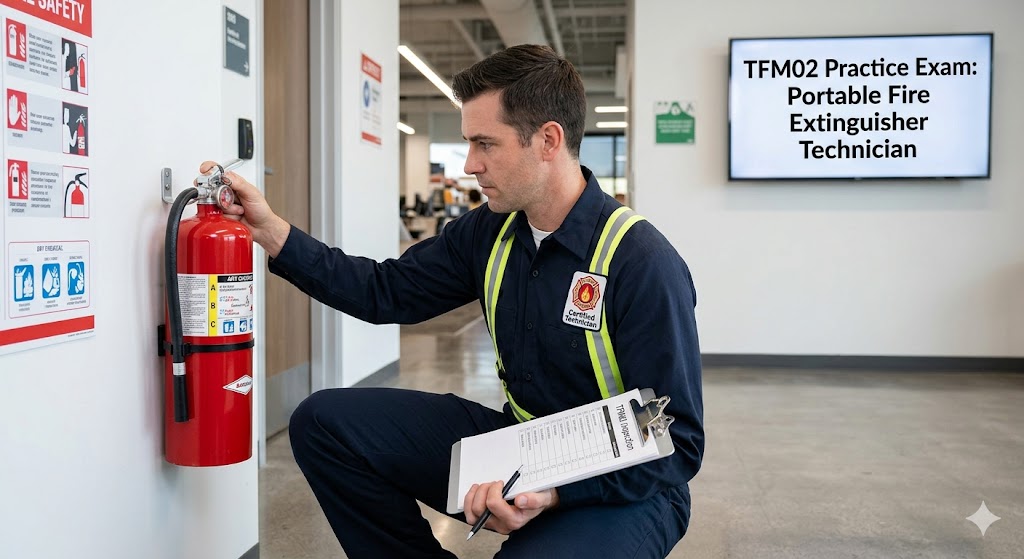
Additional Information
What the Course Entails and Exam Details
The TFM02 course and exam are typically based heavily on industry standards, most notably NFPA 10: Standard for Portable Fire Extinguishers.
The exam covers a wide range of essential topics, including:
Understanding Fire Classifications: Deep knowledge of Class A, B, C, D, and K fires and the appropriate extinguishing agents for each.
Types of Fire Extinguishers: Detailed understanding of the operation and components of stored-pressure, cartridge-operated, and wheeled fire extinguishers.
Installation and Placement: Rules for determining the correct type, size, distribution, and mounting of extinguishers within a building.
Inspection Procedures: Mastering the steps for quick monthly visual inspections to ensure extinguishers are in place and undamaged.
Maintenance and Recharging: In-depth knowledge of detailed annual maintenance processes, including when and how to recharge extinguishers after use or during required intervals.
Hydrostatic Testing: Understanding the safety regulations and procedures for pressure testing extinguisher cylinders.
Record Keeping and Tagging: Proper documentation required by local jurisdictions and safety codes.
What to Expect in the Final Exam
The final TFM02 examination is designed to rigorously assess a candidate's competency. While the exact format can vary slightly by the testing jurisdiction, candidates should generally expect the following:
Format: The exam is typically composed of multiple-choice questions. It is a closed-book exam.
Passing Score: A strong understanding of the material is required. Passing scores are usually 70% or higher.
Time Limit: There is typically a strict time limit (often between 1 and 2 hours) to complete the exam.
Content Focus: A significant portion of the questions will refer directly to specific sections of the NFPA 10 standard and relevant state-specific fire safety codes.
Candidates are typically required to register in advance and may need to provide proof of required training or experience, depending on the state’s licensing board.
How to Study and Exam Centers
Success on the TFM02 exam requires a dedicated study plan combining theoretical knowledge and practical application.
Actionable Study Strategies:
Master NFPA 10: This is the absolute core of the exam. Obtain a copy of the most current edition of NFPA 10 and study it thoroughly. Focus on definitions, inspection timelines, and maintenance requirements.
Utilize Practice Tests: Taking multiple-choice practice exams is one of the most effective ways to prepare. This helps you get used to the question format, identify your knowledge gaps, and practice under time constraints.
Enroll in a Prep Course: Many private training companies and some community colleges offer TFM02 preparation courses. These provide invaluable instruction and structured study materials.
Get Hands-on Experience: If you are already employed in the industry, ask a certified technician to walk you through maintenance and inspection procedures. Applying the concepts visually is crucial for retention.
Exam Centers:
TFM02 exams are often administered by the state fire marshal's office directly or through an approved third-party testing service. Common methods for scheduling and taking the exam include:
State Fire Marshal Testing Portals: Many states have online systems for application and scheduling.
Authorized Training Schools: Schools that offer the certification course are often authorized testing sites.
Pearson VUE: Some state licensing boards contract with national testing centers like Pearson VUE to administer the computer-based exams.
Be sure to check the specific licensing requirements for the state where you intend to work.
Job Opportunities from the Course
Obtaining the TFM02 certification is a clear signal to employers that you are qualified and committed to the profession. It opens doors to several career paths within the fire and life safety industry, including:
Certified Fire Extinguisher Technician: The primary role, focusing on servicing, inspecting, and maintaining portable extinguishers for a fire protection company.
Fire Protection Equipment Inspector: Inspecting various fire safety systems, including extinguishers, for compliance in commercial buildings.
Facility Safety Coordinator/Manager: Overseas safety protocols, including fire protection, for an organization or manufacturing facility.
Fire Suppression Systems Technician: A broader role that often requires additional certifications to service fixed suppression systems as well.
Life Safety Sales Representative: Utilizing technical knowledge to sell fire protection services and equipment to commercial clients.
Frequently Asked Questions
Reviews
5.0
Based on 0 reviews
Leave a Review
No reviews yet. Be the first to review!