
Extremities – Knee Practice Test
$69.00
- Buy to unlock unlimited access to all Quiz questions and Answers in this Quiz.
- After purchase you can print a PDF of the whole quiz at any point. The PDF will contain the questions and the correct answers.
About this Exam
Welcome to your essential preparation resource for the Extremities – Knee Practice Exam. This practice exam is expertly designed for students and professionals pursuing certifications in fields such as Sports Medicine, Physical Therapy, Athletic Training, and Orthopedic Technology. It serves as a critical benchmarking tool to assess your readiness for official licensing or certification exams that require specialized knowledge of the human knee complex. This test evaluates your understanding of anatomy, common pathologies, diagnostic procedures, and therapeutic interventions for the knee.
Ready to test your knowledge?
Buy Now to Access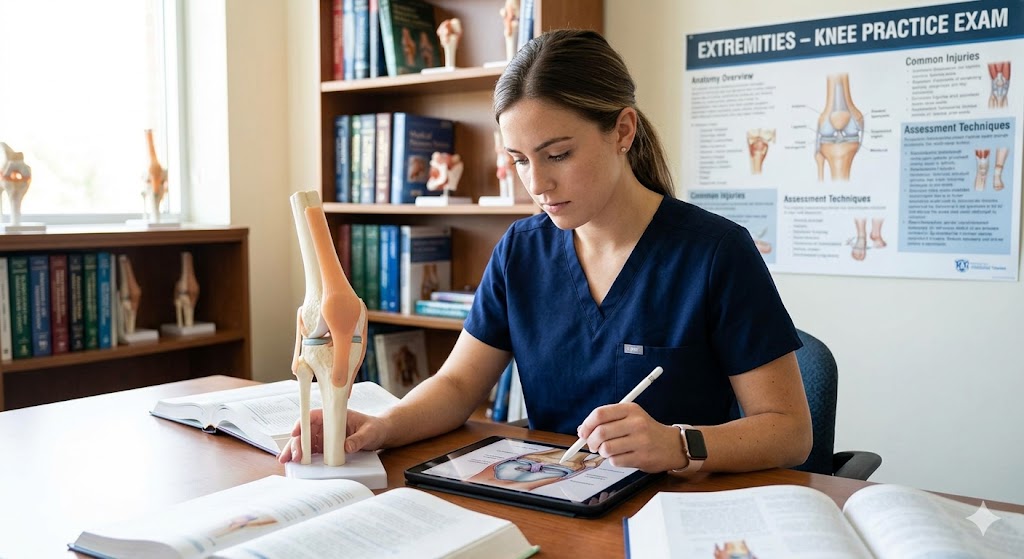
Additional Information
What the Course Entails and Exam Details
Preparing for this exam requires a deep dive into the musculoskeletal structure and function of the knee joint. The curriculum and practice questions cover a broad spectrum of critical topics to ensure comprehensive competency. Key areas include:
Detailed Anatomy: Master the bones (femur, tibia, patella), ligaments (ACL, PCL, MCL, LCL), menisci, and musculature governing knee movement.
Biomechanics and Kinesiology: Understand the normal mechanics of the knee, including gait cycle involvement and joint reaction forces.
Common Injuries and Pathologies: Identify mechanisms of injury, symptoms, and presentation for conditions like ligament tears, meniscal injuries, patellofemoral pain syndrome, and osteoarthritis.
Special Tests and Assessment: Learn to perform and interpret orthopedic special tests (e.g., Lachman, McMurray, Valgus/Varus stress tests).
Treatment and Rehabilitation: Understand standard protocols for both conservative management and post-surgical rehabilitation.
What to Expect in the Final Exam
This practice exam is structured to closely mimic the format and rigor of official certification tests. It consists typically of 50 to 100 multiple-choice questions, challenging your recall of factual knowledge and your ability to apply concepts to clinical scenarios. While a practice test may not have a formal time limit, we recommend timing yourself (allowing approximately 60-90 seconds per question) to simulate real test-taking conditions. A passing score of 75% or higher on this practice exam generally indicates a strong readiness for the formal certification.
How to Study and Exam Centers
Effective preparation requires a mix of rote learning and practical application. We suggest using a three-pronged approach:
Utilize Visual Aids: Study dynamic 3D anatomy models and detailed diagrams to visualize structures and injury mechanisms.
Take Multiple Practice Tests: Do not just take this test once. Use practice exams repeatedly to identify weak areas and track your progress.
Review Rationales: Carefully read the explanation for every question you answer, both correct and incorrect. The reasoning is often more valuable than the answer itself.
This practice test is an online resource accessible from anywhere, and does not require going to a physical testing center. However, official certification exams often utilize platforms like Pearson VUE or are hosted at authorized academic institutions.
Job Opportunities from the Course
Successfully mastering the content required for this exam and subsequent certification opens doors to several rewarding career paths in healthcare and sports science. Potential job opportunities include:
Certified Athletic Trainer (ATC): Providing preventative care, emergency care, and rehabilitation for athletes at schools, colleges, or professional teams.
Physical Therapist Assistant (PTA): Working under the direction of a Physical Therapist to help patients recover from knee injuries or surgeries.
Orthopedic Physician Assistant (PA-C): Assessing and treating patients with musculoskeletal conditions in an orthopedic clinic or hospital setting.
Orthopedic Technologist: Assisting orthopedic surgeons in applying casts, splints, and braces, and preparing patients for surgery.
Exercise Physiologist: Developing fitness and rehabilitation programs that consider specific joint health and injury history.
Frequently Asked Questions
Reviews
5.0
Based on 0 reviews
Leave a Review
No reviews yet. Be the first to review!