
F‑Gas Certification Practice Exam
$69.00
- Buy to unlock unlimited access to all Quiz questions and Answers in this Quiz.
- After purchase you can print a PDF of the whole quiz at any point. The PDF will contain the questions and the correct answers.
About this Exam
The F-Gas Certification is a mandatory legal requirement for all personnel and companies involved in the installation, maintenance, servicing, repair, or decommissioning of stationary equipment containing fluorinated greenhouse gases (F-gases). These gases, primarily used as refrigerants in Refrigeration, Air Conditioning, and Heat Pump (RACHP) systems, are potent greenhouse gases, and their handling is strictly regulated under EU and UK legislation (such as Regulation (EU) No. 517/2014).
This certification is designed for technicians, engineers, and apprentices who work directly with these systems. It provides proof of competence, ensuring they can perform their tasks safely, efficiently, and in an environmentally responsible manner to prevent harmful leaks and emissions.
Ready to test your knowledge?
Buy Now to Access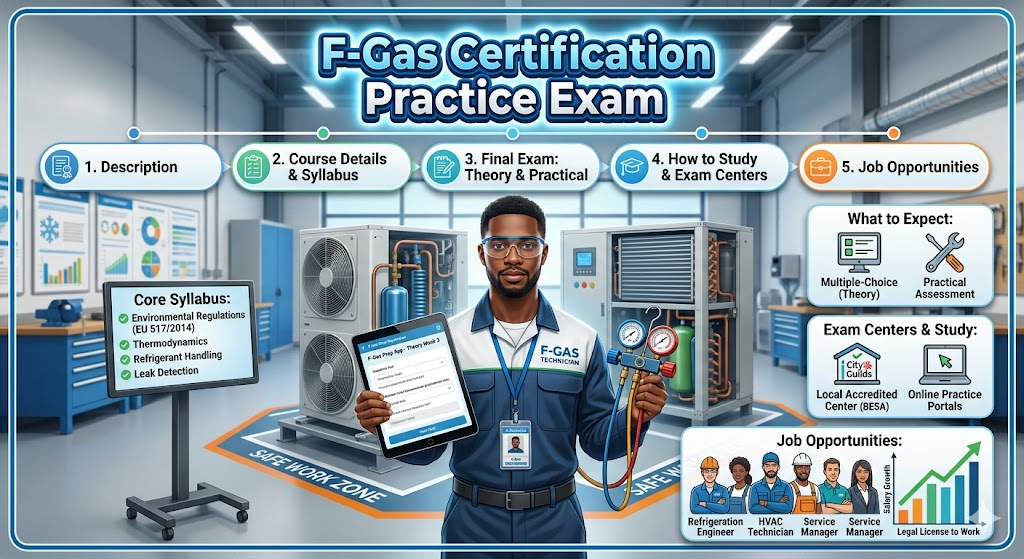
Additional Information
What the Course Entails and Exam Details
The training course preparing you for the F-Gas Certification typically covers a combination of theoretical knowledge and practical skills. The core curriculum is structured around several key skill groups, which may vary slightly depending on the specific category (I, II, III, or IV) but generally include:
Environmental Impact and Regulations: Detailed understanding of the F-Gas Regulation, ozone depletion, Global Warming Potential (GWP), and phase-down schedules.
Thermodynamics and Refrigeration Cycle: Fundamental principles of physics relevant to the refrigeration cycle, pressure-temperature relationships, and system components.
Refrigerant Handling and Recovery: Procedures for charging, recovering, recycling, and reclaiming refrigerants to prevent release into the atmosphere.
System Installation and Maintenance: Best practices for installing pipework, connecting components, and performing routine maintenance.
Leak Detection and Checks: Mandatory checking frequencies, indirect and direct leak detection methods, and proper record-keeping.
Component Familiarity: Detailed function and maintenance of compressors, condensers, evaporators, and expansion devices.
Health and Safety: Specific hazards associated with refrigerants, proper use of personal protective equipment (PPE), and cylinder safety.
The exam itself is typically split into two main components that must be passed independently to gain the certification.
What to Expect in the Final Exam
The F-Gas Certification exam is a comprehensive assessment that tests both your theoretical understanding and hands-on capability.
Theory Examination
Format: A multiple-choice, computer-based exam.
Topics: Questions cover all areas of the syllabus, including regulation specifics, calculation of charge limits, environmental science, and safe working practices.
Time Limit and Passing Score: These are set by the specific awarding body (e.g., City & Guilds, BESA, LCL Awards). For example, a passing score of around 60-70% within a 60 to 90-minute time limit is common.
Practical Assessment
Format: A hands-on test in a controlled workshop environment, observed by an assessor.
Tasks: You must demonstrate a range of skills, such as:
Identifying a system and its type.
Using a gauge manifold and interpreting readings.
Recovering refrigerant safely into a recovery cylinder.
Pressure testing a system using Oxygen-Free Nitrogen (OFN).
Vacuum pumping and dehydration of a system.
Brazing joints (often on a test piece).
Identifying and repairing simulated leaks.
Passing Score and Specific Rules: You must perform all key tasks without committing "critical failures" which could endanger yourself, others, or release refrigerant. Every awarding body has a specific checklist of competent actions.
How to Study and Exam Centers
A balanced approach of theoretical study and practical practice is key to passing.
Actionable Study Strategies:
Utilize a Study Guide: A structured companion can break down complex topics and focus on the exam objectives.
Engage with Practice Exams: Use online platforms and apps that offer F-Gas Certification Practice Exams with detailed explanations. This will familiarize you with the wording of multiple-choice questions and identify your weak points.
Focus on the Core Regulations: Understand the requirements of the 517/2014 regulation and subsequent amendments, particularly concerning record keeping and leak checks.
Attend a Prep Course: Most technicians attend a 2 to 5-day training course that includes both classroom learning and workshop practice just before the exam.
Exam Centers and Registration:
The F-Gas exam, especially the practical component, must be taken at an authorized training and assessment center. You cannot take the practical exam online.
In the UK and EU, these centers are accredited by bodies like BESA Academy, City & Guilds, LCL Awards, and CITB.
You can find a local center through their websites or through trade registration bodies like REFCOM. These centers will provide the training and then schedule your assessment, which typically takes place at their own physical facilities.
Job Opportunities from the Course
Obtaining your F-Gas Certification is a legal "ticket to work" that opens the door to a wide range of essential and well-paid roles within the building engineering services sector.
Specific Job Titles unlocked by this qualification include:
Refrigeration Engineer
Air Conditioning Engineer
HVAC Engineer (Heating, Ventilation, and Air Conditioning)
Commercial Gas Engineer (with appropriate additional Gas Safe qualification)
Industrial Gas & Refrigeration Engineer
Facilities Management Engineer
Maintenance Technician
Service and Commissioning Engineer
HVAC/Refrigeration Service Manager
This certification is not just a regulatory hurdle; it is a vital investment in your professional future, validating your skills to employers and clients alike in a industry focused on sustainability and efficiency.
Frequently Asked Questions
Reviews
5.0
Based on 0 reviews
Leave a Review
No reviews yet. Be the first to review!