
FAA Academy Basics Practice Exam
$69.00
- Buy to unlock unlimited access to all Quiz questions and Answers in this Quiz.
- After purchase you can print a PDF of the whole quiz at any point. The PDF will contain the questions and the correct answers.
About this Exam
The FAA Academy Basics course is the fundamental prerequisite for anyone beginning their journey to become an FAA Air Traffic Control Specialist. It is the first critical phase of training held at the Mike Monroney Aeronautical Center in Oklahoma City. This intensive program is designed for newly hired air traffic controller trainees who have been competitively selected to join the FAA. It provides the essential foundational knowledge of the aviation industry, the Federal Aviation Administration's mission, and the preliminary rules of the air, setting the stage for specialized, high-stakes training.
Ready to test your knowledge?
Buy Now to Access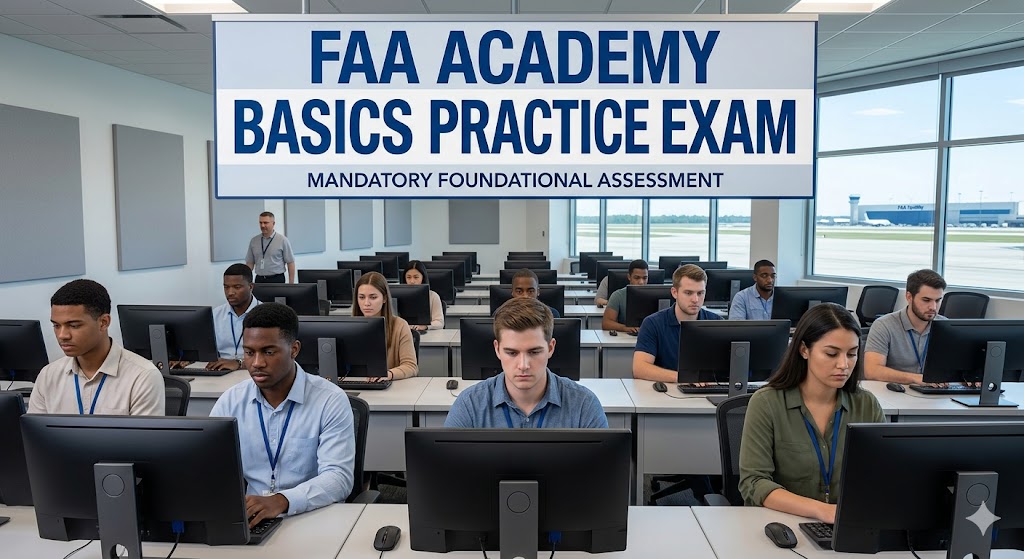
Additional Information
What the Course Entails and Exam Details
The FAA Academy Basics course, often simply called "Basics," typically spans 19 days of intensive instruction. It covers a broad spectrum of fundamental concepts crucial for all aspects of air traffic control, regardless of future specialization (Terminal Tower, Terminal Radar, or En Route). Trainees are immersed in topics such as the National Airspace System (NAS), the roles and responsibilities of different ATC facilities, visual and instrument flight rules (VFR and IFR), basic aircraft identification, and airport operations, including markings, signs, and lighting. The curriculum also introduces trainees to critical human factors in aviation and the basic principles of non-radar separation. This comprehensive knowledge base is not just academic; it is the building block for the specialized practical skills developed in the subsequent phases of the Academy.
What to Expect in the Final Exam
The culmination of the 19-day course is the end-of-course FAA Academy Basics Examination. This is a high-pressure, comprehensive test, usually delivered via a computer-based format. The exam consists primarily of multiple-choice questions designed to evaluate a trainee's understanding and recall of the core aviation principles taught during the course. Trainees must demonstrate a decisive grasp of regulations and procedures. Crucially, this is a "must-pass" exam. A score of 70 percent or better is required to pass. Failing to achieve the passing score results in the trainee's immediate termination of employment with the FAA, underscoring the serious nature of this initial filter. Successful candidates are cleared to advance to their specific initial qualification training track.
How to Study and Exam Centers
Studying for the FAA Academy Basics Exam requires discipline and immersive focus. Since this is an internal, paid training program, the primary study material is the comprehensive FAA Academy material provided to you upon arrival. Pay close attention in every class, take detailed notes, and utilize any provided student handouts and interactive exercises. Forming study groups with fellow trainees is highly recommended; explaining concepts to others is an excellent way to reinforce your own understanding. Review FAA Order 7110.65, "Air Traffic Control," as this is the "bible" of air traffic rules and procedures.
While the exact final exam is internal, the best preparation is to simulate the testing environment by creating your own practice tests using the study material and focusing on accuracy under a time limit.
The final exam is not taken at public testing centers like Pearson VUE. It is administered directly at the FAA Academy within the Mike Monroney Aeronautical Center complex in Oklahoma City. You will be scheduled for your exam as part of your initial training itinerary.
Job Opportunities from the Course
The FAA Academy Basics course is a gateway, not a final destination. Its primary purpose is to filter and prepare candidates for a specific career path. Successful completion opens the door to:
Air Traffic Control Specialist (Trainee) – Advanced Training in Terminal Tower
Air Traffic Control Specialist (Trainee) – Advanced Training in Terminal Radar Approach Control (TRACON)
Air Traffic Control Specialist (Trainee) – Advanced Training in En Route (Air Route Traffic Control Center)
Frequently Asked Questions
Reviews
5.0
Based on 0 reviews
Leave a Review
No reviews yet. Be the first to review!