
FAA Aircraft Dispatcher Practice Exam
$69.00
- Buy to unlock unlimited access to all Quiz questions and Answers in this Quiz.
- After purchase you can print a PDF of the whole quiz at any point. The PDF will contain the questions and the correct answers.
About this Exam
The FAA Aircraft Dispatcher certification is a high-stakes credential for individuals seeking a critical role in the aviation industry. An Aircraft Dispatcher shares joint responsibility with the pilot in command for the safety and operational control of a flight. These professionals must accurately assess weather, plan routes, calculate fuel, and manage weight and balance, ensuring every flight adheres to rigorous federal regulations. This certification is designed for detail-oriented, analytical thinkers who can thrive in a fast-paced, high-pressure operations center environment. It is a cornerstone for a career in airline operations and a required qualification for the position of aircraft dispatcher at any U.S.-certified air carrier.
Ready to test your knowledge?
Buy Now to Access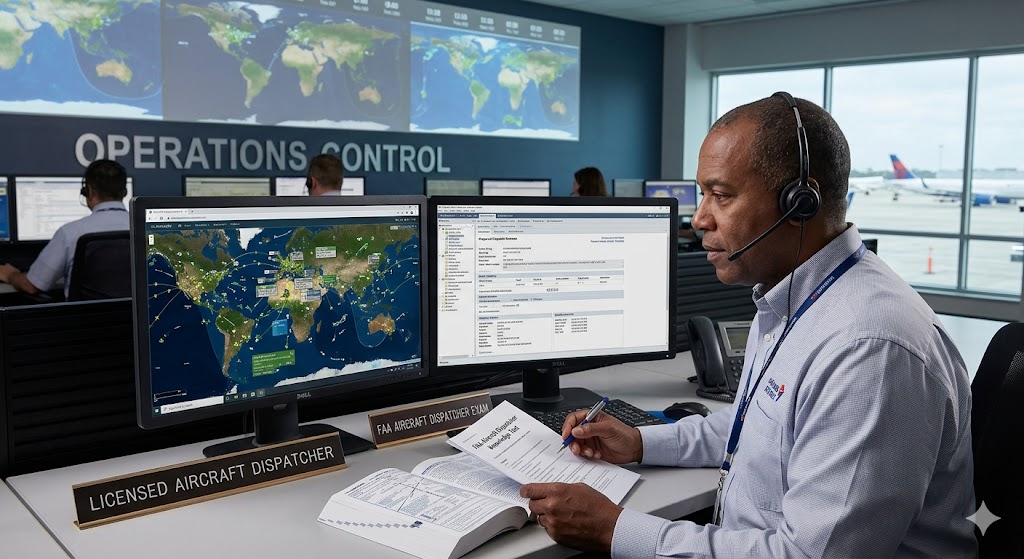
Additional Information
What the Course Entails and Exam Details
To earn the certificate, you must complete a comprehensive FAA-approved Aircraft Dispatcher training course, which requires a minimum of 200 hours of instruction. This rigorous program covers a diverse syllabus, combining advanced theoretical knowledge with practical skills. You will study Federal Aviation Regulations (14 CFR Parts 1, 61, 71, 91, and 121), advanced meteorology, and air navigation using Jeppesen charts and instrument procedures. Additional core topics include aircraft systems, performance data interpretation, weight and balance calculations, and Crew Resource Management (CRM). The process culminates in two distinct evaluations: the FAA Aircraft Dispatcher Knowledge Test and the FAA Aircraft Dispatcher Practical Test. While you can take the written knowledge test at age 21, you must be 23 to hold the actual certificate.
What to Expect in the Final Exam
The final exam process for the FAA Aircraft Dispatcher certificate is in two parts, and both require diligent preparation with practice exams. The first part is the Knowledge Test, which is a computer-based, multiple-choice exam. You will be tested on a broad range of subjects derived from the course syllabus, including weather theory, navigation calculations, and regulatory requirements. The passing score for this test is 70%. The second, and often more demanding, part is the Practical Test. This is an all-day, face-to-face evaluation with an FAA Designated Aircraft Dispatcher Examiner (DADE). It consists of two components: an oral examination and a practical application exercise. The examiner will quiz you on any topic from the syllabus and then task you with creating a complete flight plan from scratch for a specific, simulated airline flight. This includes analyzing the weather, selecting a safe and efficient route, calculating fuel, managing a mechanical issue, and generating the official dispatch release. The DADE evaluates your decision-making, regulatory compliance, and ability to handle unexpected scenarios. The practical test usually lasts between four and eight hours.
How to Study and Exam Centers
Preparation for the FAA Aircraft Dispatcher certificate requires a multi-layered study strategy. First, immerse yourself in the official FAA publications, particularly the Airman Certification Standards (ACS) for Aircraft Dispatchers, which outlines exactly what you must know and do. Complete an FAA-approved training course, as the structural learning and instructor guidance are indispensable. Actively use FAA Aircraft Dispatcher practice exams to become familiar with the format of the Knowledge Test and to identify weak areas. For the Practical Test, practice complex flight planning scenarios repeatedly. Simulate the oral exam with classmates or mentors. The Knowledge Test is administered at authorized computer testing centers across the country. The Practical Test must be scheduled through an FAA-Designated Aircraft Dispatcher Examiner (DADE) and is typically conducted at the training facility or an airline operations center.
Job Opportunities from the Course
Upon earning your FAA Aircraft Dispatcher certificate, you unlock multiple career paths within the dynamic field of aviation operations. The primary and most common role is, of course, a certified Aircraft Dispatcher for a major, regional, or cargo airline. However, this qualification is highly respected and can lead to various specialized positions, including:
Flight Follower
Flight Operations Manager
International Dispatch Specialis
Crew Scheduler
Airline Station Manager
Aviation Data Analyst
FAA Aircraft Dispatcher Practice Exam Guide
Description
The FAA Aircraft Dispatcher certification is a high-stakes credential for individuals seeking a critical role in the aviation industry. An Aircraft Dispatcher shares joint responsibility with the pilot in command for the safety and operational control of a flight. These professionals must accurately assess weather, plan routes, calculate fuel, and manage weight and balance, ensuring every flight adheres to rigorous federal regulations. This certification is designed for detail-oriented, analytical thinkers who can thrive in a fast-paced, high-pressure operations center environment. It is a cornerstone for a career in airline operations and a required qualification for the position of aircraft dispatcher at any U.S.-certified air carrier.
What the Course Entails and Exam Details
To earn the certificate, you must complete a comprehensive FAA-approved Aircraft Dispatcher training course, which requires a minimum of 200 hours of instruction. This rigorous program covers a diverse syllabus, combining advanced theoretical knowledge with practical skills. You will study Federal Aviation Regulations (14 CFR Parts 1, 61, 71, 91, and 121), advanced meteorology, and air navigation using Jeppesen charts and instrument procedures. Additional core topics include aircraft systems, performance data interpretation, weight and balance calculations, and Crew Resource Management (CRM). The process culminates in two distinct evaluations: the FAA Aircraft Dispatcher Knowledge Test and the FAA Aircraft Dispatcher Practical Test. While you can take the written knowledge test at age 21, you must be 23 to hold the actual certificate.
What to Expect in the Final Exam
The final exam process for the FAA Aircraft Dispatcher certificate is in two parts, and both require diligent preparation with practice exams. The first part is the Knowledge Test, which is a computer-based, multiple-choice exam. You will be tested on a broad range of subjects derived from the course syllabus, including weather theory, navigation calculations, and regulatory requirements. The passing score for this test is 70%. The second, and often more demanding, part is the Practical Test. This is an all-day, face-to-face evaluation with an FAA Designated Aircraft Dispatcher Examiner (DADE). It consists of two components: an oral examination and a practical application exercise. The examiner will quiz you on any topic from the syllabus and then task you with creating a complete flight plan from scratch for a specific, simulated airline flight. This includes analyzing the weather, selecting a safe and efficient route, calculating fuel, managing a mechanical issue, and generating the official dispatch release. The DADE evaluates your decision-making, regulatory compliance, and ability to handle unexpected scenarios. The practical test usually lasts between four and eight hours.
How to Study and Exam Centers
Preparation for the FAA Aircraft Dispatcher certificate requires a multi-layered study strategy. First, immerse yourself in the official FAA publications, particularly the Airman Certification Standards (ACS) for Aircraft Dispatchers, which outlines exactly what you must know and do. Complete an FAA-approved training course, as the structural learning and instructor guidance are indispensable. Actively use FAA Aircraft Dispatcher practice exams to become familiar with the format of the Knowledge Test and to identify weak areas. For the Practical Test, practice complex flight planning scenarios repeatedly. Simulate the oral exam with classmates or mentors. The Knowledge Test is administered at authorized computer testing centers across the country. The Practical Test must be scheduled through an FAA-Designated Aircraft Dispatcher Examiner (DADE) and is typically conducted at the training facility or an airline operations center.
Job Opportunities from the Course
Upon earning your FAA Aircraft Dispatcher certificate, you unlock multiple career paths within the dynamic field of aviation operations. The primary and most common role is, of course, a certified Aircraft Dispatcher for a major, regional, or cargo airline. However, this qualification is highly respected and can lead to various specialized positions, including:
Flight Follower
Flight Operations Manager
International Dispatch Specialist
Crew Scheduler
Airline Station Manager
Aviation Data Analyst
Frequently Asked Questions
Reviews
5.0
Based on 0 reviews
Leave a Review
No reviews yet. Be the first to review!