
FAA Airframe Weight and Balance Practice Test
$69.00
- Buy to unlock unlimited access to all Quiz questions and Answers in this Quiz.
- After purchase you can print a PDF of the whole quiz at any point. The PDF will contain the questions and the correct answers.
About this Exam
The FAA Airframe Weight and Balance Practice Test is a critical study tool designed for aspiring aircraft mechanics, technicians, and maintenance professionals.
This practice exam specifically focuses on one of the most vital areas of aviation safety and regulatory compliance: ensuring an aircraft's weight and center of gravity are within approved limits for flight.
It is an essential resource for candidates preparing for the FAA Aviation Mechanic Airframe (AMA) knowledge test, which is required to obtain the Airframe Rating for the FAA Aviation Mechanic Certificate (often called the A&P Certificate).
Aviation maintenance students, military transition personnel, and existing mechanics seeking to enhance their knowledge will find this practice test indispensable for mastering the intricate calculations and principles of airframe weight and balance.
By simulating the actual exam environment, it helps build confidence, identify knowledge gaps, and ensure readiness for the official FAA certification process.
Ready to test your knowledge?
Buy Now to Access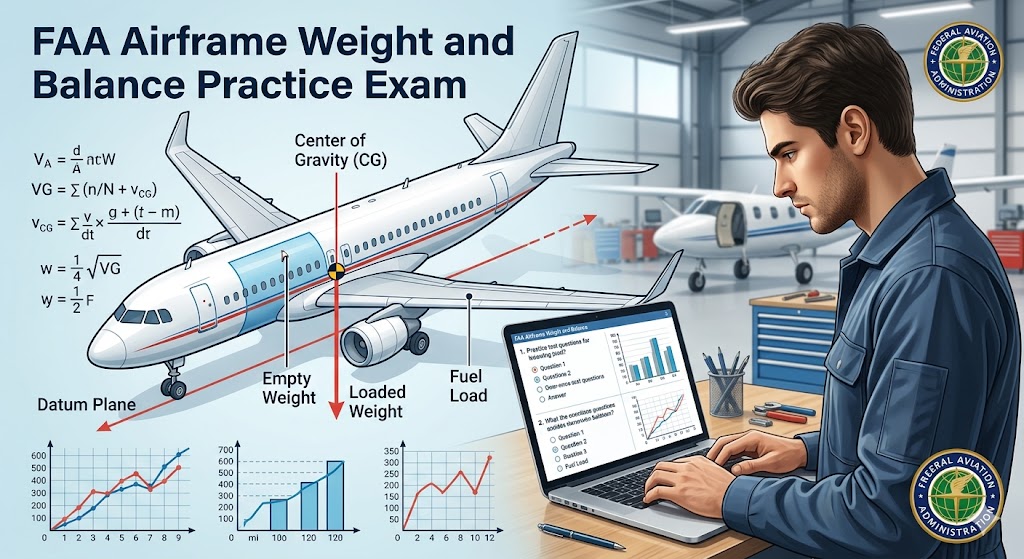
Additional Information
What the Course Entails and Exam Details
This practice exam covers the comprehensive range of topics mandated by the FAA for the Airframe knowledge area.
Candidates will delve deeply into theoretical concepts, regulatory requirements, and practical application scenarios.
Key topics include:
Weight and Balance Principles: Understanding basic terms like Datum, Arm, Moment, and Mean Aerodynamic Chord (MAC).
Calculations and Formulas: Mastering empty weight, gross weight, useful load, and center of gravity (CG) range calculations.
Aircraft Loading: Applying methods for calculating CG changes due to loading, unloading, and shifting fuel, passengers, and cargo.
Documentation and Records: Reviewing procedures for weighing an aircraft and maintaining permanent weight and balance records, including entries for repairs and alterations.
Airframe Specifics: Applying principles to fixed-wing aircraft and rotorcraft.
FAA Regulations: Understanding parts of 14 CFR related to weight and balance, such as Part 23, 25, 43, and 65.
The practice test is a representation of what is required to pass the AMA exam.
It assesses ability to solve complex problems and apply regulatory guidelines in realistic scenarios, ensuring that you are fully prepared for the safety responsibilities inherent in aircraft maintenance.
What to Expect in the Final Exam
While this is a practice test, the actual FAA Aviation Mechanic Airframe Knowledge Test has a standardized structure you must prepare for.
The official Airframe Knowledge Test (test code: AMA) consists of 100 multiple-choice questions.
You are given a maximum of 2 hours to complete the entire exam.
To pass, you must achieve a minimum score of 70%.
The official exam is administered at FAA-approved Knowledge Testing Centers (KTCs) across the United States.
You can expect questions that range from direct recall of regulations and principles to practical problem-solving that requires using diagrams, charts, and mathematical calculations provided in the official FAA-CT-8080.4G, Aviation Mechanic—General, Airframe, and Powerplant Knowledge Test Guide.
A scientific calculator (without alphanumeric memory) and specific FAA-issued figure supplements are permitted for use during the official test.
This practice exam is meticulously designed to mirror this official format, providing a realistic simulation of the time pressure and complexity you will face.
How to Study and Exam Centers
Effective preparation for the FAA Airframe Weight and Balance requirement combines theoretical study with practical application.
Here are actionable strategies to succeed:
Utilize FAA Resources: Master the content in the FAA-H-8083-1A Aircraft Weight and Balance Handbook and FAA-H-8083-30A Aviation Mechanic General Handbook. These are the primary sources of exam material.
Focus on Math: Weight and balance is heavy on mathematics. Practice calculations for Moments, Arms, and CG shifts until they are second nature. Use sample problems extensively.
Practice with Supplements: Become very familiar with the charts, graphs, and figures in the FAA-CT-8080.4G Knowledge Test Guide, as you must use these exact reference materials during the official test.
Enroll in Structured Courses: Consider utilizing training materials from authorized FAA Part 147 Aviation Maintenance Technician Schools (AMTS).
Take Multiple Practice Tests: Consistently take this practice exam and others. Analyze which specific types of problems you miss and revise those topics immediately.
Where to Take the Exam:
For this practice test, you can take it online through authorized educational platforms or simulated testing environments provided by your school or training materials provider.
For the official FAA AMA Knowledge Test, you cannot take it online from home.
You must visit a dedicated testing center. These official FAA exams are administered primarily through national test providers like PSI, at hundreds of locations throughout the country.
Candidates must create an account on the FAA's Integrated Airman Certification and Rating Application (IACRA) system and register for the exam through an approved testing provider.
Physical testing locations include local airports, community colleges, and specific authorized flight or maintenance schools.
Job Opportunities from the Course
Successfully mastering the FAA Airframe Knowledge Test (including weight and balance) is the essential hurdle required to secure the FAA Aviation Mechanic Certificate with an Airframe Rating. This credential, often held alongside a Powerplant Rating, opens up a wide range of specialized careers in the aerospace sector.
Potential job opportunities include:
FAA Certified Airframe Mechanic (A&P) for major or regional airlines, corporate flight departments, and general aviation.
Aircraft Inspector (IA), which requires advanced experience but begins with strong airframe and weight/balance knowledge.
Maintenance Supervisor/Lead Technician for maintenance, repair, and overhaul (MRO) facilities.
Avionics Technician specializing in installation and repair (strong airframe knowledge is foundational).
Helicopter Maintenance Technician with focused training in rotorcraft specificities.
Manufacturing Technician for aircraft manufacturers.
Airworthiness Engineer focusing on structural repairs and alterations compliance.
Aerospace Technician supporting flight test operations.
Frequently Asked Questions
Reviews
5.0
Based on 0 reviews
Leave a Review
No reviews yet. Be the first to review!