
FAA Assembly & Rigging Practice Test
$69.00
- Buy to unlock unlimited access to all Quiz questions and Answers in this Quiz.
- After purchase you can print a PDF of the whole quiz at any point. The PDF will contain the questions and the correct answers.
About this Exam
Master the critical skills needed for official FAA Airframe certification.
This comprehensive study guide and practice resource is designed for aspiring Aviation Maintenance Technicians (AMTs) seeking to excel in the essential subject of aircraft assembly and rigging.
Ensure your expertise in aligning and configuring aircraft structures and control systems – fundamental knowledge for airworthiness.
Ready to test your knowledge?
Buy Now to Access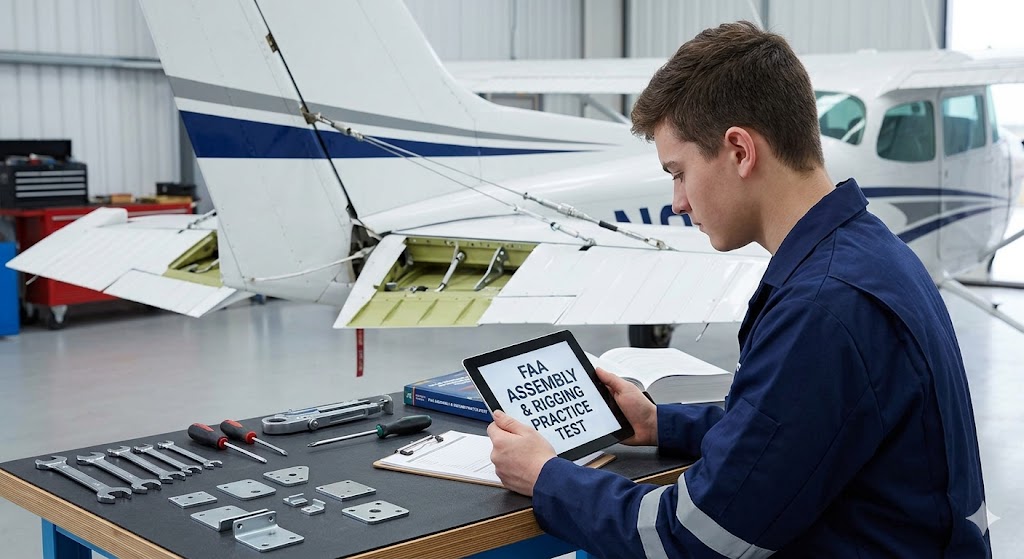
Additional Information
What the Course Entails and Exam Details
This guide deep dives into both fixed-wing and rotary-wing aircraft assembly and rigging.
You will explore aerodynamics and theory of flight as they relate to rigging, understanding the relationship between Center of Gravity (CG), axes, and stability.
The content details structural alignment references (buttlines, waterlines, body stations) and methods for checking symmetry and dihedral.
Crucially, you'll learn about primary and secondary flight controls (ailerons, elevators, rudders, trim tabs, flaps, helicopter collective, cyclic, antitorque), control systems (cables, pulleys, push-pull tubes, bellcranks), balancing procedures, specific hardware and safetying techniques, and using precision tools like tensometers and rigging pins.
While presented here as a focused study resource, this knowledge and skill are directly tested within the larger, comprehensive FAA Airframe Knowledge Test and the associated Oral & Practical (O&P) Exams.
The detailed requirements are outlined in relevant FAA Advisory Circulars and Federal Aviation Regulations.
What to Expect in the Final Exam
For official FAA certification, your competence in assembly and rigging will be assessed through the FAA Airframe Knowledge Test and the Aviation Mechanic Airframe Practical Test Standards (PTS) or Airman Certification Standards (ACS) once implemented for practical.
The Knowledge Test consists of numerous multiple-choice questions, some directly covering assembly and rigging concepts.
A minimum score of 70% is required, and there is a time limit.
The O&P (Oral and Practical) Exams are conducted by an FAA inspector or Designated Mechanic Examiner (DME).
You should expect to perform hands-on practical tasks – such as rigging a flight control surface, checking alignment, balancing a control, or inspecting a cable system – and answer technical oral questions, demonstrating understanding of the topic and relevant procedures in accordance with the manufacturer's maintenance manual and other approved data.
Preparation involves practicing these specific skills and deeply understanding the concepts outlined.
How to Study and Exam Centers
Leverage this focused study guide and other preparatory materials, including official FAA Handbooks (like the Aviation Maintenance Technician Handbook—Airframe), online courses, and detailed FAA assembly and rigging practice tests and quizzes to build knowledge and confidence.
Seek out hands-on practice on real aircraft or training aids under the guidance of a certificated mechanic or within an authorized training environment to master the essential practical skills and safety procedures.
Review manufacturer maintenance manuals and Advisory Circulars like AC 43.13-1B and -2A.
Exam Centers:
Official FAA Knowledge Tests are administered by FAA-approved computer testing centers across the United States.
You must register in advance through authorized systems (such as the PSI online portal) and pay the testing fee.
The O&P Exams are scheduled with individual FAA inspectors or DMEs, who might operate at repair stations, authorized schools, or other suitable locations.
Contact your local Flight Standards District Office (FSDO) or authorized examiners to arrange your O&P tests once you are eligible.
Ensure you have all necessary documentation and proof of eligibility.
Job Opportunities from the Course
Completion of your overall Aviation Maintenance Technician (AMT) program and passing the official FAA Airframe and Powerplant (A&P) certification exams, for which this detailed study supports, unlocks numerous exciting career paths in the aviation industry, many of which heavily rely on expert assembly and rigging knowledge:
General Aviation Mechanic: Perform maintenance, inspections, and repairs – including critical rigging adjustments – on a wide variety of piston and turboprop aircraft for individual owners and flight schools.
Commercial Airline Technician: Join a major airline or regional carrier, performing essential airframe and system maintenance, troubleshooting, and rigorous rigging checks on large passenger jets to ensure safety and fleet reliability.
Corporate Jet Mechanic: Service and maintain high-performance business jets, applying precise rigging skills to complex flight controls and retractable landing gear systems.
Helicopter Technician: Specialize in maintaining and repairing both fixed and rotary-wing aircraft, using unique knowledge and practical skills for rigging complex helicopter rotor systems and controls.
Aircraft Manufacturing Technician: Contribute to the initial assembly and precision rigging of new aircraft coming off the production line for various manufacturers.
Modifications & Repair Specialist: Work with specialized shops or repair stations focused on implementing aircraft modifications, repairs, or upgrades requiring expert structural assembly and system integration.
Quality Assurance Inspector: Leverage your knowledge of proper assembly and rigging standards to inspect work and ensure compliance with safety regulations and specifications.
Frequently Asked Questions
Reviews
5.0
Based on 0 reviews
Leave a Review
No reviews yet. Be the first to review!