
FAA Aviation Physics Practice Test
$69.00
- Buy to unlock unlimited access to all Quiz questions and Answers in this Quiz.
- After purchase you can print a PDF of the whole quiz at any point. The PDF will contain the questions and the correct answers.
About this Exam
The FAA Aviation Physics component is not a standalone exam but a critical subject area embedded within many Federal Aviation Administration (FAA) knowledge tests for pilot certification. Mastery of aviation physics principles is essential for anyone seeking to become a Private Pilot, Commercial Pilot, Remote Pilot (Drone), or an Airline Transport Pilot.
This material is designed for aspiring pilots and aviation professionals who need a rock-solid understanding of the physical laws governing flight. By understanding why an aircraft behaves as it does, you can make safer, more informed decisions in the cockpit or when operating a UAS.
Ready to test your knowledge?
Buy Now to Access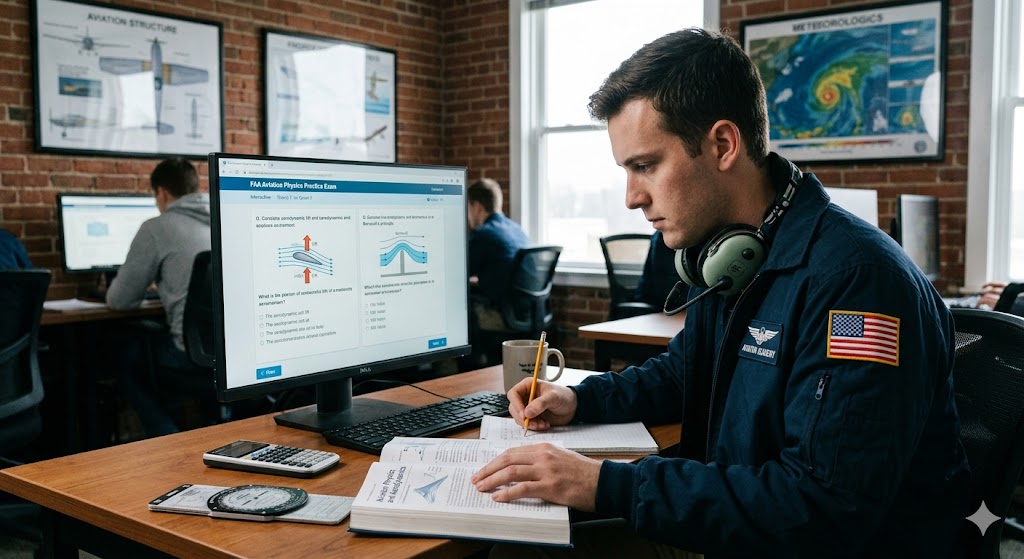
Additional Information
What the Course Entails and Exam Details
The core curriculum that prepares you for these questions focuses on standard pilot ground school topics. You won’t find a specific "Aviation Physics" course, but rather physics principles woven into multiple subjects:
Aerodynamics: This is the heart of aviation physics. You will cover the four forces of flight (lift, drag, thrust, and weight), the Bernoulli principle, Newton’s laws as they apply to wings, airfoils, and stability (longitudinal, lateral, and directional).
Flight Mechanics: You will learn how control surfaces (ailerons, elevator, rudder) manipulate the aerodynamics to achieve controlled flight along the three axes (longitudinal, lateral, and vertical).
Aircraft Systems: Understanding the basic mechanics and physics behind reciprocating engines, jet engines, electrical systems, and hydraulic systems.
Weight and Balance: The physics of leverage and center of gravity (CG). You must learn how to calculate an aircraft’s CG and ensure it stays within limits for safe operation.
Weather: While often treated separately, basic weather theory is rooted in physics, including air density, pressure systems, and humidity’s effect on performance.
What to Expect in the Final Exam
Since aviation physics is a sub-topic, the format depends on the specific FAA Knowledge Test you are taking (e.g., Private Pilot - Airplane, PAR).
Exam Format: All FAA knowledge tests are multiple-choice.
Number of Questions: The number varies by test, but physics-related questions may account for 10-15% of the total, covering aerodynamics, flight systems, and performance calculations.
Passing Score: The passing score for almost all FAA knowledge tests is 70%.
Time Limit: Time limits vary by exam (e.g., 2.5 hours for Private Pilot), providing ample time to complete the multiple-choice section if you are well-prepared.
Specific Rules: Exams are taken on computer systems at designated knowledge testing centers. You are typically allowed to use a basic calculator and an E6B flight computer, but no external reference materials.
How to Study and Exam Centers
A strategic approach is necessary to master the physics concepts required.
Comprehensive Study Strategies:
Utilize FAA Handbooks: Start with the primary source. The FAA offers excellent, free PDF handbooks that cover these principles extensively:
Pilot’s Handbook of Aeronautical Knowledge (PHAK) - Essential for basic aerodynamics and systems.
Airplane Flying Handbook - For practical application of flight mechanics.
Enroll in a Ground School: Whether in-person (FAR Part 141 or 61 school) or online, a structured ground school will break down complex physics into understandable modules.
Active Learning with Diagrams: Do not just read about aerodynamics; draw the diagrams. Sketch airfoils with airflow lines, label the forces of flight, and visualize how stability works.
Use Practice Tests: This is crucial. Use reputable online practice test banks and software. These tools categorize questions, allowing you to focus specifically on aerodynamics, performance, and systems, which are the physics-heavy sections.
Finding Exam Centers:
FAA knowledge tests must be taken at an authorized testing center.
PSI Services: PSI is the current exclusive provider for all FAA knowledge testing. You must create an account on the PSI website to register for and schedule your exam.
Testing Locations: You can search for the nearest authorized testing center (often located at flight schools, universities, or dedicated testing facilities) during the registration process on the PSI portal.
Job Opportunities from the Course
Gaining a deep understanding of aviation physics is a required step on the path to numerous professional careers in aviation.
Private Pilot: The first step to personal or recreational flying.
Commercial Pilot: Required for anyone wishing to be paid for flying (e.g., charter, aerial photography).
Airline Transport Pilot (ATP): The highest level of pilot certificate, necessary to fly for a scheduled airline.
Certified Flight Instructor (CFI): Teaches others how to fly, requiring the deepest understanding of all concepts, including aviation physics.
Unmanned Aircraft Systems (UAS) Operator: Many complex drone operations require advanced physics knowledge, which is covered in various FAA drone certifications.
Frequently Asked Questions
Reviews
5.0
Based on 0 reviews
Leave a Review
No reviews yet. Be the first to review!