
FAA Commercial Pilot Practice Test
$69.00
- Buy to unlock unlimited access to all Quiz questions and Answers in this Quiz.
- After purchase you can print a PDF of the whole quiz at any point. The PDF will contain the questions and the correct answers.
About this Exam
The FAA Commercial Pilot Knowledge Test is a critical milestone for aspiring pilots seeking to operate aircraft for compensation or hire. This exam, administered by the Federal Aviation Administration (FAA), validates a candidate's mastery of the advanced aeronautical knowledge required for the Commercial Pilot Certificate.
It is designed for individuals who have already obtained their Private Pilot Certificate and are ready to advance their aviation career into professional flight operations, such as piloting charters, agricultural applications, or pipeline patrol. Achieving success on this practice exam is the first step towards demonstrating the proficiency needed for a lucrative career in aviation.
Ready to test your knowledge?
Buy Now to Access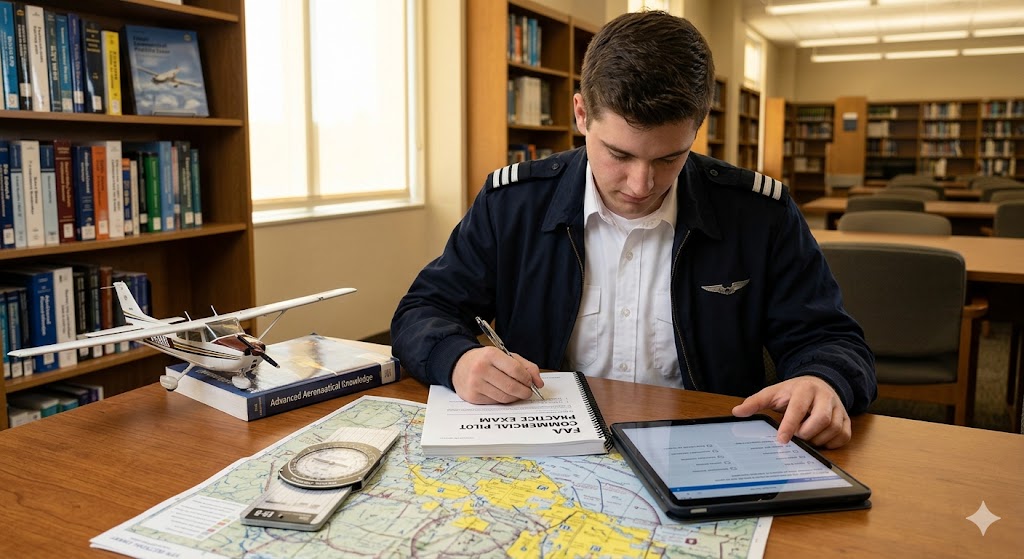
Additional Information
What the Course Entails and Exam Details
To prepare for the Commercial Pilot Knowledge Test, candidates must delve into a comprehensive syllabus covering sophisticated aspects of aviation. The course material extends well beyond basic flight principles, demanding a deeper understanding of practical application and decision-making.
Key knowledge areas covered in the course and assessed in the exam include:
Advanced Aerodynamics: Understanding high-performance aircraft operations, stalls, spins, and stalls at various bank angles and load factors.
Aircraft Systems: In-depth knowledge of complex aircraft systems, including constant-speed propellers, retractable landing gear, environmental systems, and advanced avionics.
FAA Regulations (FARs): Comprehensive understanding of 14 CFR Part 61, Part 91, and other relevant parts governing commercial operations, flight rules, and pilot privileges and limitations.
Weather and Meteorology: Interpreting sophisticated weather reports, forecasts, and charts (e.g., Area Forecasts, Terminal Aerodrome Forecasts, Winds and Temperatures Aloft), and understanding severe weather phenomena.
Performance and Limitations: Calculating aircraft performance using charts and tables for various density altitudes, weights, and configurations. Understanding the implications of overloading and center of gravity shifts.
Navigation: Advanced navigation techniques, including the use of VOR, DME, ADF, and GPS systems, as well as dead reckoning and pilotage for cross-country flights.
Flight Planning: Developing detailed VFR and IFR flight plans, considering fuel requirements, alternate airports, and routing.
Human Factors: Understanding the physiological and psychological aspects of flight, decision-making, and crew resource management (CRM).
Commercial Flight Maneuvers: The knowledge required to perform advanced maneuvers like steep turns, chandeliers, lazy eights, and pylon eights.
What to Expect in the Final Exam
The actual FAA Commercial Pilot Knowledge Test is a multiple-choice, computer-based exam. Candidates can expect a challenging set of questions designed to evaluate their analytical skills and understanding of complex aviation concepts.
While the exact number of questions can vary slightly, candidates are typically given:
Number of Questions: Around 100 multiple-choice questions.
Time Limit: A strictly enforced time limit, generally three hours (180 minutes).
Passing Score: A minimum score of 70% is required to pass.
Question Format: Each question presents a scenario, problem, or regulatory query with three or four possible answers.
References: Candidates are provided with an Airman Knowledge Testing Supplement (which contains charts, diagrams, and legends) for use during the exam.
Rules: No outside study materials, calculators with pre-programmed aviation formulas (except basic arithmetic), or communication devices are allowed in the testing room. Testing centers maintain strict proctoring and surveillance.
How to Study and Exam Centers
Preparation for the Commercial Pilot Knowledge Test requires a structured study plan and the use of diverse resources. Consistency and practice are paramount.
Actionable Study Strategies:
Utilize Comprehensive Study Guides: Purchase an FAA-approved commercial pilot knowledge test guide and textbook. Popular options include Jeppesen, ASA, and Gleim, which break down each topic systematically.
Enroll in Ground School: Participate in a formal ground school course (either in-person or online) offered by a Part 141 or Part 61 flight school. This provides structured learning and instructor support.
Take Multiple Practice Exams: This is crucial. Take timed practice exams repeatedly to normalize the test format, identify weak areas, and build speed. Use software and online question banks specifically designed for FAA exam preparation.
Analyze Practice Results: Do not just check your score. Review every single question you got wrong on practice tests, understand why the correct answer is right, and find the corresponding section in your study materials for further review.
Study the Airman Knowledge Testing Supplement: Familiarize yourself with how to quickly locate and interpret information within the supplement provided during the actual test, as speed is vital.
Join a Study Group: Collaborating with other commercial pilot applicants can help reinforce concepts and provide mutual motivation.
Exam Centers:
You cannot take the official FAA Commercial Pilot Knowledge Test online from home. It must be taken at an authorized computer testing center.
PSI Services LLC: The FAA contracts with PSI Services LLC to administer all airman knowledge tests. Candidates must register and schedule their exam through the PSI website.
Location Finder: Use the test center locator on the PSI website to find an authorized testing center near you. These centers are often located at airports, flight schools, or Pearson VUE centers authorized for FAA testing.
Required Endorsement: Before scheduling your official exam with PSI, you will need an endorsement from your flight instructor certifying that you are prepared to take the test.
Job Opportunities from the Course
Earning a Commercial Pilot Certificate opens the door to a wide range of professional piloting opportunities. This certification is a minimum requirement for employment in non-airline commercial operations, and it serves as the essential stepping stone toward achieving an Airline Transport Pilot (ATP) certificate.
Specific job titles and career paths unlocked include:
Flight Instructor (CFI): Teaching new pilots is one of the most common and valuable ways to build the flight hours required for airline employment.
Charter Pilot (Part 135): Flying passengers or cargo on demand for private charter companies.
Cargo Pilot: Operating feeder aircraft for overnight delivery services or regional cargo carriers.
Aerial Photographer: Flying aircraft for specialized photography and mapping services.
Pipeline and Powerline Patrol Pilot: Conducting aerial surveillance and inspection of critical infrastructure.
Agricultural Pilot (Crop Duster): Applying fertilizers and pesticides from the air (requires additional specialized training).
Banner Towing Pilot: Flying aircraft for aerial advertising above events and beaches.
Sightseeing and Tour Pilot: Providing aerial tours of scenic areas.
Air Ambulance/Medevac Pilot: Flying critical patient transport missions (requires significant experience).
Regional Airline First Officer: While an ATP is required to be Captain, many regional airlines hire pilots with a Commercial Certificate and specialized hour requirements as First Officers (copilots).
Frequently Asked Questions
Reviews
5.0
Based on 0 reviews
Leave a Review
No reviews yet. Be the first to review!