
FAA En‑Route Radar Controller Certification (CKT-1) Practice Test
$69.00
- Buy to unlock unlimited access to all Quiz questions and Answers in this Quiz.
- After purchase you can print a PDF of the whole quiz at any point. The PDF will contain the questions and the correct answers.
About this Exam
The FAA En-Route Radar Controller Certification (CKT-1) is a critical milestone for aspiring Air Traffic Control Specialists (ATCS).
Specifically designed for new hires at the FAA Academy, this certification validates the foundational knowledge and technical skills required to manage aircraft safely and efficiently in high-altitude, en-route airspace using radar systems.
It is the first step in a rigorous training program that transforms candidates into certified controllers who keep our skies safe.
This practice test is an invaluable resource for students to assess their readiness and build the confidence necessary to excel on the official exam.
Ready to test your knowledge?
Buy Now to Access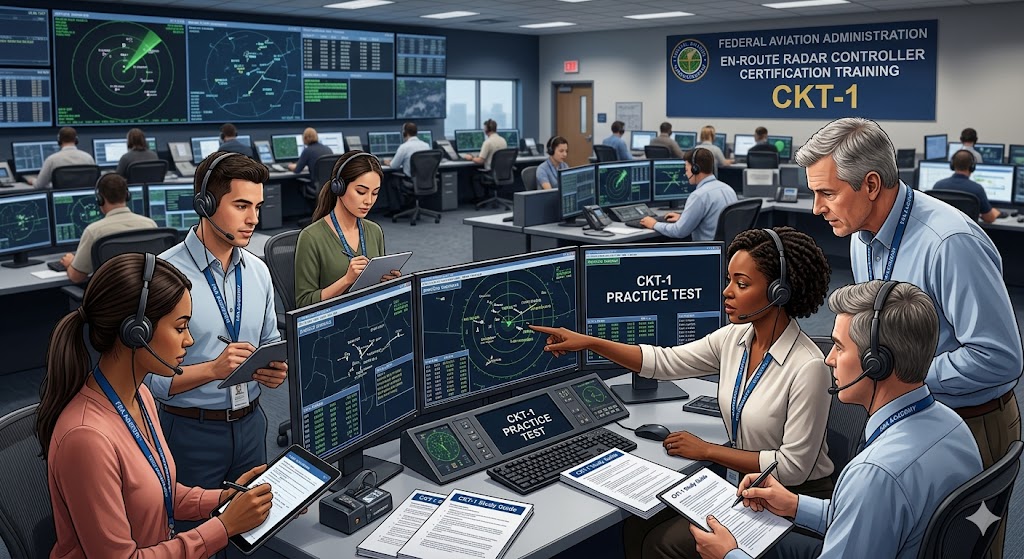
Additional Information
What the Course Entails and Exam Details
The CKT-1 course and practice test cover a comprehensive range of topics essential for an en-route radar controller.
You will delve into the intricacies of both non-radar and radar separation standards, master complex radio and interphone communication procedures, and learn to decode and organize flight plan information using flight progress strips.
The curriculum includes detailed instruction on recording and forwarding clearances, interpreting Letters of Agreement (LOAs), general control procedures, and board management.
You will also be trained on critical operational procedures such as departure and arrival flows, altimeter settings, altitude assignments, and holding patterns.
A significant portion of the course is dedicated to managing aircraft separation in all dimensions—vertical, longitudinal, and lateral—in departure, en-route, and arrival phases.
Furthermore, students are trained to apply prescribed procedures for weather hazards, manage flight plan data, prioritize duties, and respond to emergencies, unusual situations, overdue aircraft, and communication failures.
This includes the critical ability to demonstrate effective scanning techniques and manage system and equipment outages.
What to Expect in the Final Exam
The official CKT-1 certification exam, for which this practice test prepares you, is a formal, comprehensive evaluation.
The format is typically a multiple-choice examination, designed to test your knowledge retention and ability to apply concepts to realistic scenarios.
The number of questions and exact time limit are set by the FAA Academy but are always designed to be challenging yet manageable within the allotted training schedule.
A passing score, also determined by FAA Academy standards, is required to proceed to the next phase of training, CKT-2.
You must be prepared to answer questions with precision and speed, reflecting the real-time demands of the air traffic control environment.
How to Study and Exam Centers
Preparation is the key to success.
We recommend a multi-faceted approach to studying:
Immerse Yourself in the CKT-1 Study Guide: Use the official training materials provided by the FAA Academy. Every detail, acronym, and procedure is a potential test question.
Master Flashcards: Create digital or physical flashcards for contractions, phraseology, separation minima, and emergency checklists.
Take Multiple Practice Tests: Use resources like the "Ultimate Exam" and this practice test to simulate the exam experience. Analyze your mistakes to identify weak areas.
Collaborate in Study Groups: Work with your academy classmates to discuss scenarios and clarify complex regulations.
Exam Centers: The official CKT-1 certification exam is administered as part of the formal training curriculum at the Federal Aviation Administration (FAA) Academy, located in Oklahoma City, OK. It is not available through general online portals or external test centers.
Job Opportunities from the Course
Successfully completing the CKT-1 certification is a foundational achievement that unlocks a direct path to a rewarding career as a certified Air Traffic Control Specialist.
While CKT-1 is just the first step, it is the crucial prerequisite that enables you to continue your specialized training toward a full certification.
Upon achieving full certification as an En-Route Controller, you will be eligible for the following specific job titles and career paths:
Federal Aviation Administration (FAA): Air Traffic Control Specialist (ATCS) - En-Route Center.
FAA Academy: Training Instructor (after gaining operational experience).
Private Aerospace Companies: Companies that manage private terminal or en-route facilities also recruit FAA-certified controllers.
Contracting Firms: Specialized government contractors hire certified controllers for positions worldwide.
Frequently Asked Questions
Reviews
5.0
Based on 0 reviews
Leave a Review
No reviews yet. Be the first to review!