
FAA Instrument Rating Written Practice Test
$69.00
- Buy to unlock unlimited access to all Quiz questions and Answers in this Quiz.
- After purchase you can print a PDF of the whole quiz at any point. The PDF will contain the questions and the correct answers.
About this Exam
The FAA Instrument Rating is an essential step for pilots who want to advance their skills beyond flying primarily in clear weather. This rating authorizes a pilot to operate an aircraft under Instrument Flight Rules (IFR), meaning they can fly in conditions with reduced visibility, such as clouds or fog, relying solely on the aircraft’s instruments. This qualification is crucial for safety and is required for most commercial pilot positions. It is designed for pilots who already hold at least a Private Pilot Certificate and are looking to increase their flight proficiency and flexibility.
Ready to test your knowledge?
Buy Now to Access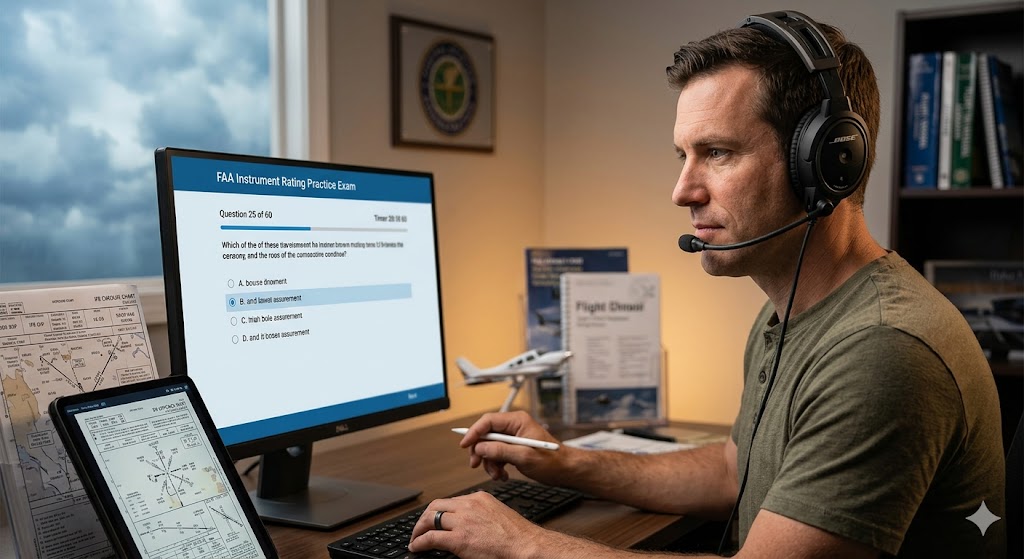
Additional Information
What the Course Entails and Exam Details
Preparing for the Instrument Rating knowledge test involves mastering several key areas of aviation. The syllabus covers:
Air Traffic Control (ATC) System: Understanding IFR clearances, communication procedures, and the structure of the National Airspace System under IFR.
IFR Navigation: Proficiency in using navigation systems like VOR, NDB (though less common), and, crucially, GPS (RNAV) procedures, including understanding instrument approach charts (plates).
Aviation Weather: In-depth knowledge of weather theory, interpreting forecasts, recognizing hazardous conditions, and understanding how weather affects IFR operations.
Federal Aviation Regulations (FARs): Specific regulations governing IFR flight operations, equipment requirements, and pilot currency.
Aircraft Instruments: Understanding the operation, limitations, and potential failures of gyroscopic and pitot-static instruments.
IFR Cross-Country Planning: Learning to plan flights that account for weather, routing, fuel requirements, and alternate airports.
What to Expect in the Final Exam
The actual FAA Instrument Rating Knowledge Test is a computer-based exam. Candidates can expect:
Format: Multiple-choice questions.
Number of Questions: The test typically consists of 60 questions.
Time Limit: You are usually given 2.5 hours (150 minutes) to complete the exam.
Passing Score: A minimum score of 70% is required to pass.
Testing Materials: You will be provided with a government-issued testing supplement containing all necessary legends, charts, and figures needed to answer the questions.
How to Study and Exam Centers
Effective preparation for the Instrument Rating written test combines theoretical study with practical application.
Actionable Study Strategies: Utilize official FAA handbooks, specifically the "Instrument Flying Handbook" (FAA-H-8083-15B) and the "Instrument Procedures Handbook" (FAA-H-8083-16B). These are comprehensive and free resources. Incorporate dedicated ground school courses, either in-person or online, which provide structured learning.
Practice Methods: The cornerstone of preparation is taking consistent practice tests, like the one this guide supports. These simulate the actual exam environment and help identify areas needing further study. Focus on understanding the why behind each correct answer, rather than just memorizing the responses.
Exam Centers: To take the actual FAA knowledge test, you must register through PSI Services, the official testing vendor. The exams are administered at authorized PSI testing centers, which are frequently located at airports or within flight schools. You will need to obtain a logbook endorsement from an authorized ground or flight instructor stating that you are prepared for the test before scheduling.
Job Opportunities from the Course
Earning your Instrument Rating is often a primary prerequisite for pursuing a professional aviation career. It is usually required before you can obtain a Commercial Pilot Certificate. Here are specific career paths that this rating unlocks or enhances:
Commercial Pilot: Whether flying regional jets, corporate aircraft, or for aerial application services, a Commercial Pilot Certificate combined with an Instrument Rating is the standard minimum for most paid flying jobs.
Airline Transport Pilot (ATP): The highest grade of pilot certificate required to fly as a captain or first officer for scheduled air carriers. An Instrument Rating is an essential building block on this path.
Certified Flight Instructor (CFI): Adding the Instrument Instructor (CFII) rating allows you to teach students seeking their instrument rating, making you more employable in flight schools.
Corporate/Business Aviation Pilot: Flying private jets or turboprops for companies often demands high-level IFR proficiency and experience.
Charter Pilot (Part 135 Operations): Flying on-demand charter flights typically requires IFR capability.
Cargo Pilot: Transporting freight, often overnight and in all weather conditions, relies heavily on instrument flying skills.
Frequently Asked Questions
Reviews
5.0
Based on 0 reviews
Leave a Review
No reviews yet. Be the first to review!