
FAA Sheet Metal Structures Practice Test
$69.00
- Buy to unlock unlimited access to all Quiz questions and Answers in this Quiz.
- After purchase you can print a PDF of the whole quiz at any point. The PDF will contain the questions and the correct answers.
About this Exam
The [FAA Sheet Metal Structures Practice Test] is an essential resource for aspiring aviation maintenance technicians. It's designed to help you prepare for and succeed in the challenging sheet metal and structural components section of the official FAA Airframe Mechanic certification knowledge and practical exams. This certification, governed by the Federal Aviation Administration (FAA) in the United States, is a critical step for anyone who wants to perform and approve maintenance, repairs, and alterations on aircraft.
This practice test is primarily targeted at students enrolled in FAA-approved aviation maintenance schools, mechanics with prior experience seeking official certification, or individuals specifically interested in specializing in aircraft structures. It focuses on the specialized knowledge, technical skills, and essential safety procedures required to work on aircraft made primarily from metal, particularly various aluminum alloys. Passing the corresponding FAA exam demonstrates your competency in assessing structural integrity, fabricating repairs, and ensuring the continued airworthiness of aircraft, making this guide an indispensable tool for your career journey.
Ready to test your knowledge?
Buy Now to Access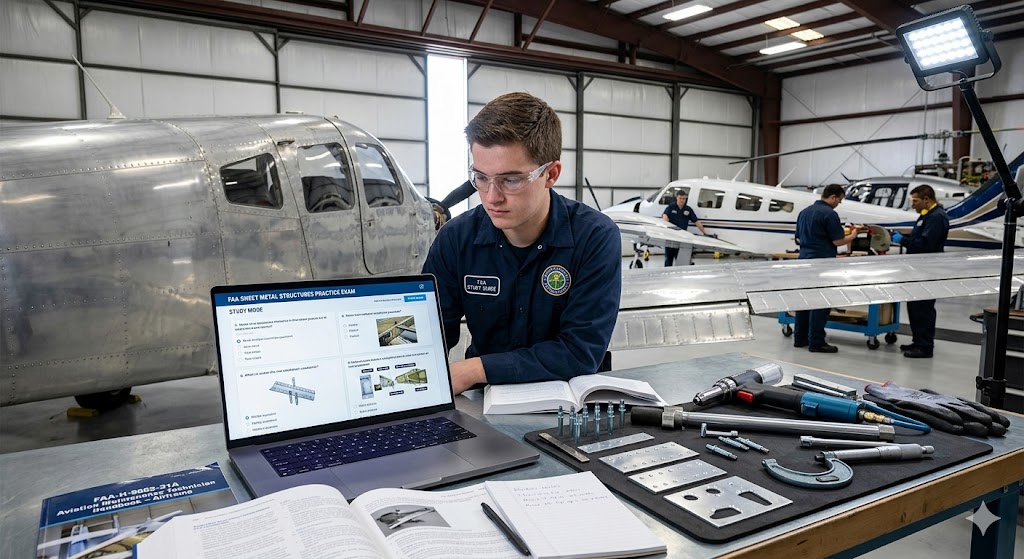
Additional Information
What the Course Entails and Exam Details
This comprehensive guide and corresponding practice test cover the theoretical and some simulated practical elements critical to aircraft sheet metal structures. Mastering these concepts is vital not only for the exam but also for a successful and safe career in aviation maintenance. The key areas covered in this course and subsequent testing include:
Aviation Materials: Understanding the properties, designations, heat treatments, and typical applications of various metals and alloys used in aviation, especially aluminum alloys (like 2024, 7075), stainless steel, and titanium.
Blueprint Reading and Lofting: Interpreting aircraft drawings, lofting (developing flat patterns), and calculating bend allowances for complex three-dimensional parts.
Fastener Identification and Usage: Knowledge of different types of solid rivets, special-purpose fasteners (blind rivets, etc.), their material codes, size calculation, and installation/removal procedures.
Shop Tools and Equipment: Correct use and maintenance of essential sheet metal tools including shears, brakes, rolls, riveting guns, bucking bars, dimpling tools, drills, and measuring devices like calipers and micrometers.
Fabrication and Repair: Demonstrating procedures for cutting, drilling, forming (hand and machine), dimpling, countersinking, proper rivet installation and inspection, and making structural repairs according to acceptable standards (e.g., FAA Advisory Circular 43.13-1B).
Structural Inspection: Techniques for identifying and assessing damage, corrosion, fatigue cracks, and improper repairs on aircraft structural components.
Safety Procedures: Essential workshop safety rules, the use of Personal Protective Equipment (PPE), and proper handling of tools and materials.
What to Expect in the Final Exam
While the [FAA Sheet Metal Structures Practice Test] helps you prepare, the official FAA Airframe Mechanic certification process involves a more robust and multi-faceted examination system. It is crucial to understand this official structure.
FAA Official Certification Process:
Knowledge (Written) Test: The corresponding official exam usually includes a dedicated multiple-choice knowledge test specifically focused on Sheet Metal and Non-Metallic Structures.
Format: Multiple-choice questions. A standard FAA knowledge test can consist of 60-100 questions.
Passing Score: Typically 70% or higher.
Time Limit: Generally allows ample time, perhaps up to 2-3 hours depending on the specific knowledge test.
Rules: Proctored at designated testing centers, no external materials allowed. The questions test theoretical understanding of materials, tools, repair standards, and procedures.
Oral and Practical Exam: To receive full certification, you must also pass an expansive oral and practical examination conducted by an FAA Designated Mechanic Examiner (DME).
Oral: The examiner will ask verbal questions based on theoretical scenarios to gauge your understanding.
Practical: This hands-on section requires you to physically perform and demonstrate skills in various structural and mechanic tasks, potentially including rivet installation, sheet metal repair, material identification, and inspecting a component. This is a critical assessment of your ability to apply knowledge safely and effectively.
Note: The [FAA Sheet Metal Structures Practice Test] you are using here is primarily a simulation tool for the knowledge test, helping you reinforce theory and prepare for the types of multiple-choice questions you will encounter. It does not replace or simulate the actual, vital hands-on practical exam which requires physical skills and real-world application with an official examiner. This guide is a study aid for the real, extensive certification process.
How to Study and Exam Centers
Preparation is the key to success for the critical FAA sheet metal structural exam components. Here is an effective strategy to leverage this guide and other resources, along with details on taking the official tests.
How to Study and Prepare for the Exam
Utilize This Practice Test Strategically: Take the practice test multiple times. Don't just focus on the final score; review both your correct and incorrect answers. For incorrect answers, understand why you got it wrong and research the correct explanation in your study materials. This reinforces knowledge and highlights weak areas.
Refer to Official FAA Manuals: The FAA provides comprehensive, officially recognized study manuals that are essential primary sources:
FAA-H-8083-30A (and latest revisions), Aviation Maintenance Technician Handbook – General (for basic shop math, tools, materials, etc.)
FAA-H-8083-31A (and latest revisions), Aviation Maintenance Technician Handbook – Airframe, Volume 1 & 2 (includes detailed chapters on sheet metal and non-metallic structures)
FAA Advisory Circular (AC) 43.13-1B, Acceptable Methods, Techniques, and Practices - Aircraft Inspection and Repair (the definitive guide for approved repair procedures)
In-Depth Study and Active Learning: Don't just read; engage with the material.
Flashcards: Create digital or physical flashcards for key terms, material codes, rivet head markings, bend allowance formulas, etc.
Practical Application (If Possible): While this guide focuses on theory, nothing beats hands-on experience. If you are in a school or have access to a shop, practice basic tasks: material identification, measurements, cutting, forming, and driving/removing different types of rivets. This makes the theoretical concepts much more tangible.
Blueprints and Drawings: Practice interpreting aircraft drawings, understanding tolerances, and visualizing flat patterns.
Understand the Theory Behind the Operations: Don't just memorize formulas. Understand why we use specific bend allowances, why certain rivets are used in certain areas (e.g., shear strength vs. tensile strength), and the principles behind each fabrication technique and inspection method.
Simulate Exam Conditions: For your final practice runs, set a timer and create a quiet, distraction-free environment to simulate the pressure of the real proctored exam. This can help improve your pacing and focus.
Where and How to Take the Official Exam
Computer-Based Knowledge (Written) Test:
Testing Centers: You cannot take the official knowledge test online or as a non-proctored test from home. You must register to take the test at an authorized FAA knowledge testing center. The two primary providers of these centers across the U.S. and some international locations are PSI Services LLC and Pearson VUE. You can locate a convenient test center through their respective websites.
Registration: Go to the official test provider's website (PSI or Pearson VUE) to register for your specific FAA Airframe Mechanic knowledge test. You will need a specific FAA authorization code or endorsement from your school/mechanic instructor to complete the registration. You must schedule your appointment and pay the required testing fee in advance. Be sure to arrive early with required identification.
Oral and Practical Exam:
Designated Examiners: The hands-on oral and practical exams are not taken at a standard testing center. You must locate an FAA Designated Mechanic Examiner (DME).
Scheduling and Locations: You can often find a DME associated with an FAA-approved aviation maintenance school, or you can use the FAA's online search tool on their official website to locate designated examiners in your region. You will need to contact the DME directly to schedule your exam and arrange the time, location (which will likely be an aircraft hangar/shop), and pay their associated examination fee (which is separate from the knowledge test fee). Your school or local FAA Flight Standards District Office (FSDO) can also provide guidance and potentially a list of examiners. You will typically complete this phase after passing all your required knowledge tests.
Job Opportunities from the Course
Successfully completing this training and passing the associated official FAA examinations unlocks diverse and essential career paths within the aviation industry. Professionals skilled in aircraft sheet metal and structures are in high demand for fabrication, maintenance, and repair work across various sectors. Some of the specific job titles and career paths this certification enables you to pursue include:
Aircraft Sheet Metal Mechanic: Specialized role focused on the fabrication, repair, assembly, and installation of aircraft sheet metal components. Employed by airlines, repair stations, manufacturing companies, and general aviation operators.
Structural Technician (or Structures Mechanic): Performs detailed inspection, modification, and major structural repair of aircraft airframes, including skins, ribs, spars, and other primary structural elements. Involves critical work that ensures structural integrity.
Aviation Maintenance Technician (AMT) - Airframe/Structures: A broader role encompassing a range of airframe maintenance tasks, with a specific expertise and authority (after passing the required exams) to maintain and repair aircraft structures. Employed in all segments of aviation.
Aerospace Manufacturing Technician: Involved in the production and assembly of new aircraft, components, or structural parts in a manufacturing environment, following strict blueprints and quality standards.
Structures Repair Specialist: A specialized AMT position often within larger repair stations or maintenance operations, focusing solely on complex structural repairs and modifications for a wide array of aircraft.
Sheet Metal Specialist (within larger maintenance organizations): A focused role within larger airlines or repair organizations, dedicating skills entirely to sheet metal repair and fabrication for their specific fleet of aircraft.
Aviation Maintenance Supervisor/Manager (with experience): Progress to a leadership role overseeing teams of mechanics and technicians, ensuring regulatory compliance, safety, and quality control in all structural maintenance operations.
Quality Control (QC) Inspector: A pivotal quality assurance role requiring expert knowledge and attention to detail. Responsible for inspecting all maintenance and repair work on aircraft structures to ensure it meets safety, FAA regulations, and airworthiness standards.
Frequently Asked Questions
Reviews
5.0
Based on 0 reviews
Leave a Review
No reviews yet. Be the first to review!