
FAA Weather Observation Practice Exam
$69.00
- Buy to unlock unlimited access to all Quiz questions and Answers in this Quiz.
- After purchase you can print a PDF of the whole quiz at any point. The PDF will contain the questions and the correct answers.
About this Exam
The FAA Weather Observation certification is a critical qualification for aviation professionals responsible for generating and reporting official weather data. This includes certified weather observers, air traffic controllers, and specific airport personnel who must provide accurate surface weather observations to support safe flight operations. The exam validates a candidate's proficiency in interpreting atmospheric conditions, reading specialized weather instruments, and correctly formatting essential aviation weather reports, such as METAR and SPECI. It is designed for individuals seeking to work in airport operations, air traffic control, or specialized meteorological roles within the aviation industry.
Ready to test your knowledge?
Buy Now to Access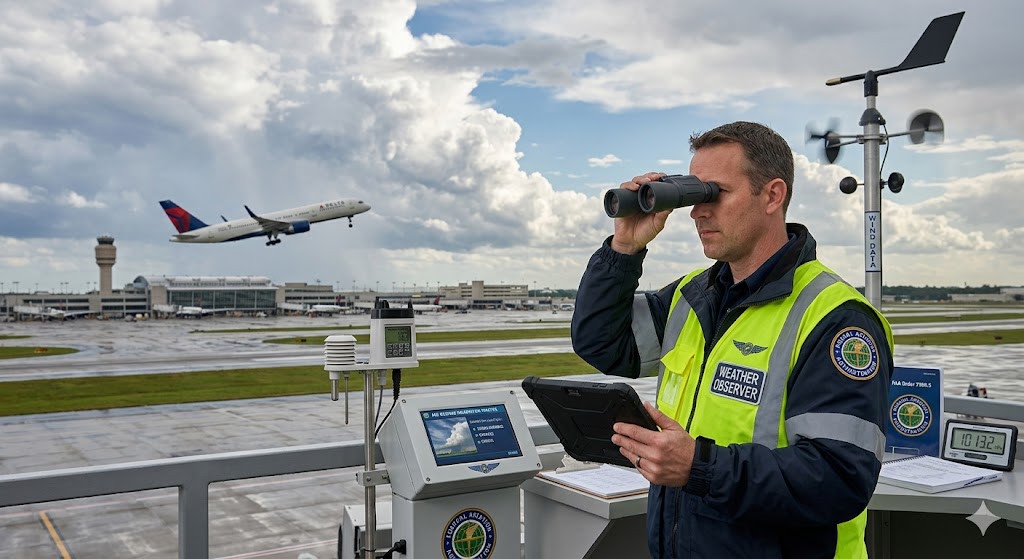
Additional Information
What the Course Entails and Exam Details
To prepare for the final certification exam, candidates must master a detailed syllabus governing standard weather observation procedures. While specific preparatory courses vary, the official training curriculum is rigorous and focuses heavily on FAA Order 7900.5, Surface Weather Observing. Key core topics and skills covered include:
Understanding METAR and TAF Codes: In-depth knowledge of how to read, decode, and manually create Meteorological Aerodrome Reports (METAR) and Terminal Aerodrome Forecasts (TAF), which are vital for flight planning.
Meteorological Phenomena Identification: Mastery in identifying different cloud types (including genus, species, and varieties), precipitation types (rain, snow, drizzle, hail), and visibility-reducing obstructions (fog, haze, mist, dust).
Instrument Interpretation: Competency in reading and interpreting data from surface weather observation equipment, including automated systems (e.g., ASOS, AWOS) and manual backup instruments like anemometers, barometers, and sling psychrometers.
Visibility and Ceiling Determination: Techniques for accurately measuring surface visibility using established visual markers and determining cloud ceiling heights.
Observation Procedures and Documentation: Strict adherence to FAA procedures for hourly routine observations, special observations (SPECI) triggered by rapid weather changes, and appropriate record-keeping.
Quality Control and Quality Assurance: Principles for ensuring the accuracy and integrity of weather data before dissemination.
What to Expect in the Final Exam
The final FAA weather observation certification exam is a formal, proctored evaluation. It is typically administered as a computerized test, although a practical, hands-on component is also common to verify observation skills in a real-world setting. Here are the key exam details you can expect:
Exam Format: The knowledge portion consists of multiple-choice questions designed to test theoretical understanding and scenario interpretation. You may be required to decode specific METAR samples, identify weather phenomena from images, or calculate meteorological values.
Practical Component: A hands-on evaluation where a designated examiner observes you performing actual weather observations, reading instruments, and formulating a correct report.
Time Limit: Candidates are generally given a fixed amount of time for the knowledge exam, often between 60 to 90 minutes.
Passing Score: Achieving a high score is crucial to demonstrate competency; typically, a score of 70% or 80% is required to pass the knowledge portion. The practical evaluation is often graded on a pass/fail basis.
Authorized Locations: The final certification exam must be scheduled through authorized FAA testing centers, approved training providers, or specifically designated airport facilities (such as major Air Traffic Control towers) that manage certifications for their personnel.
How to Study and Exam Centers
Preparation for this exam requires a structured approach. First, lean heavily on the provided FAA Weather Observation Practice Exam. Treating this practice test as a diagnostic tool allows you to identify weak areas early. Retake the practice exam under timed conditions until you consistently achieve a score well above the passing threshold.
Deeply study the official authority on the subject: FAA Order 7900.5, Surface Weather Observing. This document is the cornerstone of the certification. Augment this by utilizing the weather sections in the Aeronautical Information Manual (AIM). Create detailed flashcards for all common weather abbreviations used in METAR/TAF coding (e.g., BR, RA, SN, GR, OVC). For visual identification practice, review charts of cloud classifications and practice identifying different cloud genera from high-quality images.
Finding Exam Centers: It is important to note that you do not take the final, proctored certification exam on this practice portal. The official certification process is often tied directly to employment or specific authorized training programs. You should contact your aviation training provider, airline/airport employer (who often coordinates this), or an authorized FAA testing vendor, such as PSI, to schedule the official, proctored test. Specialized FAA personnel may be certified through their operational facilities.
Job Opportunities from the Course
Obtaining certification in FAA weather observation is an invaluable asset that opens up distinct career paths within aviation, where safety hinges on accurate meteorological information. Achieving this qualification validates your expertise and makes you eligible for several critical roles, including:
Certified Weather Observer: Working directly for contract meteorological service providers, airport management authorities, or fixed-base operators (FBOs) to produce official surface observations.
Air Traffic Controller (ATC): Weather observation knowledge is often integral to ATC training and operations, enabling controllers to relay current conditions to pilots and understand system outputs.
Airport Operations Specialist: Monitoring and managing airport conditions, which includes interpreting weather impacts for runway safety, snow removal operations, and planning.
Flight Service Station (FSS) Specialist: Providing crucial pre-flight briefings and in-flight advisory services to pilots based on current and forecasted weather.
Airline Dispatcher: Interpreting real-time weather reports for flight planning, route adjustments, and calculating necessary fuel loads.
Flight Instructor or Pilot: While not a typical primary role, having this deep weather knowledge significantly enhances an instructor’s capabilities and a pilot’s self-briefing decisions.
Frequently Asked Questions
Reviews
5.0
Based on 0 reviews
Leave a Review
No reviews yet. Be the first to review!