
Families in Canada (Grade 12) Practice Exam
$69.00
- Buy to unlock unlimited access to all Quiz questions and Answers in this Quiz.
- After purchase you can print a PDF of the whole quiz at any point. The PDF will contain the questions and the correct answers.
About this Exam
The Families in Canada (Grade 12) course, often designated as HHS4U, is a vital pre-university program within the Canadian high school curriculum. This course is specifically designed for students intending to pursue university or college programs in social sciences, humanities, or related fields. It invites students to draw on sociological, psychological, and anthropological theories and research to analyze the complex development of individuals, intimate relationships, and the dynamics of family and parent-child connections. A core focus is understanding the issues, challenges, and diverse factors that shape families in Canada’s multi-faceted society. This "practice exam" is an indispensable tool for these students, enabling them to assess their understanding of key concepts and apply analytical tools before their final, decisive evaluation. It is an ideal resource for anyone looking to refine their social science research skills and consolidate their knowledge for academic success.
Ready to test your knowledge?
Buy Now to Access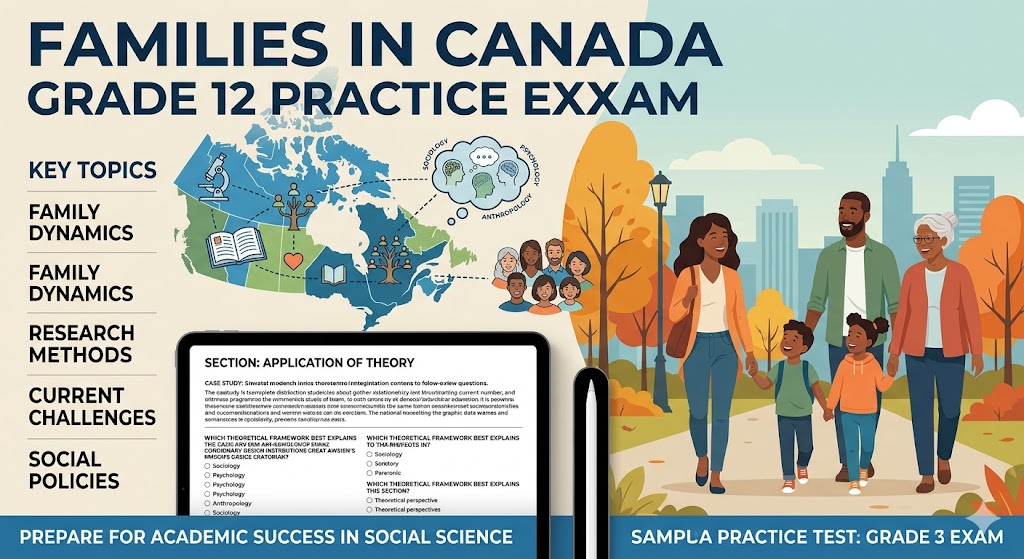
Additional Information
What the Course Entails and Exam Details
The Families in Canada (Grade 12) course provides a comprehensive exploration of the historical, contemporary, and future landscape of Canadian families. The curriculum is typically structured into four main areas, which form the basis of the final assessment:
Exploring and Investigating: This section focuses on the social science research process, from formulating questions and creating research plans to locating, evaluating, and synthesizing information using appropriate methodologies (interviews, surveys, observations, secondary analysis).
Theoretical Perspectives: Students learn and apply key theoretical frameworks to interpret family development and dynamics. This includes functionalism, conflict theory, symbolic interactionism, feminist theory, and life-course development theories like Erikson’s psychosocial stages.
The Impact of Norms and Policies: This core area examines how social institutions, cultural norms, and public policies (e.g., family law, social assistance, immigration) influence individual development, intimate relationships, and family composition and function.
Trends and Challenges: Students analyze current demographic and social trends, such as shifting family structures (e.g., blended, same-sex, multi-generational), and explore challenges like domestic violence, poverty, the impact of technology, and the process of restoring Indigenous cultural values in family life.
The entire program emphasizes critical thinking, communication, and the synthesis of theoretical and practical knowledge. The final grade is usually determined by 70% coursework and a 30% final evaluation, which frequently includes a dedicated examination and a culminating research project.
What to Expect in the Final Exam
While the exact format can vary slightly between school boards and individual institutions, the Families in Canada (HHS4U) final exam is designed to be a rigorous, comprehensive assessment of all course expectations. You can generally expect the following:
Format: The exam is typically written and often includes a combination of question types:
Multiple-Choice Questions: For testing knowledge and understanding of terms, definitions, and key thinkers.
Short Answer and Essay Questions: These require the definition, application, and analysis of theories to real-world scenarios or case studies.
Data Analysis: Interpreting demographic data, tables, or graphs to identify trends.
Categories: Assessment is based on the four achievement categories of knowledge/understanding, thinking/inquiry, communication, and application.
Time Limit: Usually runs between 1.5 to 2.5 hours.
Passing Score: Students must achieve a minimum score, often a composite of all final evaluation tasks (including a project), that contributes to passing the course, which requires a minimum final grade of 50%.
Rules: The exam is administered under strict academic integrity policies. Permitted materials are usually limited to pens and a watch; no textbooks, notes, or electronic devices are typically allowed. It is crucial to check the specific rules of your school or online academy.
How to Study and Exam Centers
Preparation for the Families in Canada (HHS4U) practice exam requires a strategic, multifaceted approach. Here is an actionable guide:
Consolidate Your Theories: Create a master guide of all primary sociological, psychological, and anthropological theories. For each, list its key proponents, main arguments, and examples of how it can be used to explain family phenomena.
Master the Research Methods: Be prepared to describe the entire research process, from the initial question to the final analysis, and know when to use each specific social science method.
Use Case Studies: Practice applying different theories to analyze various family situations, such as "a blended family navigating conflict," or "the impact of new immigration on a multi-generational household."
Create Flashcards: Use digital or physical flashcards for definitions of key terms like "nuclear family," "socialization," "agents of change," and "policy."
Simulate Exam Conditions: Take practice exams (like this one) with a timer, in a quiet, distraction-free environment, to build stamina and time management skills.
Regarding Exam Centers: For the majority of high school students, the official final exam is taken on-site at their registered high school. For those enrolled in online high schools or university preparation academies (e.g., TVO ILC, Virtual High School), examinations are often administered through a secure online platform with proctoring services, or students must arrange to take the exam at an approved physical location (such as a local school or library) with an official supervisor. You must contact your specific course provider for exact details on their exam scheduling and proctoring requirements.
Job Opportunities from the Course
A strong performance in the Families in Canada (Grade 12) course is an excellent springboard for diverse and impactful career paths. While the practice exam is not a job-qualifying certification on its own, the credit is essential for entry into college diplomas and university degree programs that unlock a vast range of jobs. The course content directly translates into skills needed in:
Social Work and Family Counseling
Child and Youth Services and Protective Care
Early Childhood Education and Care Management
Community Social Service Work
Addictions Counseling
Correctional Services, Probation, and Parole
Career and Employment Counseling
Immigration and Settlement Services
Health Policy and Social Research
University Teaching and Research (Sociology, Psychology, Anthropology)
Paralegal and Family Law Services
Frequently Asked Questions
Reviews
5.0
Based on 0 reviews
Leave a Review
No reviews yet. Be the first to review!