
Family Theories Practice Test
$69.00
- Buy to unlock unlimited access to all Quiz questions and Answers in this Quiz.
- After purchase you can print a PDF of the whole quiz at any point. The PDF will contain the questions and the correct answers.
About this Exam
The Family Theories Practice Exam is designed for individuals studying in fields such as social work, counseling, psychology, marriage and family therapy, and human services. This essential tool helps students prepare for key course examinations and professional licensure tests by assessing their understanding of the fundamental theories used to understand and intervene in family systems. Whether you are aiming to be a therapist, social worker, or case manager, mastering these concepts is crucial for effective practice, and this practice exam provides a comprehensive and encouraging environment for review and self-assessment.
Ready to test your knowledge?
Buy Now to Access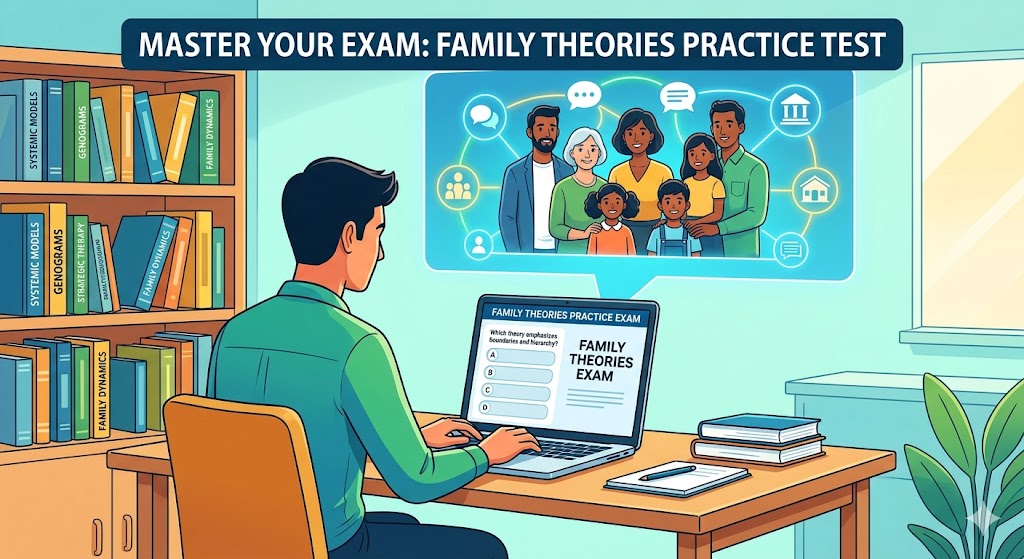
Additional Information
What the Course Entails and Exam Details
This examination covers a broad range of theoretical frameworks that explain how family systems operate, communicate, and change. Core topics typically include prominent theories such as: Systems Theory, Structural Family Therapy, Strategic Family Therapy, Bowen Family Systems Theory, Cognitive-Behavioral Family Therapy, Narrative Therapy, Solution-Focused Brief Therapy, and Feminist Family Theory. The exam assesses a student's ability to not only define these theories but also apply them to conceptualize family problems, identify dynamic relationships, and select appropriate interventions based on specific case scenarios. Practical skills like drawing and interpreting genograms, identifying boundaries, understanding power dynamics, and recognizing communication patterns are often critical.
What to Expect in the Final Exam
Students taking the Family Theories Practice Exam can expect a format consisting primarily of multiple-choice questions, which may include case studies and scenarios requiring the application of theoretical concepts. The number of questions and time limit can vary depending on the specific program or purpose, but a common length is around 50-100 questions within a 60-90 minute window. A passing score typically requires a deep understanding and a percentage correct ranging from 70% to 80% or more. The exam focuses heavily on distinguishing between different theories and their unique approaches. It may be administered online through a university learning management system or a specific testing platform, sometimes using remote proctoring technology.
How to Study and Exam Centers
Effective study strategies involve a systematic review of all course materials, textbooks, and notes for each theory. Summarizing each model's key concepts, founder(s), and primary interventions is highly beneficial. Creating comparison charts to highlight the differences and similarities between approaches like Structural and Strategic therapy can clarify concepts. Students should make and use flashcards for defining terminology and important figures in the field. Practice exams are an essential component; utilizing multiple versions can help identify weak points. Participating in study groups to discuss and apply theories to real-world scenarios or case studies is very helpful. For taking the final exam, it is often administered online through university-specific portals or learning management systems (like Canvas or Blackboard) or through established testing services like Pearson VUE or Prometric if it's a licensure-related exam. Ensure you are familiar with the correct platform and log-in procedures well in advance.
Job Opportunities from the Course
A strong understanding of family theories is fundamental for many rewarding career paths in mental health and social services.
Here is a list of potential job titles and fields:
Licensed Marriage and Family Therapist (LMFT)
Licensed Clinical Social Worker (LCSW)
Licensed Professional Counselor (LPC) or Mental Health Counselor
School Counselor or School Social Worker
Child and Family Services Worker
Human Services Professional
Community Case Manager
Family Life Educator
Researcher in Family Studies and Dynamics
Case Worker for Child Protective Services
Substance Abuse Counselor
Therapeutic Program Coordinator for Families
Frequently Asked Questions
Reviews
5.0
Based on 0 reviews
Leave a Review
No reviews yet. Be the first to review!