
FAR-AMT Practice Test
$69.00
- Buy to unlock unlimited access to all Quiz questions and Answers in this Quiz.
- After purchase you can print a PDF of the whole quiz at any point. The PDF will contain the questions and the correct answers.
About this Exam
Preparing for a career as a certified Aviation Maintenance Technician (AMT) is an exciting but challenging journey. The Federal Aviation Administration (FAA) requires candidates to demonstrate comprehensive knowledge and practical skills through a series of rigorous exams to earn their Airframe and/or Powerplant ratings (often called an A&P license). This FAR-AMT Practice Test is an invaluable tool, specifically designed to help students and aspiring mechanics assess their understanding of the Federal Aviation Regulations (FARs) relevant to aircraft maintenance and safety. This practice test is ideal for anyone in an Aviation Maintenance Technician school, military personnel transitioning to civilian aviation, or current mechanics looking to validate their knowledge before the official FAA exams.
Ready to test your knowledge?
Buy Now to Access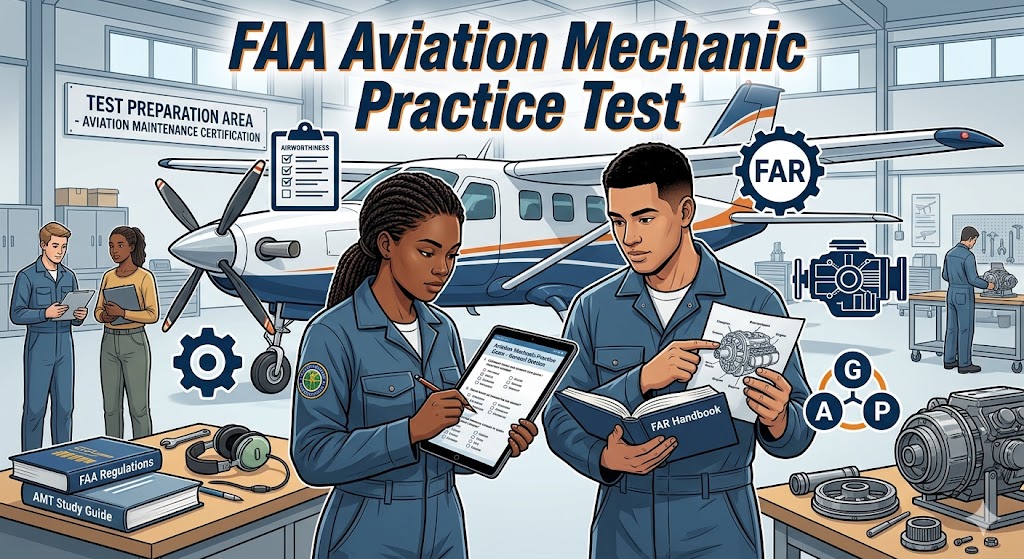
Additional Information
WHAT THE COURSE ENTAILS AND EXAM DETAILS
The underlying FAA curriculum for Aviation Maintenance Technicians is vast, covering General topics required for both ratings, plus the specific technical skills and knowledge for Airframe and Powerplant. A FAR-AMT Practice Test, while focused on regulations, covers the fundamental knowledge required for the FAA certification. Topics you can expect to be represented in such a practice context include:
General Aviation Knowledge: Basics of mathematics, physics, weight and balance, and basic aerodynamics as applied to maintenance.
Aircraft Materials & Processes: Understanding of materials, fasteners, corrosion control, NDT, and maintenance techniques.
Federal Aviation Regulations (FAR): Critical comprehension of regulations governing maintenance records, inspection requirements, airworthiness standards, maintenance procedures, and personnel certification (like FAR Parts 1, 3, 21, 23, 25, 33, 39, 43, 65, 91).
Ground Operations & Servicing: Safety procedures, aircraft handling, ground equipment, and servicing.
Airframe & Powerplant Systems: While the FAR focus is strong, practice exams often include representative multiple-choice questions on airframe structures, engines (piston and turbine), propellers, fuel systems, hydraulic systems, and avionics.
WHAT TO EXPECT IN THE FINAL EXAM
It is crucial to understand that a FAR-AMT Practice Test prepares you for the official, final certification, which consists of multiple distinct parts administered by the FAA or its designees. To become a fully certified A&P mechanic, you must pass:
Written Knowledge Tests: There are separate multiple-choice tests for General, Airframe, and Powerplant. Each test typically has 60 to 100 questions. A passing score is 70% or higher, with specific time limits (e.g., 1.5 to 2 hours per test). Your written scores also directly impact your Oral and Practical exams; a higher written score can result in a shorter oral test.
Oral & Practical (O&P) Exam: This is a comprehensive, one-on-one exam with a Designated Mechanic Examiner (DME). The examiner will ask you specific oral questions across all required subject areas and require you to physically perform practical projects to demonstrate your skill and understanding of safety and procedures. This is a critical and lengthy part of the process, and you must pass every section.
The FAR-AMT Practice Test itself is usually in a multiple-choice format, designed to simulate the written knowledge portion of the process.
HOW TO STUDY AND EXAM CENTERS
Strategic Practice: Utilize the FAR-AMT Practice Test multiple times. Analyze your results after each attempt to identify weak areas. Don't just memorize the correct answer; understand why it is correct.
In-Depth Rule Review: Pay close attention to the specific Federal Aviation Regulations covered. Keep your FAR handbook close and refer to the exact wording and application of each rule. Pay attention to terms, record-keeping procedures, and inspection guidelines.
Time Management: When taking practice tests, simulate real exam conditions. Time yourself to build stamina and practice effective time management during the actual knowledge test.
FAA Materials & Manuals: Review official FAA handbooks, advisory circulars, and study guides. These provide the foundational knowledge for all exams. Commercial study guides and online courses are also highly beneficial.
Understand the O&P Connection: Remember that the practice test is only part of the puzzle. Combine written study with hands-on practice in an aviation workshop or FAR Part 147 school to prepare for the practical and oral exams.
Where to Take the Exam: The actual FAA written knowledge tests must be taken at an authorized Airman Knowledge Testing Center. These are located across the country, often at airports, aviation schools, and testing facilities like those operated by PSI. The Oral & Practical (O&P) exam is scheduled directly with a Designated Mechanic Examiner (DME), often arranged through your Aviation Maintenance School or the nearest FAA Flight Standards District Office (FSDO). Many testing centers and schools now offer convenient online portals for scheduling.
JOB OPPORTUNITIES FROM THE COURSE
Successfully using a FAR-AMT Practice Test as part of your journey to FAA Aviation Maintenance Technician certification opens doors to diverse and stable career opportunities within the dynamic aviation industry. Potential job roles include:
Aviation Maintenance Technician (AMT) / A&P Mechanic: The core role in airlines, private aviation, or repair stations, performing all types of maintenance, inspections, repairs, and preventative maintenance on various aircraft.
Major/Regional Airline Mechanic: Work for commercial airlines on their fleets. These roles often offer excellent benefits and structured environments.
General Aviation Mechanic: Service smaller aircraft, including private planes, helicopters, and corporate jets, typically in smaller maintenance facilities.
Aerospace Manufacturing Technician: Work in aircraft production facilities for companies that build planes, engines, or components.
MRO (Maintenance, Repair, and Overhaul) Specialist: Focus on specialized services at certified repair stations. This could include turbine engine overhauls, avionics, structural repairs, or composite material work.
Avionics Technician: With specialized training and experience, focusing exclusively on the complex electrical and electronic systems within aircraft.
Quality Control / Inspection Technician: Ensure all maintenance work meets FAA standards and company quality procedures before aircraft are returned to service.
Aviation Field Service Representative: Travel for manufacturers to provide technical support and troubleshooting for their customers' aircraft.
Maintenance Supervisor/Director: Lead maintenance teams and manage maintenance operations.
Aviation Maintenance Instructor: Teach the next generation of technicians at FAR Part 147 schools.
Frequently Asked Questions
Reviews
5.0
Based on 0 reviews
Leave a Review
No reviews yet. Be the first to review!