
Farm Loan Officer Trainee (FLOT) Practice Exam
$69.00
- Buy to unlock unlimited access to all Quiz questions and Answers in this Quiz.
- After purchase you can print a PDF of the whole quiz at any point. The PDF will contain the questions and the correct answers.
About this Exam
The Farm Loan Officer Trainee (FLOT) program is a highly specialized training pathway primarily designed for individuals seeking a career in agricultural lending.
Often associated with government entities like the USDA Farm Service Agency (FSA) or private agricultural credit institutions, this program bridges the gap between agricultural knowledge and financial expertise.
The FLOT practice exam and final assessments are engineered to evaluate your readiness to manage agricultural credit portfolios, assist farmers with funding, and navigate complex federal lending regulations.
This certification is perfect for recent agriculture or finance graduates, banking professionals looking to pivot into the agricultural sector, and anyone passionate about sustaining farming communities through sound financial guidance.
Ready to test your knowledge?
Buy Now to Access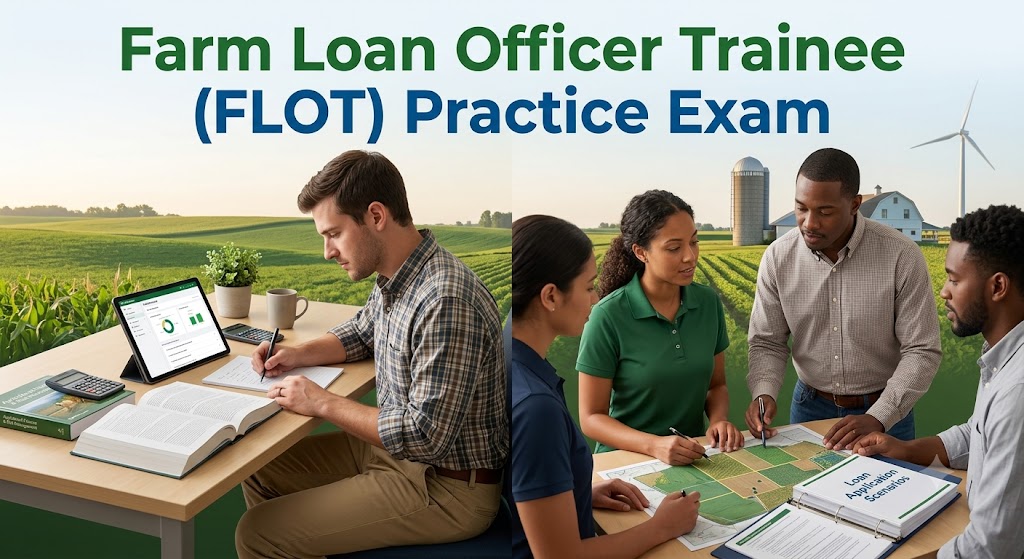
Additional Information
What the Course Entails and Exam Details
The FLOT training curriculum is rigorous and covers a unique blend of financial analysis and agricultural science.
During your coursework, you will master the principles of agricultural lending, including how to structure loans specifically tailored for farming operations.
A significant portion of the syllabus focuses on farm business planning, where you will learn to analyze a farm’s cash flow, balance sheets, and income statements.
You will also dive deep into credit risk assessment, learning how to evaluate the viability of crop yields, livestock markets, and weather-related risks.
Additionally, the training heavily covers federal lending guidelines, loan servicing procedures, environmental compliance, and legal regulations surrounding agricultural real estate and chattel appraisals.
What to Expect in the Final Exam
The final FLOT assessment is designed to test both your theoretical knowledge and your practical application of agricultural finance principles.
You can expect a comprehensive, multiple-choice format that covers regulatory guidelines, financial definitions, and procedural rules.
However, the exam heavily features practical case studies where you must analyze a mock farmer's financial portfolio, identify risks, and determine their eligibility for specific loan programs.
You will likely encounter mathematical components requiring you to calculate debt-to-asset ratios, operating margins, and repayment capacities using provided calculators.
Passing score requirements generally hover around 70% to 80%, depending on the specific agency or institution administering the test.
Time limits are strictly enforced, typically giving candidates between two to three hours to complete the assessment, ensuring you can make accurate financial decisions under pressure.
How to Study and Exam Centers
To succeed on the FLOT exam, your study strategy should be a mix of memorization and practical financial modeling.
Start by thoroughly reviewing agency handbooks, federal lending manuals, and any provided course modules, as these form the foundation of the multiple-choice questions.
Create flashcards for key financial formulas, environmental regulations, and specific loan program requirements.
Practice is crucial; utilize mock case studies to simulate the process of underwriting a farm loan from start to finish.
Regarding exam logistics, if you are employed through a government agency like the USDA, the exam is typically proctored internally at your local, regional, or state headquarters.
For other agricultural credit institutions, you may take the exam through secure online learning portals like AgLearn, or at authorized physical testing centers via providers like Pearson VUE.
Job Opportunities from the Course
Successfully completing the FLOT program and passing the required exams opens the door to a highly stable and rewarding career in agricultural finance.
The most direct path is becoming a Farm Loan Officer, where you will independently manage rural credit portfolios and work directly with local farmers.
You can also pursue a role as an Agricultural Credit Analyst, focusing heavily on the backend financial underwriting and risk assessment of large farming operations.
With experience, this certification paves the way for senior roles such as a Farm Loan Manager or Branch Manager at an agricultural credit union.
Other lucrative avenues include working as a Rural Development Specialist, an Agricultural Mortgage Banker, or a Commercial Ag Lender for major national banks that have dedicated agricultural divisions.
Frequently Asked Questions
Reviews
5.0
Based on 0 reviews
Leave a Review
No reviews yet. Be the first to review!