
Fashion Design Studio State Skills Practice Test
$69.00
- Buy to unlock unlimited access to all Quiz questions and Answers in this Quiz.
- After purchase you can print a PDF of the whole quiz at any point. The PDF will contain the questions and the correct answers.
About this Exam
The Fashion Design Studio State Skills Exam is a comprehensive assessment designed for students completing a high school or post-secondary fashion design and merchandising program. It serves as a validation of essential technical skills and industry knowledge required for entry-level positions in the fashion world. This exam is typically administered at the state level by relevant educational or technical skill agencies (such as CTE or SkillsUSA divisions) to ensure graduates meet industry-aligned proficiency standards. Preparing for this certification signals to employers that a candidate possesses not just creative talent, but also the practical competencies necessary to contribute to a professional design studio environment.
Ready to test your knowledge?
Buy Now to Access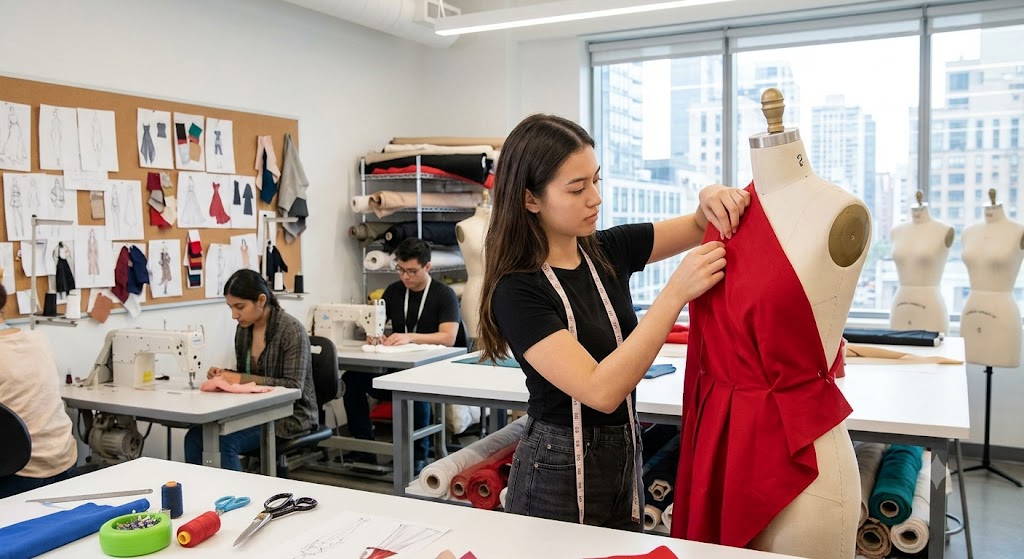
Additional Information
What the Course Entails and Exam Details
The accompanying curriculum, which this exam measures, provides an immersive foundation in the creative and technical lifecycle of apparel. Students delve into a wide range of topics, ensuring they are well-rounded design professionals. The core syllabus generally includes:
Design Fundamentals and History: An exploration of fashion history, textile science, color theory, and the principles and elements of design.
Fashion Sketching and Illustration: Mastering technical flat drawing (flats and specs) and creating croquis-based illustrations.
Textiles and Garment Construction: Understanding different fabric types, weaves, and fibers, alongside practical instruction in sewing techniques, patternmaking (drafting and draping), and apparel production.
Trend Forecasting and Collection Development: Learning the process of research, mood board creation, and developing a cohesive fashion collection.
Visual Merchandising and Retail: Understanding retail math, merchandising strategies, and portfolio development.
Industry Software and Safety: Often including introduction to Computer-Aided Design (CAD) software relevant to the industry, and crucial OSHA-aligned studio safety practices.
What to Expect in the Final Exam
This assessment is typically broken down into two distinct sections to measure both theoretical knowledge and practical application, totaling several hours.
The Written/Theoretical Component: This section is often an online or computer-based test comprising 50 to 100 multiple-choice questions. Topics include fashion vocabulary, textile properties, historic periods, design principles, cost calculation, and production safety standards.
The Performance/Practical Component: The cornerstone of the exam, this timed segment (often 2–4 hours) requires students to demonstrate core technical skills in a proctored studio environment. Students are provided with specific prompts and materials to complete tasks such as:
Pattern Drafting: Creating a basic pattern piece from measurement specifications.
Draping: Correctly pinning and manipulating fabric on a dress form to create a specific silhouette.
Garment Construction: Completing a specific sewing operation or garment segment (e.g., a dart, a placket, or a basic skirt assembly) within a tight time limit, with judges evaluating technique, precision, and efficiency.
Portfolio Review: In some cases, a reviewed portfolio of completed coursework may contribute to the final score.
The passing score requirements are set by the individual state's administering agency, often requiring a proficiency level of 70% or higher across both components to achieve certification.
How to Study and Exam Centers
Successfully preparing for the Fashion Design Studio Skills Exam requires a blend of focused knowledge and intensive hands-on practice.
Review Your Core Curriculum: Revisit all notes, textbooks, and projects from your fashion design program. Pay close attention to definitions, formulas (for retail math), and historic dates.
Take Practice Tests: Seek out sample multiple-choice questions provided by your instructor or the state agency (e.g., using official study guides or platforms like Quizlet). This will help familiarize you with the question format and typical phrasing.
Master the Practical Skills (Intensive Practice): This is critical. Time yourself completing key tasks. Practice draping the same sloper or dart, sewing the same type of seam, or drafting the same pattern multiple times until you can do it quickly, accurately, and without hesitation. Ask for feedback from your instructor on your technique.
Organize Your Portfolio: If a portfolio component is included, ensure your work is professional, well-organized, and showcases your best efforts in design, technical sketching, and construction.
Exam Centers and Registration:
Registration for this exam is generally handled through your high school or technical college CTE coordinator. The exam itself is administered in two possible ways:
Authorized Testing Schools: The practical performance assessment is almost exclusively held within approved fashion design studio classrooms at designated schools or career centers that have the necessary equipment (dress forms, sewing machines, cutting tables).
State Skills Conferences: Often, this exam coincides with a State Leadership and Skills Conference hosted by an organization like SkillsUSA, where students compete and take certification tests simultaneously in a large convention setting. The written component may be taken online shortly before the performance date. Consult your instructor to determine the specific process and official dates for your state.
Job Opportunities from the Course
Graduating from this course and earning the state skills certification confirms your technical foundation, opening doors to a variety of exciting, entry-level career paths in the fashion industry.
Assistant Fashion Designer
Patternmaker/Technical Designer Apprentice
Visual Merchandiser
Fashion Illustrator/Technical Sketcher
Production Assistant (Garment Manufacturing)
Alterations Specialist/Tailor's Assistant
Product Development Assistant
Trend Forecasting Assistant
Quality Control Inspector (Textiles/Apparel)
Frequently Asked Questions
Reviews
5.0
Based on 0 reviews
Leave a Review
No reviews yet. Be the first to review!