
FAU Advanced Health Assessment Practice Test
$69.00
- Buy to unlock unlimited access to all Quiz questions and Answers in this Quiz.
- After purchase you can print a PDF of the whole quiz at any point. The PDF will contain the questions and the correct answers.
About this Exam
Welcome to your guide for the FAU Advanced Health Assessment Practice Exam. This is a crucial milestone for students in Florida Atlantic University's advanced practice nursing programs. The primary goal of this assessment is to prepare future nurse practitioners, clinical nurse leaders, and educators for the complex task of comprehensive patient care. Designed for individuals already licensed as Registered Nurses and pursuing an advanced degree, this exam goes far beyond basic assessment skills. It evaluates your ability to perform in-depth physical, psychosocial, cultural, and cognitive evaluations, which are essential for advanced clinical decision-making. Utilizing a robust practice test as part of your study regimen is an excellent way to prepare, and this guide will show you how. We aim to help you approach this significant academic step with clarity and confidence.
Ready to test your knowledge?
Buy Now to Access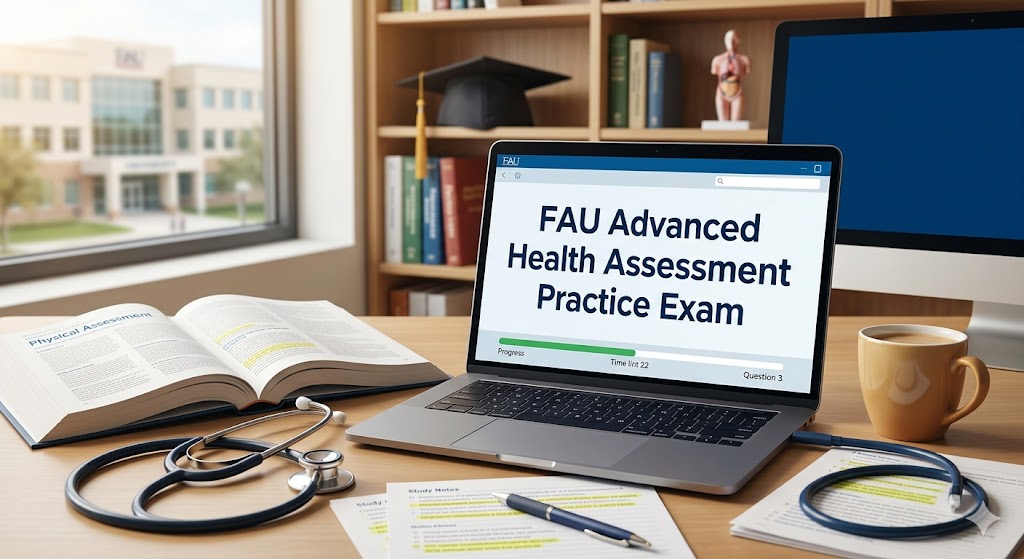
Additional Information
WHAT THE COURSE ENTAILS AND EXAM DETAILS
The FAU Advanced Health Assessment course provides a foundational yet detailed framework for advanced clinical practice. It is structured around several core domains. Students delve into the nuances of taking comprehensive health histories, applying relevant theories, and considering cultural and social determinants of health. You will develop proficiency in performing detailed physical examinations of all major body systems—including neurological, cardiovascular, abdominal, and musculoskeletal. The integration of diagnostic reasoning is paramount, requiring you to interpret assessment findings and laboratory data to formulate differential diagnoses. Ethical and legal aspects of assessment are also thoroughly explored.
The exam itself is designed to test your mastery across all these areas. You should anticipate a combination of complex scenario-based questions that assess your theoretical knowledge and, in some contexts, elements that mimic practical application. The structure aims to ensure you can apply your knowledge to real-world advanced nursing situations, focusing on patient-centered, holistic care. The course syllabus and lectures are your primary resources, but effective practice tests will bridge the gap between understanding the material and applying it under time constraints.
WHAT TO EXPECT IN THE FINAL EXAM
The format of the final Advanced Health Assessment exam typically involves a range of question types, with a focus on comprehensive knowledge and critical thinking. You should prepare for multiple-choice questions, many of which are based on specific patient cases. This means you won’t just be identifying body parts; you will be interpreting a patient's symptoms and examination findings to arrive at a logical next step. Case studies will test your diagnostic reasoning, requiring you to prioritize assessments, order appropriate diagnostic tests, and formulate differential diagnoses.
While some courses may also have a separate practical or objective structured clinical examination (OSCE), the theoretical exam described in guides such as this is often a significant, if not the primary, component of the final assessment for the course. Specific details like passing scores can vary by cohort and program, but you should generally aim for a high level of proficiency, with 80% or above often considered a baseline for strong performance in advanced nursing programs. Time limits are standard to ensure efficient decision-making, which is a vital skill for any advanced practice nurse. Standard academic testing rules and proctoring procedures, whether online or in-person, will apply. A serious commitment to preparation will be required for success.
HOW TO STUDY AND EXAM CENTERS
Success on the FAU Advanced Health Assessment exam requires a strategic, multifaceted approach. First, you should utilize all course materials: review your textbook thoroughly, revisit lecture notes, and engage with any online modules. Creating your own condensed study guide and flashcards for tricky areas like specific physical examination maneuvers and potential findings can be very effective. It’s also crucial to practice your physical examination skills regularly, perhaps on a willing peer or using a high-fidelity simulation model if available. However, a cornerstone of your study plan should be the intentional use of a realistic practice test.
A well-crafted practice exam will not only help you identify knowledge gaps but will also familiarize you with the type and complexity of questions you will encounter. We recommend treating a practice test like the real thing: time yourself, take it in a quiet environment, and resist the urge to look up answers during the test. Afterward, carefully review not just the correct answers but also the detailed rationales for every question. This will deepen your understanding and prevent similar mistakes on exam day. You can often find authorized practice tests within the university’s learning management system, as provided by faculty or course coordinators, or through recognized online educational platforms. Be sure to use resources from reputable sources that align with current Advanced Practice Nursing standards.
Regarding exam centers, as a current FAU student, you will most likely take your exam either through the university’s approved online proctoring system (e.g., Canvas/Respondus) or, in some cases, at an FAU campus testing facility, all managed through your course instructors. FAU’s dedicated testing centers are located on the Boca Raton, Davie, and other campuses. Any necessary proctoring services, scheduling, and standard rules would be communicated by your program, ensuring a structured and secure testing environment, whether virtually or physically.
JOB OPPORTUNITIES FROM THE COURSE
Completion of the Advanced Health Assessment course, and the subsequent master's or doctoral degree it is a part of, opens the door to numerous high-impact careers in healthcare. Passing this exam is a critical step toward graduation and ultimate certification as an Advanced Practice Registered Nurse (APRN). The skills you master are fundamental in these roles, giving you the authority and knowledge to provide a high standard of patient care. Here is a clear list of potential job titles and career paths this course puts you on the road to:
Family Nurse Practitioner (FNP)
Adult-Gerontology Primary Care Nurse Practitioner (AGPCNP)
Adult-Gerontology Acute Care Nurse Practitioner (AGACNP)
Pediatric Nurse Practitioner (PNP)
Psychiatric-Mental Health Nurse Practitioner (PMHNP)
Clinical Nurse Leader (CNL)
Nursing Educator (e.g., Clinical Instructor, Faculty)
Clinical Research Coordinator / Nurse Researcher
Occupational Health Nurse Practitioner
Community Health Clinic Provider
Frequently Asked Questions
Reviews
5.0
Based on 0 reviews
Leave a Review
No reviews yet. Be the first to review!