
FBLA Accounting II Practice Test
$69.00
- Buy to unlock unlimited access to all Quiz questions and Answers in this Quiz.
- After purchase you can print a PDF of the whole quiz at any point. The PDF will contain the questions and the correct answers.
About this Exam
The Future Business Leaders of America (FBLA) Accounting II competitive event is a comprehensive challenge designed for high school students who have gone beyond the fundamentals of bookkeeping.
It targets ambitious individuals who are ready to prove their mastery of advanced financial concepts and ready themselves for a future in the world of business and finance.
This event isn't just a test; it's a stepping stone, validating your advanced skill set and setting you apart as a dedicated, career-focused individual.
Ready to test your knowledge?
Buy Now to Access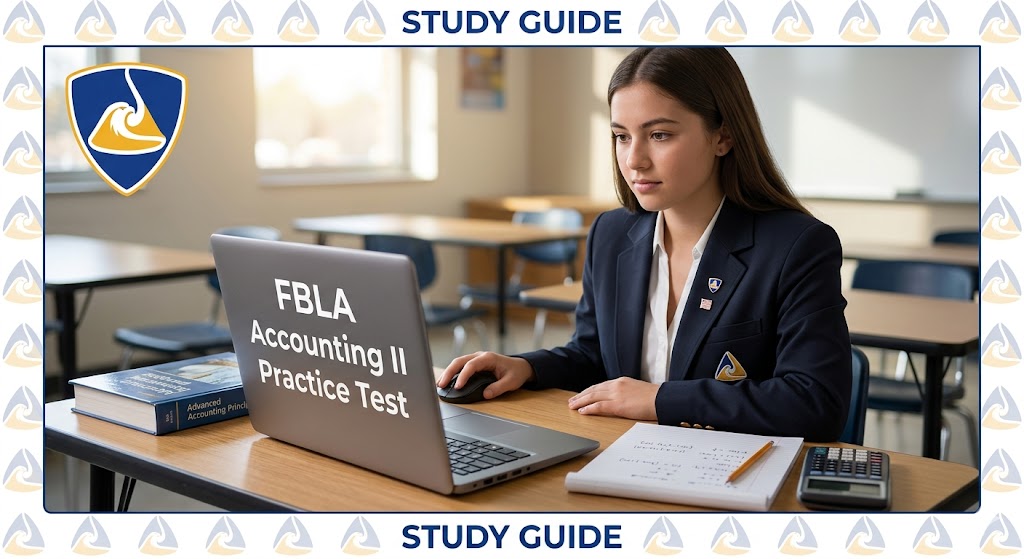
Additional Information
What the Course Entails and Exam Details
To excel in the FBLA Accounting II event, you must demonstrate a deep understanding of complex financial and managerial accounting practices.
The core competencies covered by the official syllabus are extensive, preparing you for the academic and professional challenges that lie ahead. Students should be proficient in the following key areas:
Financial Statements: Preparation, analysis, and interpretation of complex statements, including consolidated financial statements and the statement of cash flows.
Managerial Accounting: Budgeting (master, flexible), variance analysis, cost-volume-profit (CVP) analysis, and decision-making concepts.
Partnership and Corporate Accounting: Formation, allocation of profits and losses, stock transactions, and retained earnings.
Specialized Topics: Accounting for manufacturing (cost accounting), governmental and nonprofit entities, and foreign currency transactions.
Accounting Principles: In-depth knowledge of Generally Accepted Accounting Principles (GAAP) and ethical standards.
Accounting researched and standards application.
What to Expect in the Final Exam
The FBLA Accounting II event culminates in an objective test, which serves as your final exam for the competition. While some states may include a school-site application component at lower levels, the core national event is an objective assessment.
Here is what you can typically expect regarding the format and rules for this critical test:
Format: 100 multiple-choice questions.
Time Limit: 60 minutes.
Method: Proctored, on-site, online testing at your respective regional, state, or the National Leadership Conference (NLC).
Scoring: Each correct answer earns one point. There is no penalty for guessing, so be sure to answer every question. Ties are broken using pre-selected tiebreaker questions on the test.
Aids: Reference materials or external tools are not allowed. You must provide a device for testing and may receive a piece of scratch paper and access to an online calculator within the testing platform. No personal calculators are permitted.
How to Study and Exam Centers
Preparing for the FBLA Accounting II test requires a dedicated study plan that blends theoretical knowledge with practical problem-solving. Success in this event hinges on your ability to work quickly and accurately. Here are actionable study strategies:
Master the Official Guidelines: Your first resource must be the official FBLA competitive event guidelines. Review the full list of competencies for Accounting II.
Use Practice Tests: There is no better preparation than practicing with timed, objective-style tests. You can access sample questions and previous exams through your official FBLA chapter advisor or by logging into your Connect account.
Simulate Exam Conditions: When practicing, create a simulation of the exam environment. Put away your phone, use only an on-screen calculator, and time yourself rigorously for 60 minutes.
Focus on Speed and Accuracy: Practice mental calculations and quick interpretation of problem prompts to build the efficiency needed to complete 100 questions.
Review Advanced Textbooks: Go beyond standard introductory texts and utilize advanced accounting textbooks that cover partnerships, corporations, and managerial accounting in detail.
Where to take the exam: You will take the exam at designated FBLA competition sites during regional, state, and national conferences. These are structured, official testing environments managed by FBLA state and national staff and local proctors, rather than specific public testing centers like Pearson VUE.
Job Opportunities from the Course
Mastering the content of the FBLA Accounting II course provides you with a formidable advantage, unlocking numerous career paths in the high-demand fields of accounting, finance, and business management. This knowledge, coupled with your FBLA competitive experience, demonstrates exceptional career readiness to both universities and potential employers. Here are some of the job opportunities and roles that a strong foundation from this course unlocks:
Accounting Assistant
Bookkeeper
Payroll Clerk
Audit Intern
Tax Intern
Junior Accountant (often requires pursuing a CPA or Bachelor's degree)
Financial Analyst (entry-level)
Budget Analyst Assistant
Cost Accounting Clerk
Account Manager
Frequently Asked Questions
Reviews
5.0
Based on 0 reviews
Leave a Review
No reviews yet. Be the first to review!