
FBLA Exploring Economics Practice Test
$69.00
- Buy to unlock unlimited access to all Quiz questions and Answers in this Quiz.
- After purchase you can print a PDF of the whole quiz at any point. The PDF will contain the questions and the correct answers.
About this Exam
The FBLA Exploring Economics Practice Test is an invaluable tool designed for students eager to dive into the world of economics through Future Business Leaders of America (FBLA). This competition, aimed primarily at middle school and high school members, introduces essential economic concepts that form the foundation of business understanding. By engaging with this practice test, ambitious students can gauge their knowledge, identify areas for improvement, and significantly enhance their preparedness for the official FBLA competition, giving them a head start in academic and future professional endeavors.
Ready to test your knowledge?
Buy Now to Access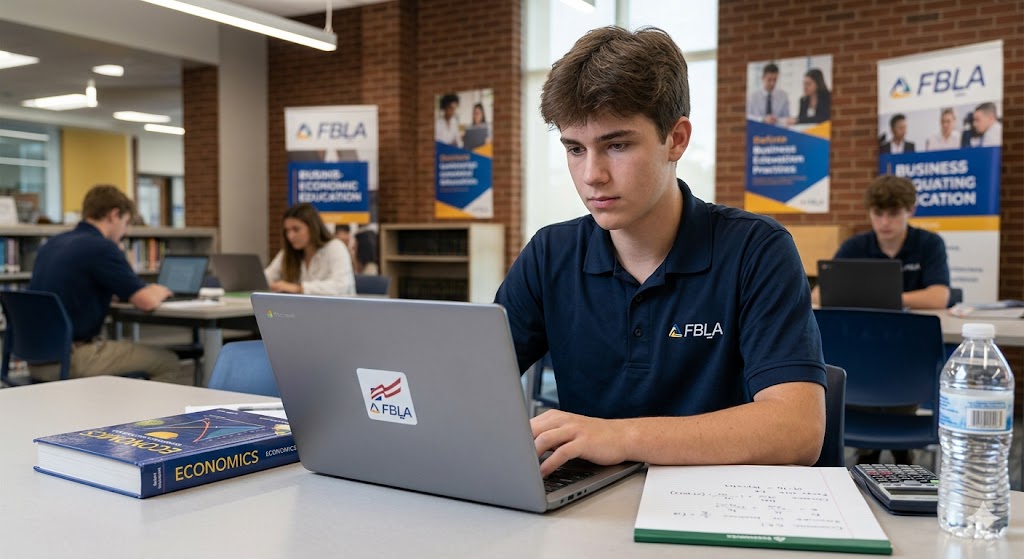
Additional Information
What the Course Entails and Exam Details
The FBLA Exploring Economics challenge focuses on foundational principles that shape our financial and business landscapes. Key topics often include:
Basic Economic Concepts: Scarcity, Opportunity Cost, Rational Decision Making.
Microeconomics: Supply and Demand, Market Equilibrium, Types of Market Structures (Competition, Monopoly, Oligopoly), Consumer and Producer Surplus.
Macroeconomics: Gross Domestic Product (GDP), Inflation, Unemployment, Business Cycles, Fiscal and Monetary Policy.
Money and Banking: The Federal Reserve, Functions of Money, Interest Rates.
Global Economics: International Trade, Comparative Advantage, Protectionism.
Financial Literacy for Young Adults: Basic investing, credit, and budgeting in an economic context.
What to Expect in the Final Exam
The FBLA Exploring Economics competitive event typically consists of a written objective test. Students are presented with multiple-choice questions assessing their understanding of the various economic principles outlined above. While official competition rules vary slightly by state and level (regional, state, national), participants can generally expect an intense, timed examination.
Specific details include:
Time Limit: Often 60-90 minutes, depending on the specific competition level and structure set by FBLA leaders.
Format: The exam typically contains 50 to 100 multiple-choice questions per exam.
Scoring: Correct answers earn points; incorrect answers are not typically penalized, making accurate selection crucial.
Rules: The final exam is proctored. It is an individual competition, not a team event, so students must work independently using designated official online platforms or physical forms, ensuring absolute academic integrity.
How to Study and Exam Centers
Effective preparation combines theoretical knowledge with targeted practice. Start by thoroughly reviewing standard middle or high school economics textbooks. Dive deep into the core concepts list, ensuring you understand the logic behind economic models and graphs. Use this FBLA Exploring Economics Practice Test frequently to simulate real exam conditions and build essential time management skills. Create flashcards for critical terms. Form a study group with other FBLA members to discuss challenging topics and explain complex concepts to each other. Consistent, focused study is the differentiator.
The official FBLA Exploring Economics competition takes place under the supervision of authorized FBLA advisors and chapter leaders. Regional competitions are often held within local school districts or designated community centers. State and National Leadership Conferences serve as the primary "exam centers" for advanced rounds and occur at specific large venues announced annually by FBLA leadership. Many regions now utilize secure designated online portals for written tests, managed securely by FBLA-approved software to ensure integrity.
Job Opportunities from the Course
Mastery of economics at a young age provides a significant advantage for numerous professional pathways. Participating and excelling in events like FBLA Exploring Economics demonstrates key analytical and strategic thinking skills sought after by universities and employers alike. The course of study unlocks paths towards careers in the following fields:
Financial Analyst: Assessing investment opportunities and financial data for corporations.
Economic Consultant: Helping organizations understand market trends and their potential economic impacts.
Policy Analyst: Researching and recommending policies for government agencies, non-profits, or think tanks.
Market Research Analyst: Studying consumer behavior and analyzing dynamic market conditions.
Business Administrator or Manager: Applying economic principles to manage operations and resources efficiently.
Accountant: Handling financial records and ensuring compliance, often grounded in business economics.
Entrepreneur: Using profound economic understanding to evaluate new business ventures and manage risks.
Economist: Conducting research on various economic issues and trends (a path requiring further higher education).
Frequently Asked Questions
Reviews
5.0
Based on 0 reviews
Leave a Review
No reviews yet. Be the first to review!