
FBLA Human Resource Management Practice Test
$69.00
- Buy to unlock unlimited access to all Quiz questions and Answers in this Quiz.
- After purchase you can print a PDF of the whole quiz at any point. The PDF will contain the questions and the correct answers.
About this Exam
Welcome to the comprehensive guide for the FBLA Human Resource Management (HRM) competitive event. This exam is designed for proactive high school students who possess a keen interest in the strategic handling of an organization’s most valuable asset: its people. This certification event provides a platform to showcase your knowledge of essential HR principles, from legal compliance to talent development, preparing you for a future leadership role in the dynamic world of business.
Ready to test your knowledge?
Buy Now to Access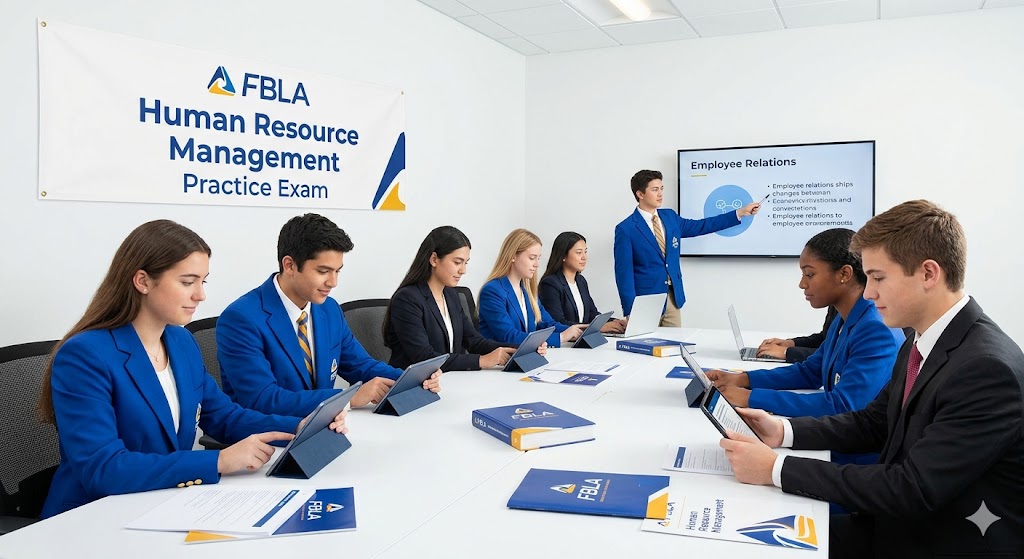
Additional Information
What the Course Entails and Exam Details
This event assesses your comprehensive understanding of human resource management through an individual objective test. The core competencies covered in the FBLA Human Resource Management syllabus include:
Staffing: Understanding the lifecycle of an employee, including recruitment, selection, career planning, and proper execution of Equal Employment Opportunity (EEO) practices.
Training and Development: Exploring methodologies for onboarding, skill enhancement, performance management, and promoting safety and health in the workplace.
Employee Compensation and Benefits: Mastering the fundamentals of designing fair pay structures and understanding the nature of legally required and discretionary benefit plans.
Performance Management: Learning how to evaluate employee contributions effectively and fair-mindedly.
Government Relations and Issues: Navigating the complex landscape of federal labor acts, including anti-discrimination laws, OSHA, and the ADA.
The final exam is a rigorous 100-question multiple-choice assessment, with a time limit of 60 minutes. This test requires not only retention of facts but also the ability to apply HR principles to real-world scenarios.
What to Expect in the Final Exam
When you arrive at the testing site, you can expect an online, proctored testing environment. You must be officially registered for the specific FBLA conference (Regional, State, or National) to compete. The format is exclusively multiple-choice.
Time Limit: You will have exactly 60 minutes to complete the 100-question test. Efficient time management is critical.
Materials: No reference or study materials are permitted. For calculations, an online calculator will be provided within the testing platform.
Scoring: Your final score is determined by the number of correct responses. Ties are broken based on a pre-selected set of tiebreaker questions from within the test, followed by a second, larger set if a tie persists.
How to Study and Exam Centers
Preparation is the key to success. Here are actionable strategies to excel on the FBLA Human Resource Management exam:
Utilize Official Guidelines: Start with the official FBLA High School Competitive Events Guidelines. This document provides the most accurate and up-to-date breakdown of competencies and sub-topics.
Flashcards for Legal Frameworks: There is a significant focus on labor laws. Create digital or physical flashcards for every act (e.g., Civil Rights Act Title VII, ADA, OSHA, FLSA). Include the name, date, and core purpose.
Practice Tests: Seek out past FBLA practice guides and example tests. Simulating the timed conditions is crucial for building your pace and identifying knowledge gaps.
Case Study Analysis: Practice applying HRM concepts to hypothetical workplace scenarios. Don’t just learn a definition; understand how an HR manager would use it to solve a conflict or improve morale.
Exam Centers: This exam is taken on-site at official FBLA conferences. You do not book this at a typical Pearson VUE or Prometric center. The testing process occurs at your:
Regional Leadership Conference (RLC)
State Leadership Conference (SLC)
National Leadership Conference (NLC) (for qualifiers)
Job Opportunities from the Course
A strong performance in the FBLA Human Resource Management event, while not a license, demonstrates specialized knowledge that is highly attractive to future employers and universities. Mastering this content can jumpstart a career path in the following areas:
Human Resources Generalist: Handling multiple HR functions in a smaller organization.
Recruiter / Talent Acquisition Specialist: Focusing on sourcing and hiring the best candidates.
Compensation and Benefits Manager: Designing and managing pay and perk structures.
Training and Development Coordinator: Organizing employee onboarding and skill-building programs.
Employee Relations Specialist: Managing workplace conflicts and maintaining morale.
Labor Relations Associate: Working directly with unions and collective bargaining agreements.
Frequently Asked Questions
Reviews
5.0
Based on 0 reviews
Leave a Review
No reviews yet. Be the first to review!