
FBLA Introduction to Business Communications Practice Test
$69.00
- Buy to unlock unlimited access to all Quiz questions and Answers in this Quiz.
- After purchase you can print a PDF of the whole quiz at any point. The PDF will contain the questions and the correct answers.
About this Exam
Welcome to the comprehensive guide for the FBLA Introduction to Business Communications competition!
This specific event is tailored exclusively for 9th and 10th-grade students, offering a exciting entry point into the world of effective corporate interaction.
It is designed to assess your understanding of essential communication principles used in professional settings, helping you build a strong foundation for future business endeavors and other competitive events.
Ready to test your knowledge?
Buy Now to Access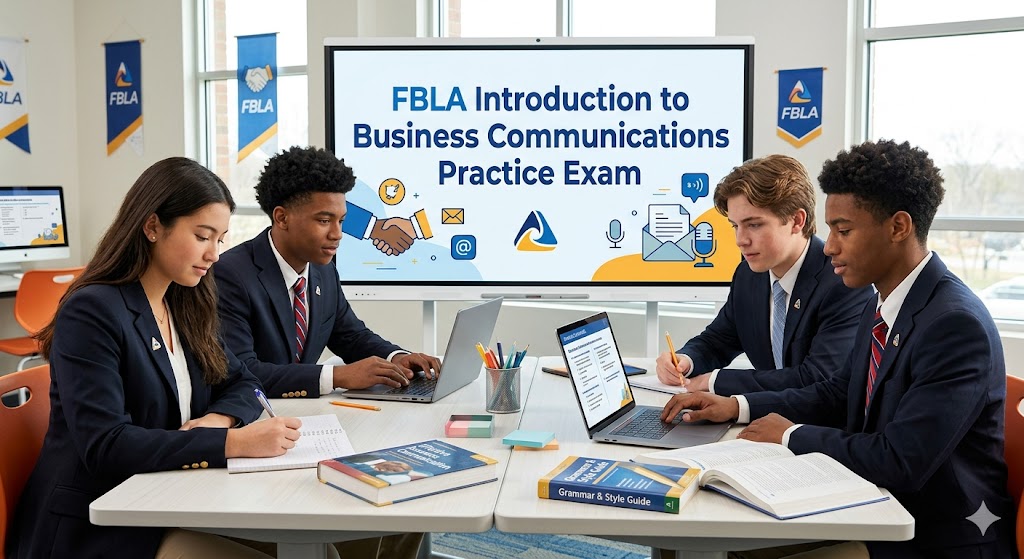
Additional Information
What the Course Entails and Exam Details
This competition doesn’t have a traditional "course" syllabus you might find in school, but rather tests your knowledge across critical business communication competencies.
To succeed, you should master a diverse range of topics:
Grammar, Punctuation, and Spelling: The foundational rules of the English language applied professionally.
Proofreading and Editing: Developing a keen eye for errors in written communication.
Word Usage and Definition: Choosing precise and impactful words.
Oral Communication Concepts: Principles of effective speaking, listening, and presentation skills.
Reading Comprehension: Understanding and interpreting various business documents.
Written Business Correspondence: Formats, styles, and best practices for emails, letters, memos, reports, and proposals (e.g., block, modified block, and semi-block formats).
Interpersonal and Verbal Communication: Effective one-on-one and group interactions.
Nonverbal Communication: Interpreting body language, facial expressions, and other cues.
Active Listening Skills: Techniques to truly understand and reduce errors.
Communication Barriers: Identifying obstacles such as language, culture, and noise.
Social Media in Business: Ethical and professional use for branding and outreach.
Ethics in Communication: Upholding honesty, confidentiality, and respect.
Audience Analysis: Tailoring messages based on demographics and needs.
Presentation Skills: Organizing content, designing visual aids, and delivering engaging presentations.
The actual event takes the form of an objective test. Here are the key exam details:
Format: 100 multiple-choice questions.
Time Limit: 50 minutes.
Scoring: One point for each correct answer; no penalty for guessing.
Competition Level: Students compete regionally, with high placers advancing to state and national leadership conferences.
Requirements: You will typically need a sharpened pencil, scratch paper, your photo ID, and proper FBLA attire (and potentially a conference-provided nametag). Some states may utilize online testing portals for initial rounds, requiring a fully powered device and internet access. Be sure to check with your specific region/state FBLA guidelines.
What to Expect in the Final Exam
The actual competitive exam is an intense, timed experience designed to test not only your knowledge but also your ability to think quickly under pressure.
Expect all 100 questions to strictly adhere to the multiple-choice format, covering any of the competencies listed in the official event guidelines.
The 50-minute time limit is demanding, meaning you have exactly 30 seconds per question, so efficient time management and decisive answering are crucial.
There are absolutely no outside resources allowed – this is a closed-book, independent test taken in a proctored environment, whether on paper or on a computer screen.
Scores are based solely on the number of correct answers, so it is beneficial to answer every question even if you are unsure.
Ties are common at competitive events and are typically broken by comparing the number of correct answers on pre-determined, key questions on the test.
Success in the FBLA Intro to Business Communications competition requires significant advance preparation and the ability to stay focused under tight constraints.
How to Study and Exam Centers
Preparation is key, and here are actionable strategies to excel:
Utilize Official Guidelines: Start with the official FBLA Introduction to Business Communications event guidelines, which precisely outline all tested competencies.
Take Practice Tests: Actively use practice tests – like this illustrative guide suggests – to familiarize yourself with question types and timing. Seek out sample questions and past exams (though remember, the actual test content changes each year) through your FBLA adviser or reputable online resources.
Master Content: Dive deep into the specific knowledge areas. Review grammar rules, business writing examples, nonverbal communication cues, and practice creating different types of business correspondence. Use study guides, Quizlet decks created by other FBLA members, and foundational business communication textbooks.
Drill Time Management: Time yourself rigorously on practice questions to get used to the pace required for 100 questions in 50 minutes.
Study with Chapter Members: Form a study group with fellow FBLA members for support, diverse perspectives, and mock test scenarios.
Consult Your FBLA Adviser: Your faculty adviser is your best resource – they often have access to past materials, study guides, and valuable advice from previous years.
Regarding Exam Centers:
The specific testing process varies:
Regional/Chapter Level: Many students take their initial competitive exams within their school or at a local chapter location, proctored by their adviser. Check with your chapter adviser on how and where this initial round is conducted.
State & National Leadership Conferences: If you advance, the tests are administered in large, controlled, proctored environments at official conference venues, such as convention centers or large hotels. These events often use extensive online testing systems or traditional paper formats, all in a dedicated, high-stakes setting.
Online Portals: Some specific FBLA programs or states may use online testing platforms for certain rounds – follow your local/state instructions carefully and ensure you meet any technical requirements (e.g., using a fully powered device with reliable internet access).
The core testing, however, is almost always handled securely within the FBLA infrastructure and competitive event structure, not through independent public testing centers. Always connect with your FBLA adviser for accurate information and required procedures.
Job Opportunities from the Course
Mastering the skills covered in the FBLA Introduction to Business Communications competition equips you for a variety of roles that heavily rely on clear and effective communication:
Administrative Assistant
Customer Service Representative
Marketing Communications Associate
Executive Assistant
Content Writer
Public Relations Assistant
Human Resources Assistant
Office Manager (entry-level)
Sales Support Specialist
Internal Communications Specialist
Business Analyst (entry-level, focusing on clear documentation and presentation)
Frequently Asked Questions
Reviews
5.0
Based on 0 reviews
Leave a Review
No reviews yet. Be the first to review!