
FBLA Introduction To Parliamentary Procedure Practice Test
$69.00
- Buy to unlock unlimited access to all Quiz questions and Answers in this Quiz.
- After purchase you can print a PDF of the whole quiz at any point. The PDF will contain the questions and the correct answers.
About this Exam
The FBLA Introduction to Parliamentary Procedure competition is designed to test a student's fundamental knowledge of the rules of order used to conduct effective and efficient business meetings. This event is part of the Future Business Leaders of America's extensive competitive events program. It is specifically aimed at younger high school members, typically those in 9th and 10th grade, who are new to the concepts of parliamentary law. By mastering these principles, students gain essential skills for effective leadership, critical thinking, and structured decision-making, which are highly valued in both corporate boardrooms and non-profit organizations. This practice test is a crucial stepping stone for students to familiarize themselves with the content and format before the official conference competition.
Ready to test your knowledge?
Buy Now to Access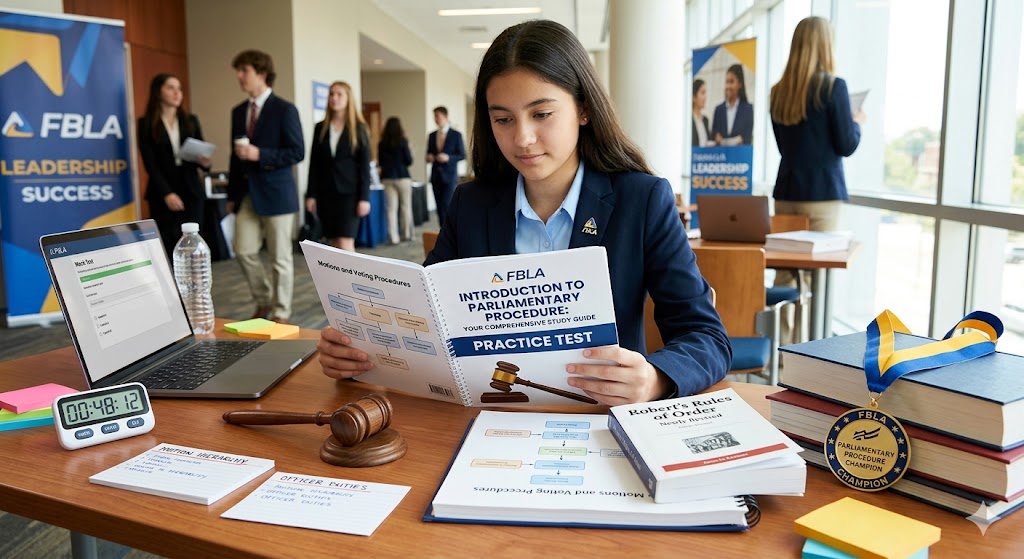
Additional Information
What the Course Entails and Exam Details
This event is not a "course" in the traditional sense, but a specific competition based on a defined set of competencies. The knowledge required for the FBLA Introduction to Parliamentary Procedure practice test is based primarily on the principles in Robert’s Rules of Order Newly Revised (RONR). The material covers:
Basic Parliamentary Concepts: Understanding the purpose of parliamentary procedure, principles of meeting structure, and the logic behind an order of business (30%).
Motions and Voting Procedures: Knowing how to make, second, state, and debate motions, as well as the types of voting and the necessary votes required for passage (35%).
Meeting Roles and Responsibilities: Understanding the specific duties and authority of key officers, including the Chair (President), Secretary, Vice President, and Parliamentarian (15%).
Rules of Order and Meeting Conduct: Mastering the process for managing the meeting, handling points of order, making appeals, and applying general rules to maintain decorum (20%).
Students are expected to study these topics to a level appropriate for an introduction, focusing on the most common and essential rules rather than the complexities of advanced parliamentary law.
What to Expect in the Final Exam
The actual FBLA Introduction to Parliamentary Procedure exam is a single, competitive element. It is not a pass/fail test, but an objective test that ranks competitors. Here is the format you can expect:
Format: A multiple-choice objective test containing 100 questions.
Time Limit: Competitors are given a total of 50 minutes to complete the exam.
Permitted Items: Students must bring pencils. No reference materials, calculators, cell phones, or any other electronic devices are allowed in the testing room. Scrap paper is typically provided by the event administrators.
Scoring: Your score is determined solely by the number of correct answers. There is no penalty for incorrect answers, so it is in your best interest to attempt every question.
Ties: In the event of a tie, pre-determined questions (typically the last 10-20 on the test) are used to break it. The completion time may also be a secondary tie-breaker at some conference levels.
How to Study and Exam Centers
Preparation for this competition requires a blend of conceptual understanding and memorization. We recommend a structured study plan:
Master the "Classes of Motions" and their Hierarchy: Create a comprehensive chart detailing the purpose, precedence, debatable, amendable, and vote required for the main motion and all privileged, subsidiary, and incidental motions.
Study Official FBLA Materials: Review the competitive event guidelines provided by FBLA-PBL on their website. These documents often include sample questions and specific competencies.
Use a Parliamentary Authority: While the official authority is Robert's Rules of Order Newly Revised, an "in Brief" version or a well-regarded introduction to RONR will provide a more digestible explanation for a student's first attempt.
Take Multiple Practice Tests: Leverage practice tests like this one to get comfortable with the wording of parliamentary questions and to identify areas of weakness.
Use Flashcards: Create flashcards for officer duties, motion definitions, and voting terms.
Exam Centers and Procedures
The FBLA Introduction to Parliamentary Procedure exam is a closed competition. You cannot sign up to take it at a public testing center like Pearson VUE. It is administered directly at official FBLA Conferences at the District, State (State Leadership Conference - SLC), and National (National Leadership Conference - NLC) levels. Students take the exam in a large, proctored testing hall, often on provided laptops, as most FBLA objective tests are now online.
Job Opportunities from the Course
A strong grasp of parliamentary procedure is a fundamental leadership skill, not just a contest entry. While a single FBLA introduction competition doesn't grant a standalone certification, it is a key differentiator on a resume that signals to future employers your understanding of structured decision-making and formal organizational governance. The proficiency unlocked by mastering parliamentary procedure opens doors to various leadership and administrative career paths:
Executive Leadership (e.g., CEO, President, Chief Operating Officer): Essential for running formal board of directors meetings and ensuring corporate compliance with bylaws.
Organizational Management (e.g., Board Member, Committee Chair, Executive Director): Vital for making effective group decisions and managing the flow of business in any non-profit, association, or government agency.
Legislative Services (e.g., Parliamentarian, Legislative Aide, Clerk): A direct application of the skill to advise public bodies, such as state legislatures or city councils, on procedural law.
Corporate Governance Specialist: Advising boards and executives on the rules of order and best practices for compliance and shareholder meetings.
Professional Parliamentarian: A consultant who is hired to preside over or advise conventions, annual meetings, and board sessions.
Administrative Management: Ensuring proper record-keeping and meeting minutes are prepared in accordance with the rules of order.
Frequently Asked Questions
Reviews
5.0
Based on 0 reviews
Leave a Review
No reviews yet. Be the first to review!