
FBLA Introduction to Supply Chain Management Practice Test
$69.00
- Buy to unlock unlimited access to all Quiz questions and Answers in this Quiz.
- After purchase you can print a PDF of the whole quiz at any point. The PDF will contain the questions and the correct answers.
About this Exam
The FBLA Introduction to Supply Chain Management competitive event is designed for high school members (typically grades 9 and 10) who are interested in exploring the foundational concepts of managing the flow of goods, services, and information from origin to consumer. This event provides an early introduction to the critical business function responsible for creating efficient, cost-effective, and resilient supply chains. Students will demonstrate their understanding of basic terminology, processes, and the strategic importance of this global industry. This event serves as an excellent starting point for those considering a career in logistics, operations, purchasing, or general business management.
Ready to test your knowledge?
Buy Now to Access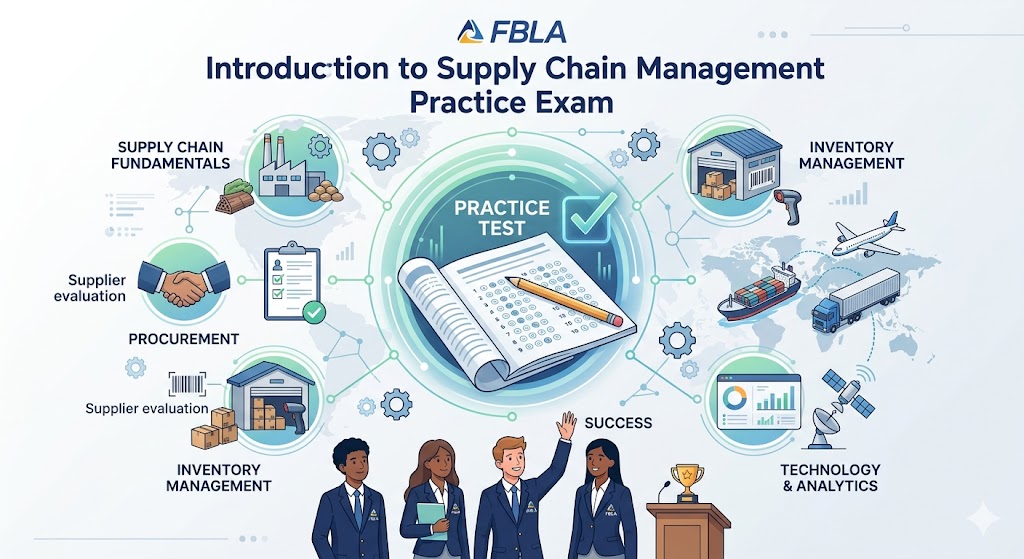
Additional Information
What the Course Entails and Exam Details
This competitive event focuses on essential competencies within the supply chain field. While FBLA doesn't require a specific prerequisite course, successful participants study the following core topics to prepare for the objective test:
Supply Chain Management Fundamentals: Definition, components, and the primary objectives of an efficient supply chain.
Procurement and Sourcing: Understanding how companies find, evaluate, and select suppliers to obtain raw materials or products.
Inventory and Warehouse Management: Key techniques for controlling stock levels, including Just-In-Time (JIT) and Economic Order Quantity (EOQ), and the purpose of warehouse operations.
Logistics and Transportation: Different modes of transporting goods (air, sea, rail, road) and the factors that influence distribution strategies.
Technology in the Supply Chain: The role of technology, such as Enterprise Resource Planning (ERP) systems, in tracking, forecasting, and managing the chain.
Global Supply Chain Considerations: An overview of challenges in international trade, including tariffs, customs, and risks.
Sustainability and Ethical Sourcing: A basic understanding of the importance of environmental responsibility and ethical practices in supply chains.
What to Expect in the Final Exam
The final competition for this event consists of an objective test. You will not be required to perform a practical demonstration or presentation. Here are the key details about the test format:
Test Format: The exam is comprised of 100 multiple-choice questions.
Time Limit: You will have exactly 60 minutes (1 hour) to complete the entire test. This requires efficient time management, averaging less than one minute per question.
Question Types: Questions will test your ability to recall definitions, apply basic principles to simple scenarios, and identify key components of supply chain operations.
Scoring: Each correct answer is worth one point. There is no penalty for an incorrect answer, so it is in your best interest to answer every question.
Advancement: To qualify for the state or national leadership conferences, you must achieve one of the top scores at your preceding competition level. Ties are often broken by looking at scores within specific sub-content areas.
How to Study and Exam Centers
Preparation is crucial for success in a knowledge-based event. Use these strategies to maximize your score:
Review the Official FBLA Guidelines: Always start by reading the current year's competitive event guidelines on the national FBLA website. It contains the official topic list and weighting, which tells you which areas to focus on most.
Use Practice Tests: Leverage the [FBLA Introduction to Supply Chain Management Practice Test] mentioned in this guide. Practice tests help you become familiar with the style, difficulty, and phrasing of actual exam questions under timed conditions.
Create Flashcards: Supply chain management has a unique vocabulary. Create flashcards (digital or physical) for key terms like "Bullwhip Effect," "3PL (Third-Party Logistics)," "Lead Time," "RFID," and "Intermodal Transportation."
Consult Standard Textbooks: Review relevant sections of introductory business or marketing textbooks. Some resources dedicated to introduction to logistics can also provide a solid foundation.
Participate in Chapter Study Sessions: Collaborate with fellow FBLA members who are competing in similar events to discuss concepts and quiz each other.
Where to Take the Exam
The FBLA Introduction to Supply Chain Management test is proctored as part of the official FBLA competitive events program. You will typically take the exam at one of the following locations:
Your School: Many local chapter preliminary tests are administered at your own school, overseen by your FBLA adviser.
Regional Competition Centers: If you advance, you will take subsequent exams at designated local or regional competition sites.
State Leadership Conference: State-level competitors take the exam on-site during the state conference.
National Leadership Conference: National qualifiers compete face-to-face at the NLC. In some cases, initial rounds of testing may use authorized online proctoring portals.
Job Opportunities from the Course
A strong performance in this FBLA event demonstrates a concrete understanding of one of the most critical sectors of the modern economy. It can pave the way for numerous entry-level positions and career paths. Here are job roles that this knowledge base can unlock:
Supply Chain Coordinator: An entry-level role assisting with the tracking, movement, and documentation of goods.
Logistics Analyst: Uses data to help a company optimize its transportation routes, warehousing, and delivery schedules.
Inventory Planner: Responsible for monitoring stock levels and generating orders to ensure a business meets demand without holding excess inventory.
Purchasing Agent/Buyer: Focuses on sourcing materials, negotiating contracts, and purchasing goods for an organization.
Operations Assistant: Supports daily operational activities within a factory, warehouse, or distribution center.
Customer Service Representative (Logistics): The first point of contact for clients, providing tracking updates and resolving order issues related to shipping.
Frequently Asked Questions
Reviews
5.0
Based on 0 reviews
Leave a Review
No reviews yet. Be the first to review!