
FBLA Network Design Practice Test
$69.00
- Buy to unlock unlimited access to all Quiz questions and Answers in this Quiz.
- After purchase you can print a PDF of the whole quiz at any point. The PDF will contain the questions and the correct answers.
About this Exam
The Future Business Leaders of America (FBLA) Network Design competition is a premier event for high school students aiming to showcase their expertise in networking technologies and infrastructure. It is a team-based event that challenges members to apply their knowledge to design, implement, and troubleshoot network solutions tailored to specific business needs. This comprehensive study guide focuses on the "FBLA Network Design Practice Test," an invaluable simulation designed to prepare students for the objective test component of the official competition. The practice test is ideal for FBLA members who want to build a foundational understanding of complex network systems and refine their test-taking skills to excel in the regional, state, and national leadership conferences.
Ready to test your knowledge?
Buy Now to Access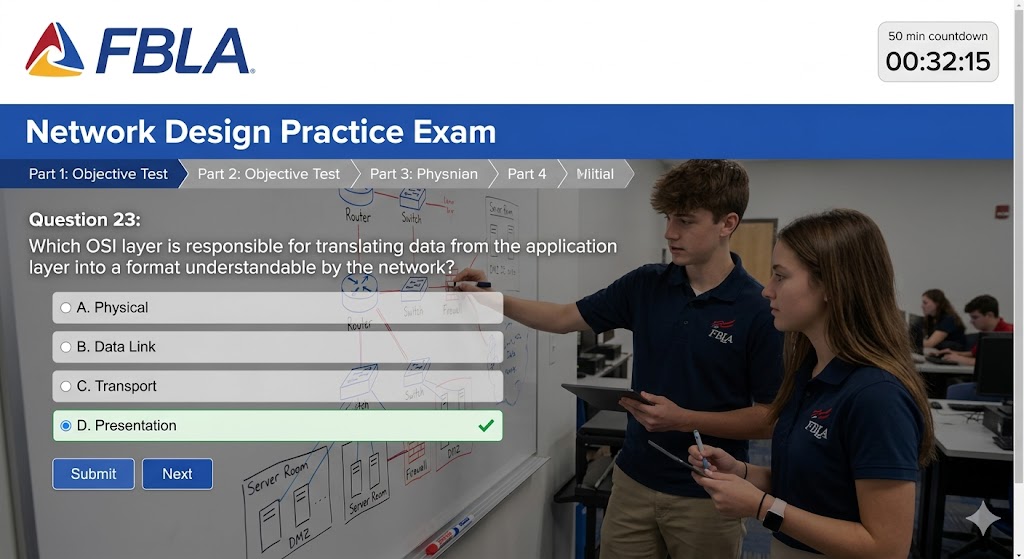
Additional Information
What the Course Entails and Exam Details
This practice test mirrors the scope of the FBLA Network Design objective event. While it isn't a traditional "course," mastering the topics it covers requires a deep understanding of network principles. The curriculum aligns with standard networking certifications (like CompTIA Network+) and covers the following key competencies:
Network Planning: This section covers defining network requirements, selecting appropriate topologies (star, mesh, bus, ring), designing for scalability, and creating comprehensive network documentation.
Network Installation and Configuration: Students must understand physical media (twisted pair, fiber optic), connecting hardware (routers, switches, wireless access points), and configuring network interface cards and basic device settings.
Network Protocols, Services, and Access: This critical area includes a thorough understanding of the OSI model, TCP/IP, UDP, common protocols like DHCP, DNS, HTTP, FTP, and SMTP, and various remote access technologies.
Network Administration: Students will be tested on network management concepts, user account administration, resource sharing, and basic performance monitoring.
Network Security and Recovery: This covers identifying network vulnerabilities, implementing security measures (firewalls, encryption, VPNs, multi-factor authentication), and disaster recovery planning, including backup strategies.
The FBLA Network Design Practice Test provides a simulated environment of the first part of the competition, which is the individual objective test.
What to Expect in the Final Exam
When you take the FBLA Network Design Practice Test, you are stepping into a simulation of the actual competitive event. Here is a breakdown of what to expect in a typical high-quality practice exam:
Format: The exam consists entirely of 100 multiple-choice questions. These questions test both conceptual knowledge and practical scenario-based application.
Time Limit: To simulate the real event, the practice test should be completed within a 50-minute timeframe. This averages to just 30 seconds per question, emphasizing the need for quick recall and efficient problem-solving.
Scoring: Like the official event, a passing score is generally not a set number. Instead, the top individual scores from each team are averaged to determine placement and qualify the team for the presentation round.
Rules: The practice test environment often simulates the constraints of a proctored setting. This means no external study materials, textbooks, or internet searches should be used. Use only a basic, non-programmable calculator.
How to Study and Exam Centers
Preparation for the FBLA Network Design Practice Test must be strategic to master the depth of material and the speed required for success.
Actionable Study Strategies:
Official FBLA Resources: Begin with the competitive event guidelines on the national FBLA website. They provide the official topic list and sample questions.
Certification Study Guides: Utilize resources designed for foundational networking certifications, such as CompTIA Network+ or Cisco Certified Network Associate (CCNA), to gain a deep conceptual understanding.
Use Network Simulation Tools: Gain hands-on experience without physical hardware using tools like Cisco Packet Tracer, GNS3, or online network diagramming software. Practice designing topologies and troubleshooting configurations.
Take Multiple Practice Tests: Do not just rely on one. Use a variety of practice tests to expose yourself to different question styles and to improve your speed and stamina.
Collaborate as a Team: Although the objective test is taken individually, the performance event is a team presentation. Discussing practice questions as a group enhances learning and builds the collaborative skills needed for the final round.
Exam Centers and Access:
FBLA Network Design Practice Test: These are not taken at a physical "center." They are typically accessed online via educational portals provided by your local FBLA advisor, specific testing platforms, or study guide publishers.
The Actual FBLA Competition: The official, proctored objective tests are held sequentially at the Regional, State, and finally the National Leadership Conference. Each level serves as a qualifier for the next, with the actual test taken at an authorized testing room at the conference venue.
Job Opportunities from the Course
Mastering the knowledge required for the FBLA Network Design competition directly translates into valuable skills for a variety of in-demand careers in information technology and cybersecurity. This experience sets a strong foundation for a future in the digital infrastructure sector.
Network Administrator: Responsible for the day-to-day operation, maintenance, and security of an organization's network systems.
Network Engineer: Focuses on high-level design, implementation, and optimization of network infrastructure.
IT Security Specialist / Cyber Security Analyst: Protects network systems from cyber threats, vulnerabilities, and unauthorized access.
Systems Analyst: Evaluates and designs IT systems, including networks, to meet business requirements.
Network Support Technician: Provides troubleshooting and support to users experiencing network connectivity issues.
Network Architect: Designs the overarching structure of complex computer networks, including local area networks (LANs), wide area networks (WANs), and intranets.
Frequently Asked Questions
Reviews
5.0
Based on 0 reviews
Leave a Review
No reviews yet. Be the first to review!