
FCCLA FCSA Etiquette Practice Test
$69.00
- Buy to unlock unlimited access to all Quiz questions and Answers in this Quiz.
- After purchase you can print a PDF of the whole quiz at any point. The PDF will contain the questions and the correct answers.
About this Exam
The FCCLA FCSA (Foundations of Career and Technical Education, Career Skills Assessments) Etiquette Practice Exam is a valuable educational resource designed for current and future members of FCCLA (Family, Career and Community Leaders of America) and students interested in developing key professional and social skills. This practice test serves as a crucial preparation tool, mirroring the content and style of the final FCSA etiquette assessment that students may encounter as part of their FCCLA experience. The actual final exam evaluates your understanding of fundamental manners, social conduct, and proper behaviors in various situations, reinforcing the intracurricular skills taught through Family and Consumer Sciences (FCS) education. Achieving success in this area enhances your employability, confidence, and ability to lead effectively within your chapter, school, and community.
Ready to test your knowledge?
Buy Now to Access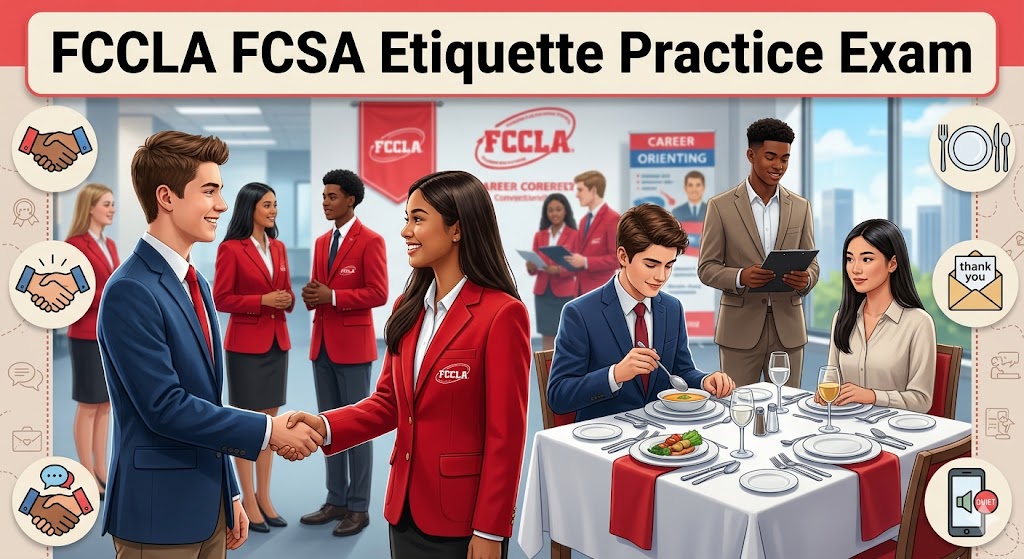
Additional Information
What the Course Entails and Exam Details
The etiquette content covered by this practice test is broad and practical, encompassing both foundational knowledge and real-world application. While specific state and conference versions might vary, the following core topics are typically addressed:
Social & Introduction Etiquette: Proper ways to introduce yourself and others, appropriate greetings (including handshakes), understanding respect for authority and personal space.
Dining Manners: Basic and formal table etiquette, utensil usage, proper behavior during meals, understanding table settings.
Communication Skills: Effective verbal and non-verbal communication, polite listening, assertive vs. aggressive communication, and respectful discourse.
Professional Conduct: Dress codes for various settings (including FCCLA official dress), punctuality, accountability, and appropriate workplace behavior.
Digital Etiquette: Proper manners for phone use, email communication, social media, and virtual interactions in professional and personal contexts.
Conflict Resolution: Approach to handling disagreements politely and constructively, recognizing diverse perspectives.
Gratitude and Consideration: The importance of saying please, thank you, sending thank-you notes, and demonstrating empathy towards others.
This practice test is an objective assessment that allows students to review and apply knowledge gained in FCS courses and through FCCLA activities. By taking this practice exam, students gain familiarity with the test structure, common question types, and key concepts, enabling them to identify areas for improvement before taking a potentially required certification.
What to Expect in the Final Exam
While you are preparing with this practice test, it’s important to understand the typical nature of the actual FCCLA FCSA final exam for this subject. The specific format can be determined by state or regional guidelines, but you can generally expect:
Question Type: FCSAs are subject-oriented, objective tests. This typically means multiple-choice and potentially true/false questions.
Administration: The actual exam is often administered during Regional Leadership Conferences (RLC) or State Leadership Conferences (SLC). It might be an online or device-based test.
Device Requirement: Students are often responsible for bringing their own fully charged electronic device (laptop, tablet, etc.) with internet access to the testing venue.
Passing & Medals: Scores on FCSA tests generally correlate with recognition. Typically, a passing score within a specified range allows members to receive a gold, silver, or bronze certificate or medal, acknowledging their proficiency. Exact scoring ranges can vary but often use a 70-100 point scale.
Specific Rules: All competitive event guidelines, including FCSA details, are usually found in the official FCCLA Competitive Events Guidelines for the current year. Students must be in official FCCLA dress code to take the final test.
Practice Component: Remember, the FCCLA FCSA Etiquette Practice Exam itself is your tool to prepare for this environment and knowledge check!
How to Study and Exam Centers
Successfully preparing for the FCCLA FCSA Etiquette Practice Exam and the final assessment requires a proactive approach. Here are actionable study strategies and information on where to find the test:
Actionable Study Strategies:
Utilize Official Resources: First and foremost, consult your FCCLA chapter advisor for access to state-specific FCSA guidelines, sample questions, and any available official study materials. FCCLA often provides specific etiquette resources and curriculum through their chapter tools and FCS programs.
Take the Practice Test Repeatedly: Engaging with this very practice exam is key! Review the questions you missed to understand the concepts and improve with each attempt. Time yourself if possible to build comfort with test-taking speed.
Review FCS Etiquette Materials: If you are enrolled in FCS classes, revisit your notes and textbooks related to dining, professionalism, and social manners.
Explore Reputable Etiquette Guides: Use reputable online guides, etiquette books (general and specific for youth or professionalism), and educational videos to reinforce and broaden your knowledge. Focus on both traditional manners and modern etiquette (digital, professional).
Create Flashcards: Make flashcards for key terms, types of dining utensil, dress code definitions, and etiquette scenarios.
Practice in Real Life: Make a conscious effort to apply good manners in your daily life – at school, work, during family meals, and online. Observing proper etiquette will make the concepts much easier to remember.
Study with Peers: Form a study group with fellow FCCLA members to discuss scenarios, quiz each other, and practice dining or introduction skills together.
Exam Centers & Registration:
FCSA Adminstration: The actual FCSA exams are generally not administered at common commercial testing centers like Pearson VUE. Instead, they are typically offered through approved proctors, most frequently within the school setting under the supervision of a chapter advisor or at FCCLA Regional/State Leadership Conferences.
Online Portals: The test is often accessed via an approved online platform or portal specific to FCCLA or FCS assessments during a designated testing window.
Registration: Registration for the final FCSA assessment is generally done through the standard FCCLA conference or event registration system by your chapter advisor. There may be a registration fee associated with the final exam.
State Variations: Specific procedures, platforms, and registration details can differ significantly by state FCCLA associations, so always consult with your chapter advisor for accurate information specific to your location.
Job Opportunities from the Course
While the FCCLA FCSA Etiquette qualification is not a direct requirement for a specific job title in itself, the skills it cultivates are highly sought after by employers across countless industries. Strong social and professional etiquette are transferable soft skills that significantly enhance your career readiness and can unlock pathways in fields like:
Hospitality and Tourism (Customer Service, Event Planning, Hotel Management, Tour Guide)
Public Relations and Communication (Spokesperson, Media Relations, Corporate Communications)
Sales and Marketing (Client Relations, Account Management, Sales Representative)
Human Resources (Recruiting, Employee Relations, Training & Development)
Education and Training (Teacher, Corporate Trainer, Youth Mentor)
Management and Leadership Roles across all sectors
Customer Service & Support across all sectors
Non-Profit & Community Organization (Program Coordinator, Community Liaison, Advocacy)
Wait Staff & Server
Administrative Assistant
Retail Associate
Frequently Asked Questions
Reviews
5.0
Based on 0 reviews
Leave a Review
No reviews yet. Be the first to review!