
FCCLA Parliamentary Procedure Practice Test
$69.00
- Buy to unlock unlimited access to all Quiz questions and Answers in this Quiz.
- After purchase you can print a PDF of the whole quiz at any point. The PDF will contain the questions and the correct answers.
About this Exam
The FCCLA Parliamentary Procedure STAR Event is a highly respected competitive event within the Family, Career and Community Leaders of America (FCCLA) organization. Designed primarily for middle and high school students who are FCCLA members, this event is focused on developing an in-depth understanding and practical application of parliamentary law. It evaluates participants on their ability to conduct a business meeting effectively and efficiently, fostering essential leadership, public speaking, decision-making, and critical thinking skills within a structured governance model. The written knowledge assessment is a crucial part of this overall competition, and this practice test serves as a valuable tool for students to measure their readiness and build confidence in their grasp of parliamentary rules and procedures.
Ready to test your knowledge?
Buy Now to Access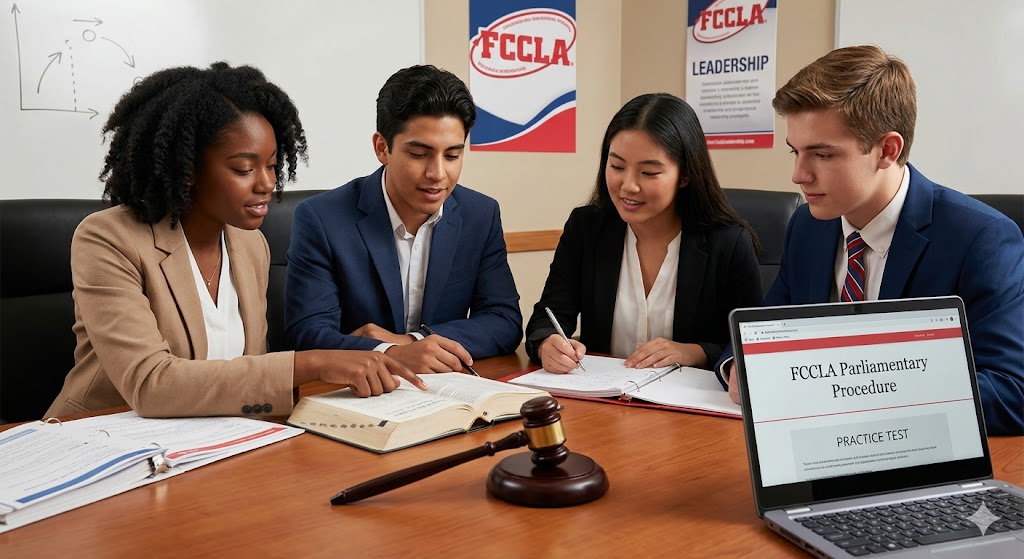
Additional Information
What the Course Entails and Exam Details
While not a conventional "course," preparing for the Parliamentary Procedure STAR Event and its accompanying knowledge test involves a dedicated study of foundational governance principles and procedural rules, largely based on authoritative sources like Robert's Rules of Order Newly Revised.
Core topics and skills you need to master include:
Principles of Parliamentary Law: Understanding the rationale behind rules that maintain order, respect all opinions, ensure majority rule, and allow a group to focus on one item at a time.
Meeting Structure and Order of Business: Familiarity with the standard sequence of events, including the call to order, opening ceremonies, approval of minutes, reports, unfinished business, new business, closing ceremonies, and adjournment.
Types of Motions and Their Classification: Mastering the detailed structure of parliamentary motions (main, subsidiary, privileged, incidental, and unclassified), including their ranking, and the rules governing each—such as if a motion requires a second, is debatable, can be amended, and the necessary vote for approval.
Voting Methods: Knowing the standard ways to take a vote (voice vote, rising vote, secret ballot, roll call) and when specific methods are appropriate or required.
Roles of Officers: Understanding the duties and correct procedures for the meeting chair (or president), secretary, parliamentarian, and other official roles.
What to Expect in the Final Exam
It's important to understand that the "final exam" here refers specifically to the Knowledge Test component of the broader FCCLA Parliamentary Procedure competitive event. The overall event also involves a presentation/demonstration part.
Exam Format: The knowledge test is a written assessment, almost always consisting of multiple-choice questions. It tests your theoretical understanding of terms, motion rules, procedural sequences, and officer roles based on the official guidelines.
Time Limit: Participants typically have a set time limit, often around 30 minutes, to complete this part of the orientation/test session at their respective FCCLA competition level.
Scoring: Your score on this knowledge test contributes a significant portion to your team's total competitive score. A higher test score greatly enhances your team’s performance level and potential for awards and advancement to higher competition levels (Regional, State, or National). There is usually no single "passing" score; success is measured by your performance relative to other teams and your ranking within the competition structure.
Rules: The test is usually closed-book, and strict competition environment guidelines are in place. The content is directly sourced from the materials specified in the current FCCLA Competitive Events Manual.
How to Study and Exam Centers
Effective study and knowing how to access the competition are critical for your success in FCCLA's Parliamentary Procedure event.
Actionable Study Strategies:
Thoroughly Review Official Rules: Your advisor and the latest FCCLA Competitive Events Manual are your primary guides. These documents explicitly state the requirements, scoring criteria, and official sources for the knowledge test.
Master Robert's Rules: Dedicate study time to the specific edition of Robert's Rules of Order Newly Revised specified by FCCLA. Pay close attention to motion rankings and the "cheat sheet" rules for each type of motion.
Practice with this Test and Others: Utilize this FCCLA Parliamentary Procedure Practice Test. Look for official FCCLA practice materials or additional study resources provided by advisors or state-level organizations. Repeated practice helps cement your knowledge and improve recall speed.
Group Study & Mock Meetings: Form study groups with your teammates. Quiz each other, run mock meetings, and take turns assuming different officer roles. This active participation reinforces procedural knowledge in a practical context.
Rehearse the Presentation: Do not neglect the non-test components. Practicing running a clean, efficient mock meeting for your demonstration will inevitably strengthen your understanding of the rules you’ll be tested on.
Exam Centers:
Not a Standard Testing Center: You will not find the final knowledge test for this event at public testing centers like Pearson VUE or at typical academic testing locations.
Official FCCLA Events: The actual knowledge test is administered only at official FCCLA Leadership Conferences. These conferences are organized and run by FCCLA leadership at the Regional, State, and National levels.
Consult Your Advisor: Your FCCLA chapter advisor is the only way to register and receive information about official study resources, the location of regional or state conferences, and all specific guidelines for competing. All communication and entry into the competition go through official FCCLA channels.
Job Opportunities from the Course
While the FCCLA Parliamentary Procedure experience is not a job-training course, the comprehensive knowledge and transferable skills acquired are highly respected in numerous professional fields. The expertise you develop in governance, communication, and leading structured meetings can significantly advance your career prospects in many paths, including:
Attorney / Legal Professional: Procedural clarity and adherence are core to legal practice and non-profit/corporate governance.
Political Candidate / Elected Official: Masterful navigation of legislative meetings is critical for success in government roles at all levels.
Public Administrator: Leading city councils, school boards, and public meetings efficiently requires deep knowledge of parliamentary law.
Corporate Executive: Skills in directing ordered meetings, managing boards of directors, and understanding bylaws are invaluable at top corporate levels.
Non-Profit Board Member / Leader: Helping non-profits operate effectively and legally through sound governance.
School Board Member / Administrator: Guiding school district decisions and facilitating orderly board and faculty meetings.
Legislative Aide: Providing crucial support in a politician’s office, involving legislative research and procedural assistance.
Professional Parliamentarian / Facilitator: A career specifically dedicated to guiding groups through proper meeting procedures.
Meeting Planner / Coordinator: Planning and managing orderly business meetings for various organizations.
Association Manager: Leading professional associations, trade groups, or community organizations requires deep procedural skills.
Conflict Mediator / Arbitrator: Applying procedural fairness and structure in dispute resolution.
Human Resources Manager: Utilizing structured, clear procedures for workplace governance.
Lobbyist: Effectively navigating governmental and legislative bodies.
Frequently Asked Questions
Reviews
5.0
Based on 0 reviews
Leave a Review
No reviews yet. Be the first to review!