
FDEP Water Treatment C Practice Exam
$69.00
- Buy to unlock unlimited access to all Quiz questions and Answers in this Quiz.
- After purchase you can print a PDF of the whole quiz at any point. The PDF will contain the questions and the correct answers.
About this Exam
The FDEP Water Treatment C certification is a vital credential for anyone wishing to launch or advance their career in the drinking water treatment industry in Florida. This certification, administered by the Florida Department of Environmental Protection (FDEP), confirms a professional’s fundamental understanding of safe and effective potable water production. It is designed for entry-to-intermediate-level operators who are responsible for the day-to-day operation and maintenance of water treatment plants. By achieving this certification, operators demonstrate their competence to protect public health and ensure compliance with environmental regulations. It’s an essential step towards becoming a licensed professional in this critical field.
Ready to test your knowledge?
Buy Now to Access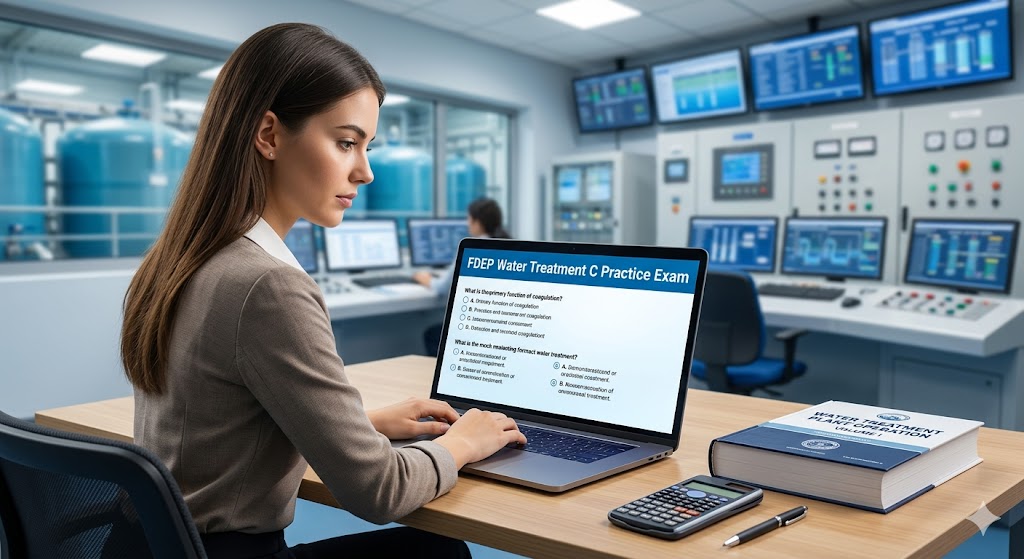
Additional Information
What the Course Entails and Exam Details
Before taking the final exam, candidates are typically required to complete an FDEP-approved training course, which covers the core principles and practices of water treatment. These comprehensive courses ensure students possess the necessary technical knowledge. Core topics covered in the training and tested in the exam include:
Regulatory Framework: Understanding federal and state drinking water regulations, such as the Safe Drinking Water Act and specific Florida Administrative Code chapters (62-550 and 62-602), is fundamental.
Water Sources and Treatment: Learning about various water sources, their characteristics, and common treatment processes like aeration, coagulation, flocculation, sedimentation, filtration, disinfection, fluoridation, and stabilization.
Safety Procedures: Essential safety protocols for chemical handling (including chlorine), confined space entry, electrical safety, and general plant safety are covered.
Operational Controls: Understanding equipment monitoring, pumping systems, chemical feed systems, process flow control, and routine plant operations.
Calculations: Proficiency in performing mathematical calculations related to flow rates, chemical dosages, detention times, filter loading rates, and efficiencies is critical.
Sampling and Analysis: Knowing how to properly collect and analyze water samples for parameters like pH, turbidity, chlorine residual, color, and microbiological quality.
Maintenance: Understanding the basic maintenance required for plant equipment, instruments, and structures.
The actual FDEP Water Treatment C exam is typically a comprehensive multiple-choice test. While the exact details can vary, here are some general expectations:
Number of Questions: The exam often consists of approximately 100 questions.
Time Limit: Candidates are usually given 3 or 4 hours to complete the exam.
Passing Score: Achieving a score of 70% or higher is generally required to pass. (Please always verify the most current and specific details directly with FDEP, as these are subject to change).
What to Expect in the Final Exam
On exam day, you should expect to be in a controlled testing environment, possibly at a designated state center or via an approved computerized testing vendor. You will likely face 100 multiple-choice questions designed to test your technical knowledge and practical application skills through scenarios. The questions will be well-distributed across the core topics listed above, with a significant emphasis on regulatory compliance and critical operational decisions. The time pressure can be a factor, so it’s important to manage your time wisely. Be prepared for potentially complex calculation questions, for which a basic, non-programmable calculator is typically allowed. Ensure you bring proper identification and any other required materials as specified in your exam registration. The environment is proctored, and standard rules regarding misconduct will be strictly enforced.
How to Study and Exam Centers
Effectively preparing for the FDEP Water Treatment C exam requires a structured approach. Use these actionable study strategies to increase your chances of success:
Utilize Official Study Materials: Obtain and thoroughly review the recommended study guides and textbooks, such as the relevant manuals from the California State University at Sacramento (CSU Sacramento) Water and Wastewater program. These are often the foundation for course curriculum.
Review FDEP Resources: Consult the FDEP website and official guidelines for updated information on rules, regulations, and exam procedures. Pay close attention to Chapters 62-550 and 62-602 of the Florida Administrative Code.
Practice with Sample Exams: Find reputable sources of practice questions and mock exams. Look for questions that mirror the style, format, and difficulty of the actual test to build your confidence and identify weak areas. Ensure you are using high-quality practice materials.
Focus on Math and Calculations: Dedicate significant time to practicing water math problems. Create flashcards for common formulas and work through numerous dosage, flow, and efficiency calculations until they become second nature.
Create Detailed Flashcards: Use flashcards for key terms, definitions, regulatory limits, chemical characteristics, and treatment process details.
Form a Study Group: Collaborative study can be highly effective. Discussing concepts, working through problems together, and testing each other can enhance understanding and retention.
Consider an Exam Prep Course: Enrolling in a dedicated exam preparation course, like those offered by universities and technical institutions, can provide a focused review and expert guidance.
When you are ready to take the exam, you must first register. The application and scheduling process is typically handled through official FDEP channels or authorized third-party testing vendors. Check the latest FDEP guidance for instructions on:
Registration Portals: Where to apply and pay the necessary fees.
State-Approved Centers: Finding specific physical locations within Florida where the exam is administered.
Computer-Based Testing Options: Understanding if and where online or proctored computerized testing is available.
Educational Institutions: Some approved training providers may also facilitate or host the exam for their students.
Job Opportunities from the Course
Successfully completing the FDEP Water Treatment C certification course and passing the exam unlocks a range of critical and rewarding career paths in the water treatment sector. Becoming a certified operator demonstrates technical proficiency and opens doors to various roles. Here are some key job opportunities this certification can lead to:
Certified Water Treatment Operator (Class C): This is the direct career path, working as an operator at a drinking water treatment facility, performing operational tasks, monitoring processes, adjusting treatment parameters, and ensuring regulatory compliance.
Water Quality Technician: With your strong understanding of sampling and analysis, you could work in a laboratory or field setting, focusing specifically on testing water quality at various stages of the treatment process.
Lead Water Plant Operator: With experience, your Class C certification is a crucial stepping stone to becoming a lead operator, supervising shifts and other operators.
Senior Water Plant Operator: Further experience and potentially higher levels of certification allow for progression to more senior operator roles with greater responsibility.
Water Utility Supervisor / Superintendent (with experience): While requires significant years and possibly higher-level licensing, this path leads to management roles overseeing entire water treatment plant operations and staff.
Frequently Asked Questions
Reviews
5.0
Based on 0 reviews
Leave a Review
No reviews yet. Be the first to review!