
FDIC AIDT Ready-To-Work (RTW) – Money Smart Practice Exam
$69.00
- Buy to unlock unlimited access to all Quiz questions and Answers in this Quiz.
- After purchase you can print a PDF of the whole quiz at any point. The PDF will contain the questions and the correct answers.
About this Exam
This practice exam serves as a critical preparation tool for the FDIC AIDT Ready-To-Work (RTW) "Money Smart" final assessment. It is not the final exam itself, but rather a comprehensive study resource designed to simulate the types of questions and topics covered. The Ready-To-Work program, part of the FDIC's broader Money Smart initiative, aims to equip individuals entering the workforce or seeking career advancement with essential financial literacy skills. The primary audience includes high school students, college attendees, transitioning veterans, and anyone aiming to improve their basic financial management abilities for greater employability.
Ready to test your knowledge?
Buy Now to Access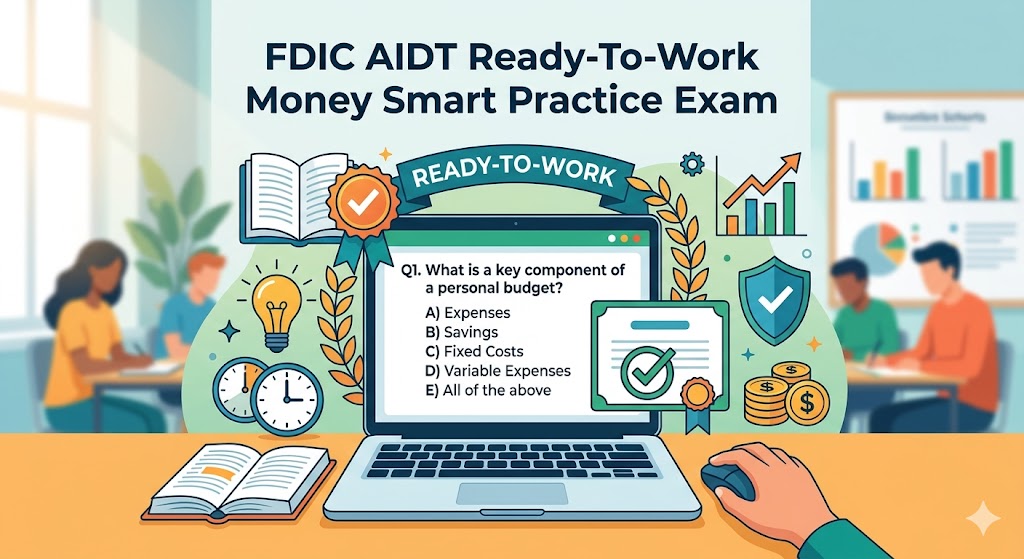
Additional Information
What the Course Entails and Exam Details
The Ready-To-Work "Money Smart" curriculum focus is on foundational personal finance concepts applied to a workplace and career context. The practice exam, reflecting the underlying coursework, will cover key areas such as:
Understanding Your Pay: Deciphering paystubs, understanding deductions (taxes, benefits), and different payment methods.
Saving and Budgeting: The importance of saving, creating a realistic budget, and setting financial goals.
Borrowing Basics: The cost of borrowing, different types of loans, and responsible credit management.
Checking Accounts and Banking Services: Selecting a bank, using checking and savings accounts, and understanding electronic banking options.
Consumer Protection: Recognizing predatory lending practices, managing debt, and protecting your identity.
Using Credit Wisely: Building and maintaining a good credit score, understanding credit reports, and managing credit cards.
Protecting Your Finances: Understanding insurance options and basic security measures to prevent financial fraud.
What to Expect in the Final Exam
While individual experiences may vary, a standard FDIC Ready-To-Work "Money Smart" final exam typically follows a multiple-choice format. You can expect a series of questions (e.g., 20-30 questions) assessing your understanding of the curriculum's core financial principles. The exact passing score and time limits can vary slightly depending on the specific program or organization administering the test, but a standard passing score is often around 70-80%, with a time limit of 30-45 minutes to complete the assessment. It's a closed-book exam. This practice exam is designed to mimic these parameters as closely as possible to build your confidence and familiarity with the test structure.
How to Study and Exam Centers
The best strategy for studying for the FDIC Ready-To-Work "Money Smart" exam is a blend of reviewing the course material and practical application. Begin by working through the official "Money Smart" learning modules, which are often available as interactive online courses or via instructor-led workshops. Take diligent notes, ensuring you grasp key definitions and understand how financial concepts like interest or budgeting work. Use this practice exam repeatedly to identify weak points and reinforce areas where you are strong. For the final exam, the test itself is rarely taken at a standalone commercial testing center like Pearson VUE. Instead, the final "Money Smart" Ready-To-Work exam is often administered through the organization or educational institution that provided the training. This includes high schools, colleges, non-profit community organizations, career centers, and potentially certain government-sponsored employment programs. Contact the program where you are receiving your "Ready-To-Work" training for specific instructions on scheduling and taking the actual final exam.
Job Opportunities from the Course
Successfully completing the "Ready-To-Work" (RTW) "Money Smart" certification, along with achieving your career-specific training, demonstrates to employers that you possess critical foundational financial skills, which can distinguish you for entry-level positions and career-path roles across many industries. Examples of job opportunities that this program can help unlock include:
Customer Service Representative (especially in financial services or banking)
Administrative Assistant (requiring basic organizational and financial awareness)
Retail Sales Associate (understanding transactions and customer financial options)
Bank Teller or Teller Trainee (direct application of banking and transaction knowledge)
Bookkeeper Assistant (foundational support role needing financial literacy)
Logistics or Warehouse Associate (many companies value basic cost/budget understanding)
Hospitality Front Desk Agent (handling guest accounts and basic transactions)
Call Center Support (supporting financial products or services)
Call Center Collector (understanding credit and debt management)
Frequently Asked Questions
Reviews
5.0
Based on 0 reviews
Leave a Review
No reviews yet. Be the first to review!