
FDNY Non-Fire Emergency Response Practice Test
$69.00
- Buy to unlock unlimited access to all Quiz questions and Answers in this Quiz.
- After purchase you can print a PDF of the whole quiz at any point. The PDF will contain the questions and the correct answers.
About this Exam
The Fire Department of New York (FDNY) is not just about battling blazes; it also plays a critical role as the city’s primary responder to all types of emergencies. This study guide focuses on the FDNY’s non-fire emergency response, designed for dedicated individuals aspiring to fill crucial roles such as Emergency Medical Technicians (EMTs), paramedics, specialized rescue technicians, and hazardous materials responders within the department. This certification pathway is essential for those who want to be on the front lines, providing life-saving care, managing dynamic and dangerous scenarios, and ensuring public safety in the face of medical crises, technical rescues, and potential disasters. Mastering these skills is not just about passing an exam; it’s about preparing yourself for a rewarding career dedicated to serving the diverse communities of New York City and making a life-saving difference every single day.
Ready to test your knowledge?
Buy Now to Access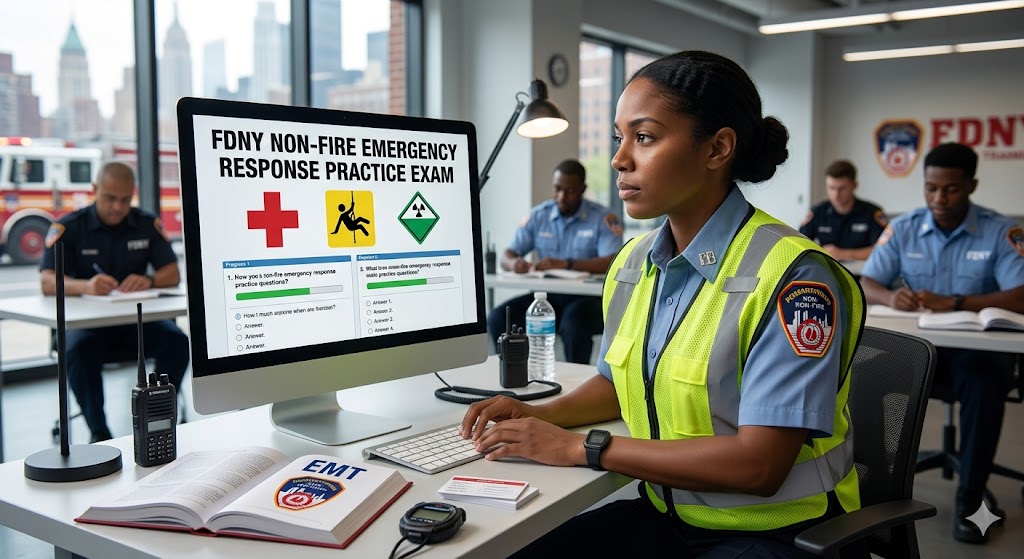
Additional Information
WHAT THE COURSE ENTAILS AND EXAM DETAILS
The comprehensive preparation for FDNY non-fire emergency response roles encompasses a diverse range of critical skills and knowledge areas. The core topics generally include:
Emergency Medical Services (EMS) Fundamentals: In-depth training in patient assessment, airway management, CPR, automatic external defibrillator (AED) use, oxygen administration, and managing a wide array of medical emergencies (respiratory distress, cardiac issues, diabetic crises, etc.) and traumatic injuries.
Patient Care Protocols: Adherence to strict New York State and regional EMS protocols and standards of care.
Safety and Operations: Understanding scene safety, personal protective equipment (PPE), infection control, emergency vehicle operations, communication procedures, and department-specific operational guidelines.
Hazardous Materials (Hazmat) Awareness: Basic and potentially advanced knowledge for identifying and safely responding to incidents involving hazardous substances, depending on the specific role.
Specialized Rescue Concepts: Introductory to advanced concepts in technical rescue (high-angle, confined space, structural collapse, water rescue), depending on the career path and unit.
NYC Geography and Departmental Procedures: Specific knowledge of the city's complex environment and FDNY's unique procedures for various non-fire situations.
The specific "exam" people are preparing for is usually the comprehensive written or computer-based certification exam required for their desired level (e.g., NYS EMT, National Registry of Paramedics) and potentially additional department-specific evaluations or recruitment exams. The practice test is a vital tool to simulate these formats and assess readiness across all relevant content areas. The course you take (whether a state-approved EMT program or internal academy training) provides the foundational knowledge, and the exam validates that mastery.
WHAT TO EXPECT IN THE FINAL EXAM
For operational non-fire roles like EMTs and Paramedics, the final certification exams typically follow specific structures, often administered through state or national organizations (like New York State Department of Health and/or the National Registry of EMTs). You can generally expect:
Exam Format: Most written/computer-based certification exams are primarily comprised of multiple-choice questions. Some, like the Paramedic NREMT exam, can be a Computer Adaptive Test (CAT), meaning the difficulty of questions adjusts based on your performance. Some career paths may also require successful completion of practical skills stations where you must demonstrate your hands-on proficiency in key medical or operational tasks.
Passing Score and Requirements: While exact scoring can vary by year and organization, you will typically need to achieve a predetermined passing percentage. For NREMT exams, scores are presented on a scale with a specified minimum standard. For NYS EMT, you must pass both the written and practical components. A limited number of attempts are generally allowed to pass each part within a certain timeframe (e.g., two years from course completion for NYS EMT).
Time Limits: Computer-based exams are typically timed, with limits clearly stated. For example, the Paramedic NREMT cognitive exam can have a time limit around 3.5 hours. Be sure to check the specific rules for your exam.
Strict Proctoring and Rules: These are professional certification exams and are taken very seriously. Expect strict rules, including mandatory identification checks, prohibitions on electronic devices, and continuous proctoring (either in-person or remote). Failure to adhere to these rules can result in immediate termination of your exam attempt. You may also need to undergo background checks and medical/psychological evaluations as part of the overall hiring process, separate from the content exam.
HOW TO STUDY AND EXAM CENTERS
Preparation is the absolute key to success on any FDNY or associated operational certification exam. Here are actionable study strategies and information on test administration:
Study Strategies:
Utilize Practice Tests and Questions: Take advantage of multiple full-length practice exams. Analyze your results to identify weak areas and understand the types of questions you might encounter. This practice test is an excellent starting point!
Thorough Review of Manuals and Textbooks: Study standard EMT/Paramedic textbooks (like those by AAOS), American Heart Association guidelines, and any specific FDNY operational and training manuals available to you or relevant to your position. Pay close attention to current protocols and safety procedures.
Create Flashcards and Study Guides: Condense key information, medical terminology, abbreviations, and protocols into study aids you can review frequently.
Practice Practical Skills: If your career path includes a practical component, dedice time to repeatedly practicing all requisite skills (patient assessment, splinting, spinal immobilization, etc.) under the guidance of instructors or peers.
Form a Study Group: Collaborate with fellow candidates to discuss complex topics, quiz each other, and practice skills together.
Seek Instructor/Mentor Guidance: Don't hesitate to ask course instructors, current FDNY members, or mentors for clarification and advice.
Simulate Exam Conditions: When taking practice tests, try to simulate real exam conditions – time yourself, minimize distractions, and follow all instructions closely.
Physical and Mental Fitness: Maintain overall wellness. Operational roles are physically and mentally demanding, so being fit and having healthy coping mechanisms is crucial. Ensure you are well-rested before exam day.
Exam Centers and Registration:
The final certification exams are typically not held at regular FDNY stations but rather in designated, proctored testing centers or through secure online portals.
Written/Computer Exams (e.g., NYS EMT, NREMT): These are often administered by contracted testing services like PSI Services LLC or Pearson VUE. After completing your approved course and receiving eligibility notification, you will be directed to their respective websites to register and select a convenient testing date and location at one of their many center in NYC and the surrounding area. Remote proctoring may be an option for some exams.
Practical Skills Components: These are generally scheduled by your course sponsor or regional EMS council and may be held at various approved locations, potentially including training centers or educational facilities.
FDNY Internal Recruitment/Operational Tests: Specific recruitment-related evaluations or internal FDNY operational tests may take place at dedicated department training facilities, such as the FDNY Fire Academy (often referred to as "The Rock" on Randall's Island) or other internal sites. You will receive detailed information on these tests directly from the department if applicable to your hiring process.
JOB OPPORTUNITIES FROM THE COURSE
Successfully completing the necessary certifications, including passing the non-fire emergency response exam(s), is a critical step towards several vital operational roles within the FDNY. These career paths allow you to directly contribute to the department's diverse mission beyond fire fighting:
Emergency Medical Technician (EMT - Basic and possibly Advanced)
Paramedic
Specialized Rescue Technician (within specific specialized units)
Hazardous Materials Technician
Emergency Medical Specialist (EMT/Paramedic command positions)
EMS Dispatcher (requires additional specialized training, but medical knowledge is beneficial)
Potential for promotion to supervisory and training roles within the EMS and specialized response commands.
Frequently Asked Questions
Reviews
5.0
Based on 0 reviews
Leave a Review
No reviews yet. Be the first to review!