
Federal Aviation Regulations Practice Test
$69.00
- Buy to unlock unlimited access to all Quiz questions and Answers in this Quiz.
- After purchase you can print a PDF of the whole quiz at any point. The PDF will contain the questions and the correct answers.
About this Exam
The Federal Aviation Regulations (FAR) certification and its associated tests form the foundational knowledge required for anyone aspiring to enter the aviation industry.
This vital assessment ensures that individuals thoroughly understand the legal and safety frameworks that govern the skies.
It is expertly designed for aspiring private pilots, commercial aviators, certified flight instructors, aircraft mechanics, and even drone operators.
By mastering these rules, you prove your dedication to safety, compliance, and the highest professional standards in aviation.
Ready to test your knowledge?
Buy Now to Access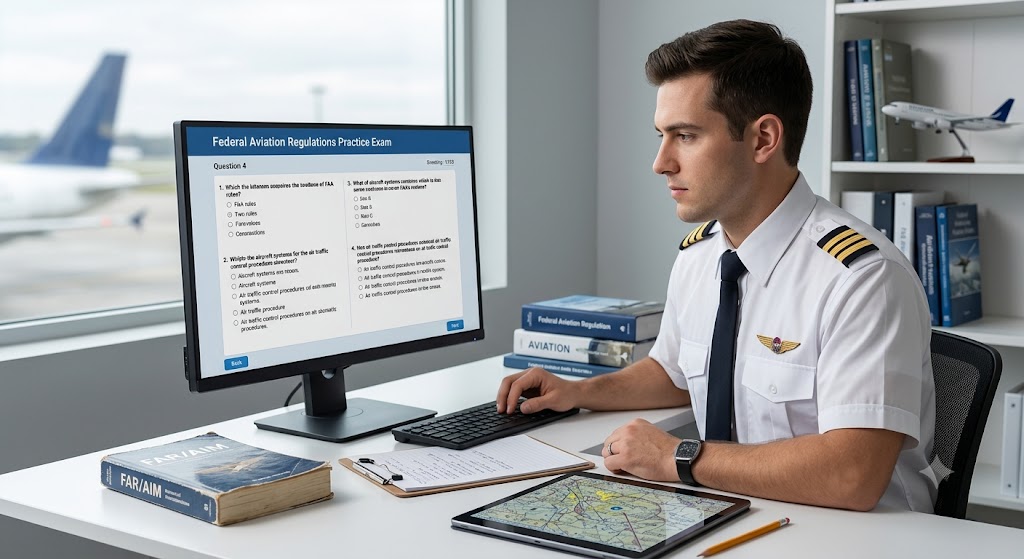
Additional Information
What the Course Entails and Exam Details
Preparing for the FAR exam requires a deep dive into the official rules outlined by the Federal Aviation Administration (FAA).
The core syllabus extensively covers airspace classifications, ensuring you know exactly where and how you can legally operate an aircraft.
You will also study visual flight rules (VFR) and instrument flight rules (IFR), which dictate how to navigate safely in varying weather conditions.
Furthermore, the curriculum covers vital topics like aircraft maintenance requirements, pilot certification standards, minimum equipment lists, and emergency safety protocols.
You will emerge with a comprehensive understanding of the legal responsibilities of the pilot in command.
What to Expect in the Final Exam
The Federal Aviation Regulations are typically tested as a major component of the overarching FAA Airman Knowledge Test.
You can expect a rigorous multiple-choice format, where each question offers three possible answer choices.
To achieve a passing grade, you must score at least 70 percent on the final exam.
Depending on the specific certificate you are pursuing (such as Private Pilot or Commercial Pilot), you will be given a strict time limit ranging from 2 to 2.5 hours to complete the test.
The exam environment is highly secure, meaning personal electronics are strictly prohibited, and you will only be allowed to use an approved flight computer or basic calculator.
How to Study and Exam Centers
Success on this exam relies on consistent preparation and familiarizing yourself with the official FAR/AIM (Federal Aviation Regulations/Aeronautical Information Manual).
One of the most actionable study strategies is to take multiple timed practice exams to build your test-day stamina and identify your weak areas.
Using flashcards to memorize specific regulations, such as visibility minimums and alcohol consumption rules, is also highly recommended.
When you are ready to take the official test, you will need to schedule an appointment through an authorized testing provider.
Currently, all FAA Airman Knowledge Tests are administered exclusively through PSI Services at approved testing centers, which are usually located within local flight schools or dedicated physical testing facilities.
Job Opportunities from the Course
Mastering the Federal Aviation Regulations is the ultimate stepping stone to a lucrative and exciting career in the aviation sector.
A thorough understanding of these laws unlocks the path to becoming a Commercial Airline Pilot, allowing you to fly passengers and cargo globally.
It is also a mandatory requirement for becoming a Certified Flight Instructor (CFI), where you can build your flight hours by teaching the next generation of aviators.
Additionally, this knowledge is critical for Air Traffic Controllers who manage airspace flow and ensure aircraft maintain safe distances.
Other outstanding career paths include working as a certified Aviation Maintenance Technician (A&P Mechanic), a Flight Dispatcher planning commercial routes, or a licensed Commercial Drone Pilot executing aerial photography and surveying missions.
Frequently Asked Questions
Reviews
5.0
Based on 0 reviews
Leave a Review
No reviews yet. Be the first to review!