
Federal Emergency Management Agency (FEMA) Standardized Awareness Practice Test
$69.00
- Buy to unlock unlimited access to all Quiz questions and Answers in this Quiz.
- After purchase you can print a PDF of the whole quiz at any point. The PDF will contain the questions and the correct answers.
About this Exam
The FEMA Standardized Awareness designation is a critical milestone for anyone pursuing a career in emergency management, public safety, or disaster response. It is not just one specific course, but rather a foundational level of competency achieved by completing a suite of essential, all-hazards Independent Study (IS) courses. This comprehensive practice test guide is designed to prepare students for the key exams that establish this standard, including introductory courses on the Incident Command System (ICS), the National Incident Management System (NIMS), and the National Response Framework (NRF). This designation is essential for first responders, government employees at all levels, private sector partners with response duties, and dedicated volunteers who must understand the shared language and structure of disaster response in the United States. Our guide offers a realistic practice experience, helping you identify knowledge gaps, build confidence, and ensure you are ready to pass the official exams.
Ready to test your knowledge?
Buy Now to Access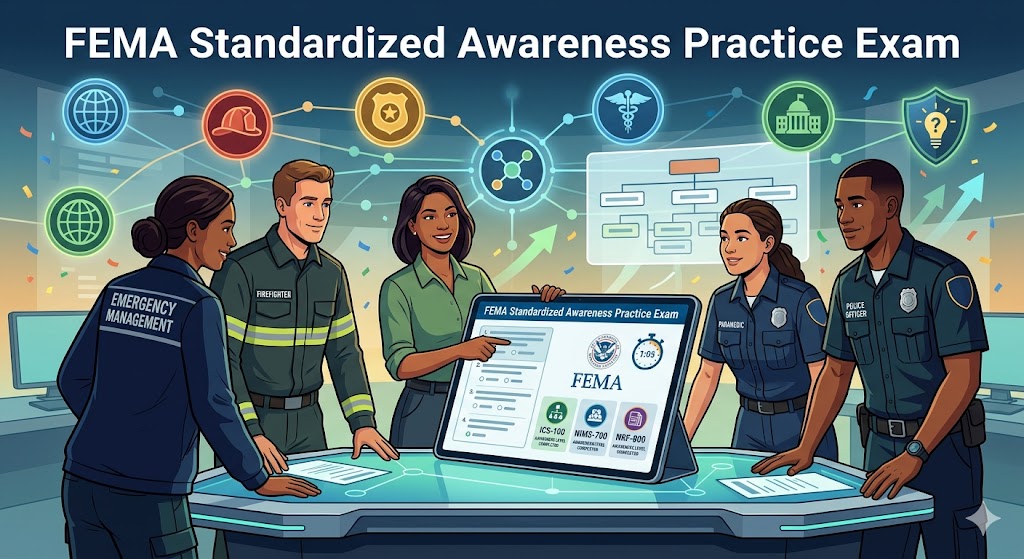
Additional Information
What the Course Entails and Exam Details
Achieving FEMA Standardized Awareness competency involves mastering the core principles of a unified national response. Students must complete individual web-based courses and their subsequent exams.
Key Compulsory Modules for this Designation:
IS-100: Introduction to the Incident Command System (ICS): Introduces the history, features, principles, and organizational structure of the Incident Command System, the bedrock of on-scene incident management.
IS-700: National Incident Management System (NIMS), An Introduction: Provides an overview of NIMS, which provides a consistent nationwide template to enable federal, state, tribal, and local governments, the private sector, and non-governmental organizations to work together effectively and efficiently.
IS-800: National Response Framework (NRF), An Introduction: Covers the purpose, scope, and organization of the National Response Framework, which outlines how the nation responds to all types of disasters and emergencies.
Individual Exam Details: For each of these foundational courses (e.g., IS-100, IS-700, IS-800), the student must take a separate online final exam. The exam format is multiple-choice. Students generally have as much time as they need to complete it, and they can retake the exam multiple times without penalty until they pass. Passing these specific exams collectively validates your achievement of the Standardized Awareness level.
What to Expect in the Final Exam
Each course within the Standardized Awareness suite concludes with its own official examination, delivered online through the FEMA Emergency Management Institute (EMI) portal. Here is what to expect for each individual exam attempt:
Format: The final exam for each foundational course consists of multiple-choice questions.
Number of Questions: For introductory courses like IS-100 and IS-700, you can typically expect a total of 25 to 30 questions derived randomly from a larger question pool.
Passing Score: To pass and receive a certificate of completion for an individual course, you must achieve a score of 75% or higher.
Time Limit: There is typically no formal time limit enforced during the individual Independent Study exams. You should dedicate approximately 60 minutes to complete each exam with care and thoroughness.
Retakes: If you do not pass an exam on your first attempt, you may retake it immediately or at a later time with no penalty. The value of our practice test is to help you pass efficiently, preferably on your first try.
How to Study and Exam Centers
Preparation is the key to success on all FEMA examinations, even introductory ones. Here is the recommended approach to study for the Standardized Awareness level and details on where to take the exams:
Study Strategies:
Download Official Guides: FEMA EMI provides comprehensive Student Manuals and downloadable course materials (PDFs) for each course. Download, read, and thoroughly review these materials as your primary source.
Take Notes: As you study, write down key terms, definitions (e.g., ICS titles, NIMS components), organizational flowcharts, and coordination principles.
Engage with Virtual Content: Many courses offer interactive scenarios or video explanations within the online learning modules. Do not skip these, as they clarify difficult concepts.
Use a Comprehensive Practice Test: Integrate a high-quality practice test (the tool our guide supports) into your final review. It should simulate the type and complexity of questions from all relevant courses, allowing you to test your combined knowledge of ICS, NIMS, and NRF principles.
Exam Centers:
For the FEMA Standardized Awareness suite of courses (IS-100, IS-700, IS-800, etc.), there are no physical testing centers. The exams are taken exclusively online. To access and take the final exams, you must log in to the FEMA Emergency Management Institute (EMI) Independent Study Portal using your FEMA Student Identification (SID) number. This virtual portal serves as your primary location for both studying course materials and taking the final exams.
Job Opportunities from the Course
A strong understanding of FEMA's standardized response systems is a mandatory requirement for hundreds of job roles across the public and private sectors. Achieving the Standardized Awareness level is often the first step to unlocking these career paths:
Emergency Management Specialist
Firefighter (all ranks)
Paramedic / Emergency Medical Technician (EMT)
Law Enforcement Officer (local, state, and federal)
Public Information Officer (PIO)
Disaster Recovery Coordinator
Business Continuity Manager
Hospitals and Healthcare Emergency Preparedness Coordinator
Critical Infrastructure Security Manager (Transportation, Energy, Water)
Non-Profit Disaster Response Lead (e.g., Red Cross, Salvation Army)
Port Authority Operations Specialist
Search and Rescue (SAR) Team Member
Government Program Manager (with response duties)
Private Sector Security and Safety Manager
Frequently Asked Questions
Reviews
5.0
Based on 0 reviews
Leave a Review
No reviews yet. Be the first to review!