
Federation of State Boards of Physical Therapy (FSBPT) Practice Exam
$69.00
- Buy to unlock unlimited access to all Quiz questions and Answers in this Quiz.
- After purchase you can print a PDF of the whole quiz at any point. The PDF will contain the questions and the correct answers.
About this Exam
The National Physical Therapy Examination (NPTE) is the critical gateway for anyone aspiring to become a licensed physical therapist (PT) or physical therapist assistant (PTA) in the United States. Administered by the Federation of State Boards of Physical Therapy (FSBPT), this comprehensive exam assesses the essential knowledge, skills, and judgment required for safe and effective practice. Our FSBPT NPTE Practice Exam is your premier official preparation tool, meticulously designed to simulate the actual exam experience and help candidates understand their readiness. Whether you are a graduating student or a graduate of an accredited physical therapy program, this resource is crafted for you, offering a realistic assessment to boost your confidence and performance when it matters most. Embracing this challenge is a vital step towards your goal of professional licensure and a rewarding career in physical therapy.
Ready to test your knowledge?
Buy Now to Access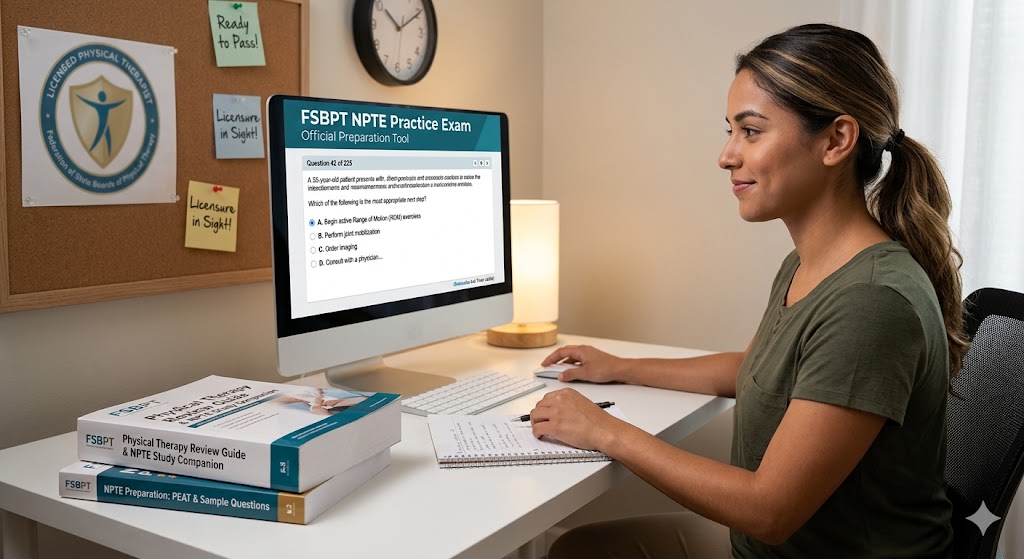
Additional Information
What the Course Entails and Exam Details
The PEAT is not a course but a sophisticated exam simulation that mirrors the complexity and structure of the final NPTE Content Outlines. For both PT and PTA candidates, the practice materials mirror the distribution of questions across critical domains. A fundamental portion of the content covers the evaluation and management of diverse patient conditions within the major body systems, including Musculoskeletal, Neuromuscular & Nervous System, Cardiovascular & Pulmonary, and Integumentary. Candidates will also encounter questions related to other essential body systems such as Metabolic, Endocrine, Gastrointestinal (GI), Genitourinary (GU), and the Immune System. In addition to this deep clinical focus, the NPTE includes substantial "Non-System Domains" that account for approximately 40% of the total questions. These sections are crucial and test practical knowledge in Equipment and Assistive Technologies, Therapeutic Modalities, Safety and Emergency Protocols, Professional and Ethical Responsibilities, and the application of Research and Evidence-Based Practice. PEAT helps you practice applying clinical reasoning to the scenarios presented in these diverse content areas.
What to Expect in the Final Exam
The final licensure examination, the National Physical Therapy Examination (NPTE), is a computer-based, objective test administered at secure testing facilities.
Physical Therapist (PT) Exam Format: The NPTE for PTs consists of 250 multiple-choice questions distributed across five sections. Of these, 200 are scored questions that contribute to your final score, and 50 are unscored pretest items used to evaluate questions for future exams. You will not be able to distinguish between scored and unscored items, so you must treat every question as if it counts. The total testing time is 5 hours. Candidates are provided with one optional 15-minute break after the second section.
Physical Therapist Assistant (PTA) Exam Format: The NPTE for PTAs consists of 200 multiple-choice questions distributed across four sections. This includes 160 scored questions and 40 unscored pretest items. The total testing time is 4 hours. PTA candidates also have an optional 15-minute break after the completion of the second section.
Scoring: For both the PT and PTA exams, results are reported as a scaled score ranging from 200 to 800. A scaled score of 600 or higher is required to pass. The FSBPT uses this system to ensure uniformity in scoring across different forms of the exam. There is no penalty for guessing, so candidates are strongly advised to answer every question.
How to Study and Exam Centers
How to Study: The core of an effective study plan must involve FSBPT's dedicated resources.
Practice Exam and Assessment Tool (PEAT): This is your most powerful asset. PEAT provides full-length, timed practice tests that are psychometrically validated and feature retired NPTE questions. By taking these timed, computer-based practice exams, you can experience a realistic simulation, manage your time effectively, and, most importantly, identify specific areas of strength and weakness through a detailed, diagnostic performance report. Rationales and references are provided for every question, allowing you to turn mistakes into learning opportunities.
Structured Preparation: Start by analyzing your initial PEAT score. Use it to create a structured study calendar that allocates dedicated time to high-yield topics and the often-overlooked Non-System Domains. Use a trusted comprehensive study guide, relevant textbooks, and your coursework notes. Form study groups with peers for mutual accountability and use diverse methods like flashcards or patient scenario discussions. Aim for multiple full-length, timed simulations using PEAT in the weeks leading up to the actual exam to build endurance and reduce anxiety.
Exam Centers: The final NPTE is administered at Prometric testing centers located throughout all 50 U.S. states, Washington D.C., Puerto Rico, the Virgin Islands, Guam, and Canada. The FSBPT does not provide "online" testing from home. After registering with the FSBPT and obtaining an Authorization to Test (ATT) letter, you must schedule your appointment directly with Prometric. You can choose any available test center, which does not need to be in the state where you are seeking licensure. It is highly recommended to schedule your appointment as soon as you receive your ATT, as testing sites fill up quickly, especially on preferred dates.
Job Opportunities from the Course
Passing the NPTE is the absolute and essential step toward achieving licensure as a physical therapy professional. This credential unlocks a wide and fulfilling array of career opportunities across various settings for:
Physical Therapist (PT)
Physical Therapist Assistant (PTA)
Common work settings for both PTs and PTAs include:
Outpatient Physical Therapy Clinics: Treating a wide range of orthopedic, sports, and musculoskeletal injuries.
Hospitals and Acute Care Facilities: Providing immediate post-surgical care, wound management, and early mobility to patients.
Inpatient Rehabilitation Centers: Helping patients with severe neurological or multiple trauma conditions regain independence.
Skilled Nursing Facilities and Long-Term Care: Assisting older adults with mobility and functional maintenance.
Home Health Physical Therapy Services: Working directly with patients in their residential environments.
Sports Medicine and Athletic Training Facilities: Supporting injury prevention and rehabilitation for athletes of all levels.
Pediatric Settings: Treating children with developmental, neurological, or orthopedic conditions in schools or clinics.
Frequently Asked Questions
Reviews
5.0
Based on 0 reviews
Leave a Review
No reviews yet. Be the first to review!