
Fellow Craft Proficiency Practice Test
$69.00
- Buy to unlock unlimited access to all Quiz questions and Answers in this Quiz.
- After purchase you can print a PDF of the whole quiz at any point. The PDF will contain the questions and the correct answers.
About this Exam
The Fellow Craft Proficiency examination is a vital educational milestone for members of Freemasonry who have successfully completed their Entered Apprentice degree and have been passed to the degree of a Fellow Craft.
This assessment is explicitly designed for brethren seeking to demonstrate their understanding of the moral, philosophical, and historical teachings imparted during their second degree.
It serves as a testament to a candidate's dedication and prepares them for the sublime degree of a Master Mason.
By taking this proficiency test, candidates prove they have internalized the rich symbolism of the builder's trade and the importance of intellectual cultivation.
Ready to test your knowledge?
Buy Now to Access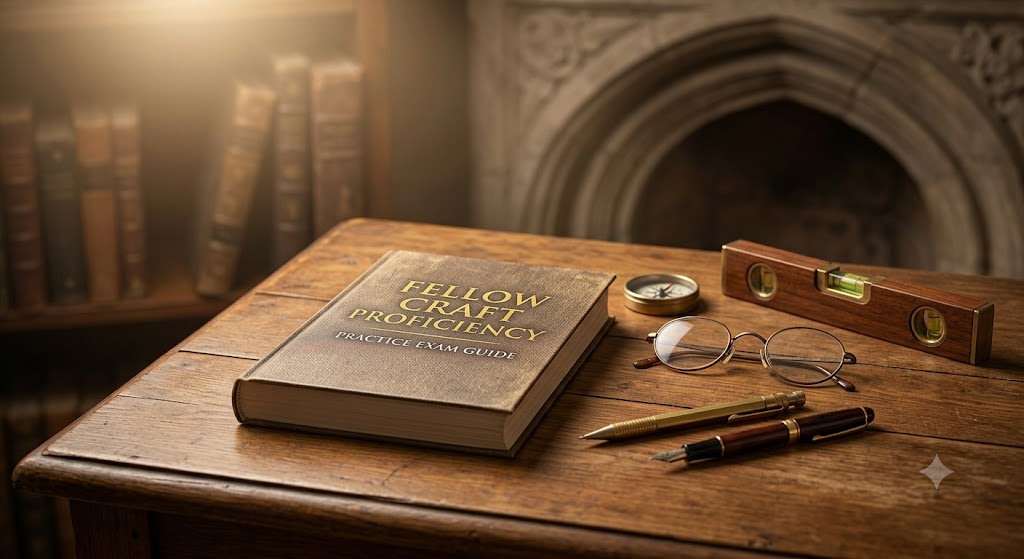
Additional Information
What the Course Entails and Exam Details
The study material for the Fellow Craft degree is deeply rooted in the exploration of the liberal arts, sciences, and architectural symbolism.
Candidates are required to memorize and recite a specific catechism, which acts as a question-and-answer dialogue covering the events of their initiation into this degree.
Core topics include the symbolic meaning of the working tools of a Fellow Craft, namely the plumb, the square, and the level.
Students will also explore the allegorical ascent of the winding stairs leading to the Middle Chamber of King Solomon’s Temple.
The syllabus places a heavy emphasis on the five senses of human nature and the seven liberal arts and sciences: grammar, rhetoric, logic, arithmetic, geometry, music, and astronomy.
What to Expect in the Final Exam
Unlike traditional written academic tests, the final exam for the Fellow Craft Proficiency is typically an oral examination conducted in open lodge or before a designated committee.
Candidates should expect to stand before their Worshipful Master and brethren to answer a series of specific, standardized questions from memory.
The format requires a high level of accuracy, and the passing requirement is generally a near-perfect recitation of the prescribed catechism.
There are usually no strict time limits to complete the entire degree process, but once the exam begins, a steady, confident pace is expected.
Certain jurisdictions may offer a "short form" or multiple-choice written alternative, but traditional memorization remains the gold standard.
How to Study and Exam Centers
The most effective way to prepare for this examination is through consistent, one-on-one sessions with your assigned mentor or lodge "posting coach."
Actionable study strategies include breaking the catechism down into small, manageable sections, practicing out loud during your daily commute, and writing out the first letter of each word to test your memory recall.
Because of the esoteric nature of the material, studying is usually done through word-of-mouth repetition rather than digital online portals.
Your specific "exam center" will be your local Masonic Lodge where you hold your membership.
Always consult your lodge's Secretary or your personal coach to schedule your proficiency examination once you feel fully prepared.
Job Opportunities from the Course
While the Fellow Craft Proficiency is a fraternal milestone rather than a corporate certification, successfully completing it unlocks numerous leadership and developmental "career" paths within the Masonic framework.
First and foremost, passing this exam is the direct prerequisite for being raised to the degree of a Master Mason.
Once you achieve Master Mason status, you become eligible to hold official officer positions within your local lodge, such as Junior Deacon, Senior Warden, or Worshipful Master.
Additionally, this proficiency opens the gateway to joining appendant Masonic bodies, including the Scottish Rite, the York Rite, and the Shriners.
The communication, memorization, and public speaking skills gained during this process also highly translate into professional leadership, project management, and public administration roles in your everyday civilian career.
Frequently Asked Questions
Reviews
5.0
Based on 0 reviews
Leave a Review
No reviews yet. Be the first to review!